
Story published on Sept. 9, 2026.
City the Kitty’s Cat Fanciers’ Association Petition.
DANGEROUS INFORMATION FOR CATS: CAT FANCIERS’ ASSOCIATION’S NEW ARTICLE PRESENTS THE “PROS” OF DECLAWING, ACKNOWLEDGES SERIOUS HARMS, AND TELLS OWNERS WHAT TO DO “IF YOU DECIDE DECLAWING IS NECESSARY”—DESPITE CFA CLAIMING IT IS “100% AGAINST” DECLAWING
CFA’s September 2026 article presents “PROS” and “CONS” of declawing — instead of just clearly explaining why declawing harms cats and how owners can solve their concerns without inhumanely amputating their cats’ toes and claws.

The Cat Fanciers’ Association (CFA) has enormous influence in the cat world and a responsibility to provide accurate, current information that protects cats.
Yet CFA’s September 1, 2026 article by Kate Preston, “To Declaw … Or NOT to Declaw,” raises serious questions about its claim that it is “100% against” declawing.
To be fair, CFA does include humane alternatives in the article. But an organization that is truly 100% against declawing should not frame this dangerous and inhumane amputation procedure as having “PROS.”
It should explain the facts about the harm declawing can cause and show owners how to address scratching, furniture damage, aggression and other concerns without declawing them.
Instead, CFA lists these supposed “PROS”:
- Reducing furniture damage.
- Decreasing potential injury to humans.
- Preventing climbing or escape.
- Making homes with small children easier to manage.
- “Declawing may save an aggressive cat’s life.”
The story also includes a section titled “If you decide declawing is necessary,” with postoperative instructions.
That is difficult to reconcile with CFA’s claim that it is “100% against” declawing.
CFA’S OWN POLICY CONTRADICTS “100% AGAINST”
In January 2025, City the Kitty contacted CFA about its outdated 2003 declawing guidance statement.
CFA Animal Welfare representative Charlene Campbell responded:
“as you can tell by our information CFA is 100% against the declawing of felines. Declawed felines are not allowed to even be shown in our Household Pet Category that mostly come from rescue shelters! I will glad to share any anti declaw information with our community you share.”
“CFA is against the declaw of any feline!”
But CFA’s official 2003 guidance statement says it “disapproves of routine declawing,” not all declawing.
It says, “CFA disapproves of routine declawing or tendonectomy surgery in lieu of alternative solutions to prevent household damage. In certain situations, including high risk of injury or disease transmission to owners with bleeding disorders or compromised immune systems, declawing may be justified in order to maintain the cat-human bond.”
There is no data that shows that declawing saves a cat’s life or maintains the cat-human bond. None.
There are no human health or veterinary organizations that condone declawing for human health issues since declawing causes many cats to become aggressive and bite and that’s a much bigger risk for a human. Number 11 in our facts vs myths section has all the data.
City the Kitty pointed out the contradiction to CFA but they never responded.
Here are some of CFA’s Facebook posts about declawing.

CFA SAYS IT PROMOTES THE WELFARE OF “ALL CATS”
CFA’s 2024 Health and Welfare policy says CFA and the World Cat Congress “promotes the health and welfare of all cats.”
Yet its declawing policy still condones the procedure because of a human’s health condition.
CFA Opposed California’s 2003 West Hollywood declawing ban and the 2004 Exotic Cat Declawing Ban
In 2003, Assemblymember Paul Koretz introduced AB 395, a bill to ban declawing of cats in California. The bill was defeated in committee, and CFA’s opposition is documented in its official meeting records, beginning at the bottom of page 31 of the CFA transcript.
The CFA Legislative Committee report was given by Chair Joan Miller, author of CFA’s 1996 Guidance Statement – Declawing of Cats. The minutes also state that the statement, including its background information, was used by the AVMA with CFA’s permission in preparing the AVMA’s revised statement.
CFA’s Joan Miller said:
“CFA continues to disapprove of declawing for domestic cats but since 1996 there have been several changes. Great strides have been made in pain alleviation, thanks to the Winn Foundation funded work on the fentanyl patch – in addition laser surgery is now available, which has also resulted in very quick healing and little to no discomfort/pain, though it is more expensive. Behavioral problems reported are still only anecdotal. Our opposition to declawing continues because cats like scratching and this is generally unnecessary surgery since there are better alternatives to protect furnishings.”
Miller described behavioral problems as “still only anecdotal.” However, peer-reviewed veterinary research examining behavioral changes associated with declawing already existed by 2003, including research involving biting and litter-box avoidance. Several relevant studies had been published in the late 1980s, 1990s and early 2000s.
For example, a 1987 retrospective survey of 887 cat owners from private practices examined aggressive behavior. 60 of 252 declawed cats (23.8%) were reported to have bitten family members, compared with 168 of 613 intact cats (27.4%). Here’s a list of all the declawing studies from VIN and Dr Jean Hofve’s Little Big Cat.
Miller also explicitly explained CFA’s position on legislation:
“Miller: As chair of the Health Committee, in 1996 I wrote the background information and the guidance statement on declawing of cats, before we ever thought this issue would come up in legislation. While we were and are against declawing, CFA has taken a strong stand against legislating surgical procedures. The California Veterinary Medical Association was extremely pleased that CFA came out against this along with them.”
The AVMA’s 2003 journal documented CFA’s opposition to the proposed West Hollywood declawing ban and its alignment with the California VMA (CVMA) on the issue. The article reported that although CFA opposed declawing, it also opposed prohibiting the procedure by law. Here are the relevant excerpts:
“But West Hollywood’s proposal is drawing criticism from the Cat Fanciers’ Association, California VMA, and The Animal Council, a California-based group that seeks humane solutions to the challenges of animal rights activists. According to Joan Miller, CFA legislative coordinator, the association disapproves of declawing cats, as well as tendonectomies. But Miller believes that the decision to have one of the procedures is a private matter and should be decided on a case-by-case basis. “We’re in an awkward position here because we don’t approve of (the procedure), but at the same time, we feel that veterinary procedures should be decided between a pet owner and their veterinarian,” she said. Following the council’s vote, Sharon Coleman, legislative legal analyst with the CFA, wrote Mayor Sal Guarriello and city council members on behalf of The Animal Council, explaining that declawing is a private matter between veterinarians and their clients. If adopted, the prohibition could interfere with the veterinarian’s professional judgment and the client’s right to privacy in obtaining services from state-licensed veterinarians.”
“Coleman affirms the city council’s First Amendment right to condemn the procedure, but contends cat owners living in the city will circumvent the ban by getting the procedure at veterinary clinics outside West Hollywood. What’s more, rather than being a humane act, banning onychectomy might inadvertently increase the number of unowned and unwanted cats.
“Veterinary practice is a complex field combining medicine with the needs of individual clients and animal patients,” Coleman wrote. “These include measures to ameliorate behavioral extremes that can prevent the animal patient from remaining in its home, in effect, lifesaving measures.”
Link to this AVMA story: https://www.avma.org/javma-news/2003-03-01/california-city-weighs-ban-animal-declawing
In 2019 Sharon Coleman said this in an email to City the Kitty: “California has a long history with failed legislation on declawing of domestic cats, with yet another bill this year, Assembly Bill 1230. After the author presented the bill in its first policy committee, testimony taken and he closed, asking for the usual “aye” vote, he looked up to realize that the most of the committee members had left the room. The Chair asked for a motion. There was no motion and no vote. The author presented his other bill about allowing immediate adoption of under 8 week impounded kittens, the members returned and passed this bill unanimously. Sharon A. Coleman
CFA Legislative Legal Analyst”
After the 2003 effort to ban declawing failed, Koretz introduced AB 1857 the following year. Unlike AB 395, this bill was narrowly limited to wild and exotic cats, after opposition from groups representing domestic cats.
Here are all the organizations that supported the bill and the two that opposed it, Cat Fanciers’ Association and Animal Council. Link to this information. https://leginfo.public.ca.gov/pub/03-04/bill/asm/ab_1851-1900/ab_1857_cfa_20040615_135639_sen_comm.html
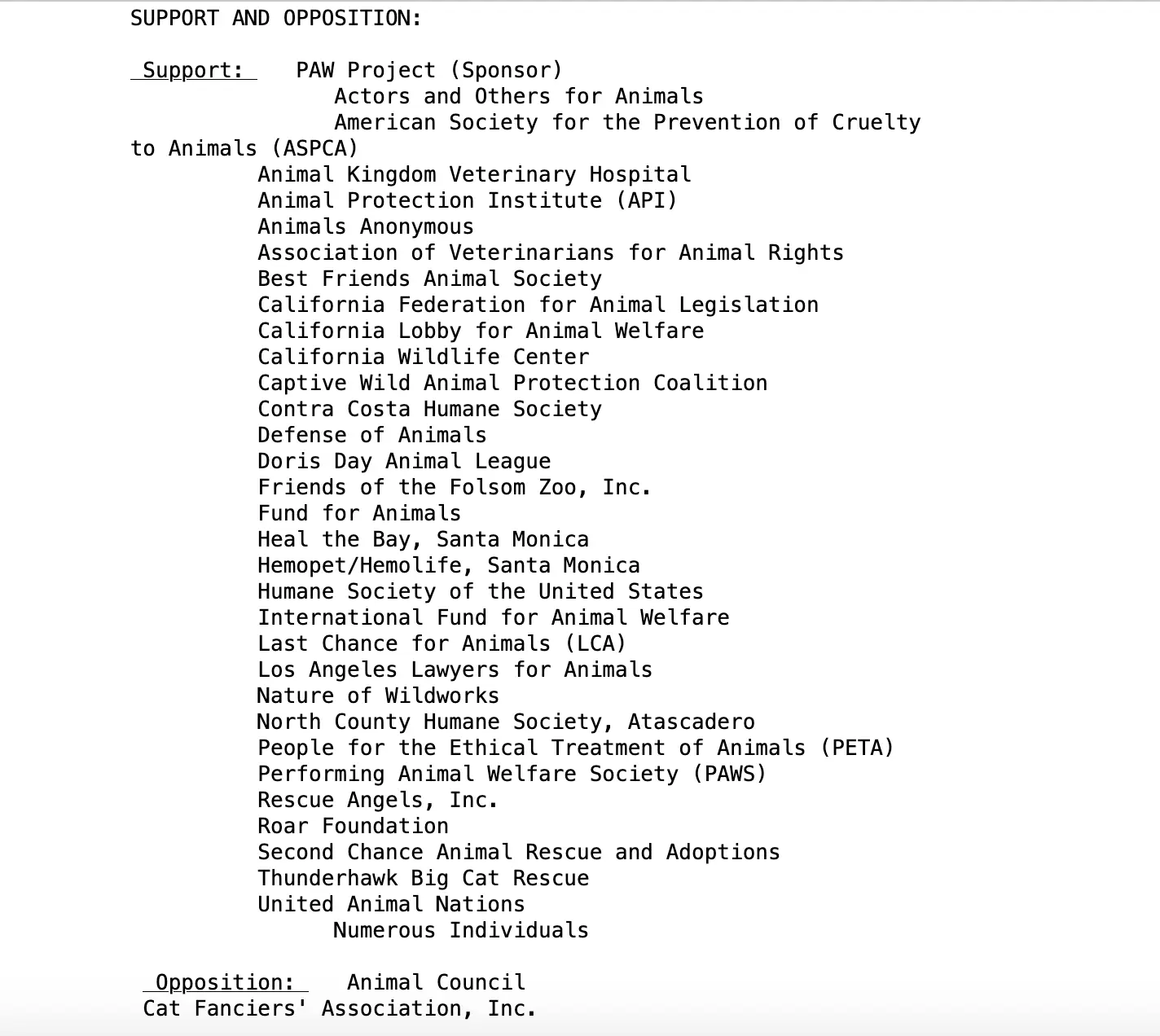
In 2004, the Cat Fanciers’ Association (CFA) opposed AB 1857, which would prohibit declawing of exotic and native wild cats except when performed for a therapeutic purpose. The bill passed the Legislature and was signed into law by Gov. Arnold Schwarzenegger on September 29, 2004, taking effect in January 2005.
CFA’s position, entered into the official legislative record, stated:
“The Cat Fanciers’ Association (CFA) opposes any legislative attempts to target veterinary elective surgical procedures. As argued by CFA, few declawing procedures are executed on exotic/wild cats in California so there is no pressing need for this law, and the option to declaw should remain available to experienced individuals based on their veterinarian’s professional judgment and advice. CFA objects to the criminalization of a lawful procedure that is safe when competently performed and possibly necessary for other than “medical necessity” for exotic cats.”
Here’s a quote from the Paw Project’s Fall 2004 newsletter about the bill. “Also opposing the bill, as they
do all pro-animal bills, were the pit bull breeders’ group called The Animal Council, and cat show judge, Joan Miller, of the Cat Fanciers’ Association. Their rationalizations for declawing included “making the animals
safe for human contact and maintaining liability insurance for big cat owners.”
CFA ACKNOWLEDGES SERIOUS HARMS — WHILE LISTING “PROS”
CFA’s 2026 article acknowledges that declawing can affect normal standing, walking, climbing and jumping; cause permanent paw pain; cause nail fragments and ingrown nails; contribute to litter-box avoidance; increase risks if cats escape outdoors; and increase aggression.
CFA states: “Aggression may be enhanced by loss of claws”
Yet the same article says: “declawing may save an aggressive cat’s life.”
How can declawing supposedly save an aggressive cat while CFA acknowledges that losing claws may increase aggression?
And why present this as a “pros and cons” debate instead of clearly explaining the risks and promoting humane solutions?
CFA ACKNOWLEDGED ALTERNATIVES—BUT DEFENDED AN EXCEPTION
CFA’s own policy recognizes alternatives to declawing, including nail trimming, claw covers, scratching posts and redirecting cats to appropriate surfaces.
In 2019, CFA Legislative Coordinator George Eigenhauser told City the Kitty by email:
“CFA opposes routine declawing of cats. There are better options for most pet owners. Most cats can be trained to scratching posts and nails can be trimmed.”
But Eigenhauser then defended an exception for human health:
“However, we oppose legislation which would remove that possibility when medically necessary for the human owner. Humans with special medical situations should make the decision in consultation with their medical doctor.”
To support that position, he cited the AVMA’s then-current policy, which said declawing could be considered when a cat’s clawing “PRESENTS AN ABOVE NORMAL HEALTH RISK FOR ITS OWNER(S).”
The AVMA removed that language in its 2020 policy update. Did CFA update their position after that? Nope.
When City the Kitty challenged Eigenhauser on the facts, asking, “Are you someone who doesn’t believe in facts, data, and science George?” he replied:
“Insults are the arguments of those who know they are in the wrong.”
He then refused further responses.
CFA Legislative Legal Analyst Sharon A. Coleman likewise wrote in 2019 that CFA “oppose[s] legislation which would remove that possibility when medically necessary for the human owner.”
CFA PRAISED VCA FOR BANNING DECLAWING
When VCA Animal Hospitals banned declawing in 2020, CFA responded:
“This is something we can get behind.”

Yet CFA representatives had opposed legislation to remove declawing as an option, while CFA’s policy maintained a human-health exception.
That history conflicts with CFA Animal Welfare representative Charlene Campbell’s 2025 statement:
“CFA is 100% against the declawing of felines.”
“CFA is against the declaw of any feline!”
SO WHO IS REALLY SHAPING CFA’S GUIDANCE STATEMENT ON DECLAWING?
Are different people within CFA taking different positions? The organization’s statements and policies contain multiple contradictions and discrepancies.
So which position does CFA actually stand behind—and who is making these decisions?
If CFA is truly “100% against” declawing and “against the declaw of any feline,” why won’t it unequivocally oppose it and support legislation to end it?
CFA’S September 2026 ARTICLE ALSO RELIES ON ANTIQUATED AND QUESTIONABLE SOURCES
The sourcing raises another serious concern.
CFA’s 2026 article relies on old, outdated, undated and secondary sources, including a 1990 book and an undated website.
Among them:
CatHelp-Online says declawing is unlikely to drastically change a cat’s behavior or personality and that most operations are performed safely without complications.
Yet CFA’s own article acknowledges potential behavioral harm, including increased aggression.
CFA also cites a 2020 Reader’s Digest article quoting a veterinarian, Dr Samantha Canup, who recommends declawing “if it ensures the cat will have a home for the rest of its life.” (We reached out to this vet in 2020 about her comment in that story and asked her a few questions including if she is up-to-date about the latest studies and facts about declawing that show how bad it is for cats but did not receive a response.)
Where is the evidence that declawing prevents surrender, abandonment or euthanasia. There is none because declawing often causes the opposite to happen.
CFA also cites “How Old Does a Cat Have to Be to Get Declawed and Fixed?” which treats declawing like a routine procedure, recommends waiting until at least six months and claims newer techniques have made it “safer and more effective than ever before.”
Where is the credible scientific evidence for that claim?
CFA is therefore using sources that include:
- A 1990 book.
- An undated website.
- Secondary articles.
- Material minimizing behavioral consequences.
- Material presenting declawing as a way to keep a cat in a home.
- Material treating declawing as a routine procedure.
- Unsupported claims that newer techniques make it “safer and more effective.”
That is not what current, evidence-based cat-welfare education should look like.
CFA CANNOT HAVE IT BOTH WAYS
CFA says: “100% against” declawing.
Its 2003 declawing guidance statement says: declawing “may be justified.”
CFA says: it opposes declawing of “any feline.”
Its 2026 article says: there are “PROS.”
CFA acknowledges: pain, impaired movement, litter-box problems and possible increased aggression.
It also says: declawing may save an aggressive cat’s life.
CFA says: there are better alternatives.
It still defends: a human-health exception.
CFA praised: VCA’s elective declawing ban.
CFA itself: Yet won’t completely condemn declawing and support legislation to ban it.
CFA claims: to promote the welfare of “all cats.”
Its 2026 article: relies on outdated, questionable and permissive sources.
IT’S TIME FOR CFA TO UPDATE ITS 2003 GUIDANCE STATEMENT
CFA’s declawing policy was revised in 2003.
More than two decades later, CFA is still maintaining a human-health exception while publishing an article that presents supposed “PROS” of declawing and tells owners what to do “if you decide declawing is necessary.”
CFA already knows there are humane alternatives.
An organization that is truly 100% against declawing should explain why declawing is harmful and help owners solve their concerns without amputating their cats’ toes — not present declawing as a choice with “pros” and “cons.”
CFA SHOULD:
1. REMOVE the human-health exception from its guidance statement.
2. REPLACE its 2003 policy with a current, evidence-based position.
3. STOP presenting elective declawing as having “PROS.”
4. STOP using outdated, questionable and permissive sources.
5. FOCUS on humane solutions to scratching, furniture damage, aggression and other owner concerns.
6. SUPPORT laws prohibiting declawing
7. MAKE ITS POLICY MATCH ITS CLAIM that it promotes the health and welfare of all cats.
THE BOTTOM LINE
CFA’s Animal Welfare representative said:
“CFA is 100% against the declawing of felines.”
But CFA’s policy says declawing “may be justified.”
Its 2026 article has a section called “PROS.”
It tells owners what to do “if you decide declawing is necessary.”
It acknowledges serious harms while still presenting supposed benefits.
And it relies on antiquated and questionable sources, including a 1990 book and an undated website.
CFA cannot credibly claim to be “100% against” declawing while its own policy and educational material continue to leave the door open to it.
CFA has already said of VCA’s declawing ban:
“This is something we can get behind.”
Now it’s time for CFA to get behind its own words.
UPDATE THE POLICY.
REMOVE THE EXCEPTION.
STOP PROMOTING THE “PROS.”
USE CURRENT, EVIDENCE-BASED INFORMATION.
FOCUS ON HUMANE ALTERNATIVES.
STAND UNEQUIVOCALLY FOR CATS.
Here’s the full transcript from CFA ANNUAL AND EXECUTIVE BOARD MEETINGS
JUNE 18-22, 2003 Minutes.
(13) CFA LEGISLATIVE COMMITTEE. Legislation Committee Chair Joan Miller
gave the following report: I am in the process this month of moving my home and office,
including computer this week so this report will be brief.
Action Item:
In 1996, as former Chair of the CFA Health Committee, I prepared the background information
summary and wrote the CFA Guidance Statement – Declawing of Cats. At the October 1996
meeting, the CFA Board unanimously approved this guidance statement:
32
“The Cat Fanciers’ Association recognizes that scratching is a natural behavior
of cats and that cats may be defenseless without full use of their claws if they,
either intentionally or unintentionally, go outdoors. Scratching damage to
household furnishings can be minimized or avoided by routine clipping of the
claws, the use of claw covers and by redirecting the cat’s activity to acceptable
surfaces.
CFA perceives the declawing of cats (onychectomy) and the severing of digital
tendons (tendonectomy) to be elective surgical procedures which are without
benefit to the cat. Because of post-operative discomfort or pain, and potential
future behavioral or physical effects, CFA disapproves of declawing or
tendonectomy surgery.”
The statement including background information is on our web site and, with permission, was
used by the AVMA in preparing their revised statement. Considering the recent legislation
starting in California and also in Rhode Island to actually ban elective surgery like declawing in
cats and other procedures in dogs we have taken another look at our guidance statement. CFA
continues to disapprove of declawing for domestic cats but since 1996 there have been several
changes. Great strides have been made in pain alleviation, thanks to the Winn Foundation
funded work on the fentanyl patch – in addition laser surgery is now available, which has also
resulted in very quick healing and little to no discomfort/pain, though it is more expensive.
Behavioral problems reported are still only anecdotal. Our opposition to declawing continues
because cats like scratching and this is generally unnecessary surgery since there are better
alternatives to protect furnishings.
In addressing the legislation we have communicated with veterinarians, cat fanciers and animal
advocates who agree with our legitimate points against an outright ban on declawing. There are
instances when this surgery, competently executed, may be justified for the health of
immunocompromised people and those with diabetes or bleeding disorders or in cases where the
cat is in jeopardy of relinquishment to a shelter or abandonment. I have worked with Dr. Susan
Little, Winn Feline Foundation board member, to modify the CFA Guidance Statement on
Declawing. I am asking for board approval of the following amended wording:
“The Cat Fanciers’ Association recognizes that scratching is a natural behavior
of cats and that cats may be defenseless without full use of their claws if they,
either intentionally or unintentionally, go outdoors. Scratching damage to
household furnishings can be minimized or avoided by routine clipping of the
claws, the use of claw covers and by redirecting the cat’s activity to acceptable
surfaces.
CFA perceives the declawing of cats (onychectomy) and the severing of digital
tendons (tendonectomy) to be elective surgical procedures that are without
benefit to the cat. Because of the discomfort associated with any surgery and
potential future behavioral or physical effects, CFA disapproves of routine
declawing or tendonectomy surgery in lieu of alternative solutions to prevent
household damage. In certain situations, including high risk of injury or
disease transmission to owners with bleeding disorders or compromised
33
immune systems, declawing may be justified in order to maintain the cat-
human bond. ”
The California Bill, AB 395, to ban declawing of cats was defeated in Committee this month. The
California Veterinary Medical Association has expressed their interest in working with CFA on
a video or other means to educate veterinarians and pet owners on alternatives to declawing. I
will welcome hearing from fanciers who can help with this project, which has potential to reduce
declawing and unproductive time spent fighting future legislation to prohibit veterinary medical
procedures.
Miller: As chair of the Health Committee, in 1996 I wrote the background information
and the guidance statement on declawing of cats, before we ever thought this issue would come
up in legislation. While we were and are against declawing, CFA has taken a strong stand against
legislating surgical procedures. The California Veterinary Medical Association was extremely
pleased that CFA came out against this along with them. Many people thought we should review
our existing guidance statement. This allows the justification for declawing in certain
circumstances and I would like to make a motion that the board ratify this revised guidance
statement. Williams called the motion. Motion Carried.”