Western Veterinary Partners (WVP) CEO Carollee Brinkman mentors others in leadership and animal health while leading one of the largest veterinary group companies in the U.S with over 300 clinics.
Yet under her leadership, Western Veterinary Partners (WVP) continues to allow their vet clinics to perform declawing — a harmful and inhumane procedure that amputates the last bones of a cat’s toes.
The contradiction raises a fundamental question: How can a company that says every pet deserves a “healthy, happy life” and claims to put people first continue to allow declawing when it harms cats and creates ethical conflict and harm for veterinary professionals and staff who oppose it?
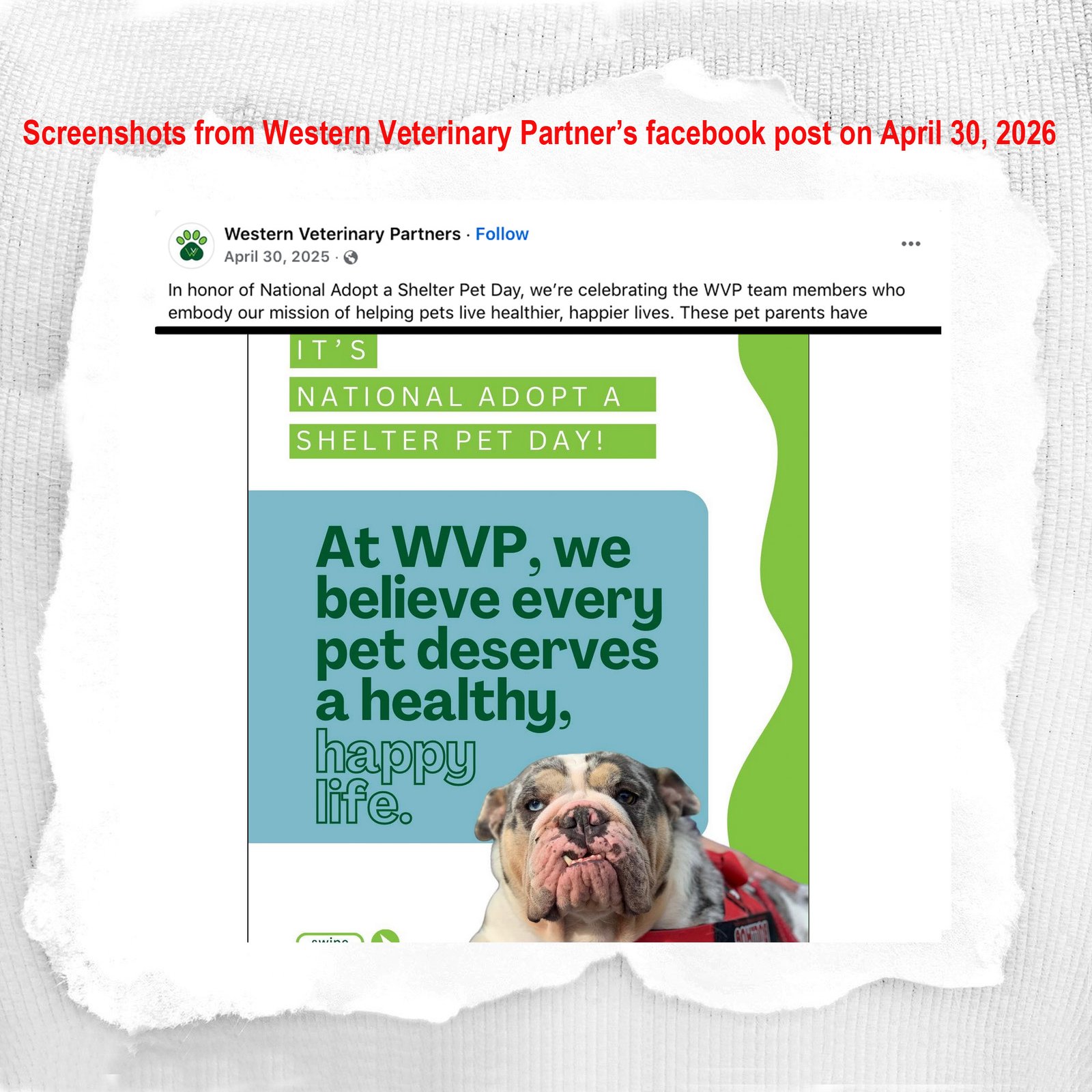
April 20, 2025 Facebook post, WVP says, “At WVP, we believe every pet deserves a healthy, happy life.”
WVP Leadership, NOMV and the Human Cost
According to a March 31, 2025 Facebook post, WVP CEO Carollee Brinkman serves as an active mentor with Women in Leadership and Management in Animal Health (WILMAH), an organization whose members “share a passion for animal health.”
Brinkman has also said WVP has a strategic partnership with Not One More Vet (NOMV), an organization that addresses mental health challenges, burnout, suicide and moral distress in the veterinary profession. NOMV also lists WVP as a Blue Ribbon Sponsor.
Yet WVP continues to allow affiliated hospitals to perform elective declawing.
When veterinarians or staff oppose the procedure, they may still be expected to schedule it, assist with surgery or care for cats afterward. Being required to participate in a procedure they believe is harmful or unethical can create moral distress and ethical conflict.
That raises a question for Brinkman and WVP: How does allowing declawing align with the company’s stated commitment to animal health, healthy workplaces and putting people first — particularly when the practice can place veterinary professionals in the very kind of moral conflict NOMV works to address?
On Aug. 5, 2026, City the Kitty asked Brinkman and other WVP leaders: “If Western Veterinary Partners truly stands behind its commitment to compassion, integrity, healthy workplaces, and helping pets live healthier lives, will you consider banning declawing across your network? If not, how does continuing to allow the amputation of healthy cats’ toe bones align with those values?”
We contacted WVP by email and Instagram direct message in March and August 2026 seeking comment on this issue but received no response.
City the Kitty’s Investigation
City the Kitty’s investigation found that some WVP-affiliated clinics refuse to perform declawing, while others continue to perform the procedure.
WVP’s Medical Advisory Board is described on the company’s website as helping ensure decisions are aligned with the “best interests of the pets, clients, veterinarians and practice team members.”
Dr. Doug McInnis and Dr Kara Plotz are WVP’s VP’s of veterinary leadership, head the board. McInnis’s WVP bio says he is a “great animal advocate.” The clinic he works at does not offer declawing.
WVP also states: “Putting People First. We believe that the most successful partnerships are built on collaboration and trust. That’s why people are at the heart of everything we do, and the focus of every decision we make.”
But whose interests come first when veterinarians and staff who oppose declawing work in WVP hospitals that continue to perform it?
Declawing can affect more than the cats undergoing the procedure. Veterinary professionals who oppose it may still be expected to schedule the surgery, assist with it or provide postoperative care, creating moral stress, ethical conflict and workplace tension. City the Kitty documented this issue in a 2022 investigation. https://citythekitty.org/is-the-angst-of-declawing-contributing-to-veterinarian-suicide/
Is “Medical Autonomy” WVP’s Defense for Allowing Declawing?
Brinkman’s bio states: “Her passion is creating cultures where medical autonomy thrives.”
But medical autonomy does not require allowing elective declawing. Other major veterinary companies with the same medical-autonomy operating models such as VCA, NVA, PetVet Care Centers, Mission Veterinary Partners , and more have banned this inhumane procedure, demonstrating that veterinarians can retain medical independence while companies establish clear animal-welfare boundaries. These companies put animal welfare first over the interests of their declawing veterinarians.
The question is whether WVP is using “medical autonomy” as an executive shield to avoid taking a moral stance against this very harmful, outdated, and unnecessary non-therapeutic amputation procedure.
Declawing is not treatment for a healthy cat. It is an elective surgery that amputates the last bones of a cat’s toes.
Declawing is an elective and inhumane surgery that amputates the last bones of a cat’s toes. By allowing clinics to continue performing it rather than establishing a network-wide ban, WVP continues to permit a procedure that conflicts with its public commitments to animal health, compassion, integrity, healthy workplaces and putting people first.
Only One Vet Performs Declaws at Hospital Tied to WVP’s Medical Advisory Board
The contradiction is especially clear at Frey Pet Hospital in Cedar Rapids, Iowa, a WVP hospita and an AAHA-accredited hospital that promotes Fear Free care and “stress-free healthcare.”
An employee told a City the Kitty researcher that declawing is “a rough procedure” and “more of a cosmetic thing than a necessary procedure.” The employee described the surgery as cutting off “the very tips of their fingers,” said cats need time to adjust and acknowledged that declawing can cause arthritis later on in life.
Yet the hospital still offers the procedure.
According to the employee, only one veterinarian, Dr. Heather Kingus, performs declaws. (They have 8 vets listed on their website.)
The employee said Dr Kingus performs the procedures regularly and quoted approximate prices of $780 to $880 for a neuter with a two-paw declaw and $840 to $1,000 for a neuter with a four-paw declaw.
The Fear Free Connection
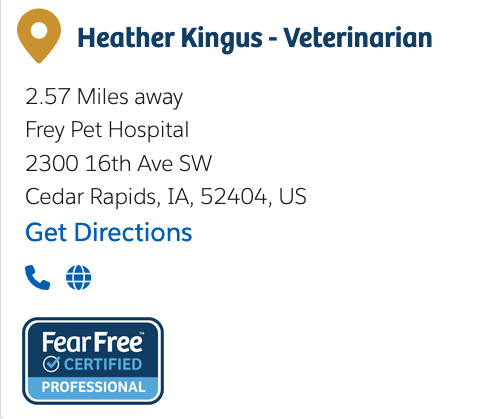
Dr. Heather Kingus is listed on Fear Free Pets’ website as a Fear Free Certified Professional. Yet she is also the only veterinarian at Frey Pet Hospital who performs elective declawing, according to a Frey employee. The hospital’s other veterinarians refuse to perform the procedure.
Frey prominently promotes Fear Free on its website and has a dedicated Fear Free section, but the hospital itself is not listed as a Fear Free Certified Practice. Fear Free’s directory appears to list only Kingus and one other Frey veterinarian as Fear Free Certified Professionals, despite the hospital having about 30 veterinary professionals.
That raises a troubling question: Does prominently promoting Fear Free give pet owners the impression that the hospital or its veterinary team is Fear Free certified when only two individual professionals, out of 30, appear to hold the certification and one of them performs declawing?
The distinction in Fear Free’s certification system makes that possible. Fear Free Certified Practices have been prohibited from providing declaw services since 2021, but individual Fear Free Certified Professionals who work at non-certified hospitals are not held to the same standard.
Asked for this story why Fear Free allows its certified professionals to declaw cats and whether declawing is consistent with Fear Free principles, Fear Free responded in August 2026: “Existing Fear Free Certified Veterinary Practices ceased providing declaw services at the end of 2021. Fear Free Certified individuals (that are not part of a certified practice) are not held to this same standard as not all of them have the choice of what services are provided at the hospital they work.”
Fear Free gave a similar explanation on Feb. 16, 2022, when a customer experience manager said: “As you are aware, starting January 1st, this year, our Certified Practices are not allowed to provide declaw services. We are not able to enforce what services are provided or not provided within a clinic at an individual level of certification.”
It also raises a fundamental question about the meaning of the certification: How can a veterinarian be recognized as Fear Free while performing an inhumane amputation procedure that causes chronic pain, nerve damage, arthritis and behavioral problems in cats?
City the Kitty sought further clarification from Fear Free but received no additional response.
An industry increasingly moving away from declawing
WVP’s policy allowing elective declawing stands in contrast to a growing number of major veterinary networks and organizations with medical autonomy operating models that have prohibited the procedure.
A network-wide ban on elective declawing would not prevent WVP veterinarians from amputating a cat’s toes when medically necessary. It would simply prevent the elective amputation of healthy toes when there is no medical need for the procedure.
WVP won’t respond
Who Is Shaping WVP’s Declawing Policy?
Of the 13 veterinarians on WVP’s Medical Advisory Board, six are affiliated with practices that allow elective declawing. Five of those six — 83% — choose to offer it. Only one does not.
That raises a serious question: Is WVP’s Medical Advisory Board protecting the interests of veterinarians who choose to declaw instead of protecting cats from a harmful, unnecessary amputation — and veterinary professionals and staff from the moral distress it can cause?
The pattern also shows why laws are needed. As most humane and ethical veterinarians have moved away from elective declawing, the veterinarians who continue performing it are keeping this unnecessary and inhumane procedure alive — harming cats and putting veterinary professionals who oppose it in an ethical conflict. If the profession and the companies that employ and support these veterinarians won’t draw the line, lawmakers must.
Is Business Growth Influencing WVP’s Policy?
WVP’s executive team is dominated by leaders with backgrounds in finance, operations, corporate development, acquisitions, and rapid business growth rather than veterinary medicine or animal welfare.
WVP repeatedly emphasizes that it puts “people first” and builds partnerships around collaboration, trust, and healthy workplaces.
Yet by continuing to allow declawing, the company leaves veterinarians and staff who oppose the procedure in a difficult position — still expected in some hospitals to schedule it, assist with surgery, or provide postoperative care.
If animal welfare and people are truly priorities, why has WVP’s executive leadership not used its authority to prohibit a procedure that is widely recognized as unnecessary and harmful to cats — and that can create moral distress and ethical conflict for the very veterinary professionals the company says it puts first?
Our survey of several Western Veterinary Partners clinics found the following:
THE METHOD
Our researchers made calls to survey some WVP veterinary practices.
The general questioning went like this:
The practice was called by a researcher asking for a price for a spay/neuter and declaw, asked which vet performs the declaw, and asked if it was a routine procedure
We have withheld the names of employees for fear that they might suffer a backlash for their honest answers.
VETERINARY CLINICS AFFILIATED WITH WVP’S 13 MEDICAL ADVISORY BOARD MEMBERS.
April 2026
1) Dr. Doug McInnis serves as VP of Veterinary Leadership for Western Veterinary Partners while also practicing at East & West Ridge Animal Hospitals in Klamath Falls, Oregon which has two locations.
East Ridge Animal Hospital. The employee said that they do not perform declaws. Researcher asked if it’s bad for a cat and the employee said it can be, it can cause behavioral issues and can cause a pretty long list of issues.
West Ridge Animal Hospital. The employee said that they do not perform declaws. Researcher asked why and the employee said none of their doctors will do that. Researcher asked if it’s bad for a cat and the employee said the recovery part of it is painful and it takes quite awhile to heal.
2) Dr. Kara Plotz (VP of Veterinary Leadership).
Prior experience includes Banfield Pet Hospital and National Veterinary Associates (NVA) operations/leadership (Both of those companies banned declawing in 2020.) No current primary vet clinic identified in public sources.
Houndstooth Veterinary Dentistry and Oral Surgery / Pacific Northwest Veterinary Dentistry and Oral Surgery (Longview, WA)
It’s illegal to declaw a cat in California since it was banned on January 1, 2026
5. Dr. Nicole Canon. Animal Hospital of Sebastopol (Sebastopol, California).
Listed as Veterinarian/President.
The employee said the practice does not perform declawing. When asked why, the employee said declawing is controversial topic and can be considered inhumane because the procedure involves amputating a bone. The employee added that many veterinarians do not perform declawing and said they did not know of any veterinarians who do.
It’s illegal to declaw a cat in California since it was banned on January 1, 2026
6) Dr. Krista Gibson. Founder and Medical Director at Kierland Animal Clinic. Scottsdale, Arizona.
The employee said that a neuter is $269 and a neuter/declaw is around $1200. The employee said that all of their doctors do declaws. Researcher asked if the cats seem to be ok after a declaw and the employee said they don’t recommend it unless absolutely necessary, and said, “yea they do ok.”
7) Dr. Monique Weldon. Animal Dental Clinic (Aurora, Colorado).
Founder and Medical Director; focuses on accessible pet dentistry and serves on the WVP board.
9) Dr. Rachel South. River Valley Animal Hospital in Barling, Arkansas.
The employee said that they need an exam first to get a cost for the neuter/declaw and to see if they can do them together.
10) Dr. Deborah Peale. Hayden Pet Medical Center. Hayden, Idaho.
Patty, their AI assistant picked up the phone and the researcher asked if they perform declaws and Patty said, “Yes we do offer declaw procedures at our clinic.”
Then Patty asked, “Is this something you are considering for your cat” and asked if the researcher would like more information about the process. Researcher asked who performs their declaws and Patty said, “All of our veterinarians are able to perform the declaw procedure.” She said that their vets can discuss the risks, aftercare and long term outlook in detail.
Patty then transferred the researcher to a real human being. The researcher asked for the cost of a neuter/declaw.
The employee said she couldn’t provide the cost of a declaw but gave the cost for a neuter. The employee said they have a couple different doctors who do their declaws. Researcher asked if the cats are ok after a declaw and the employee said they unfortunately couldn’t answer that.
11) Dr. Ryan Steen. Frey Pet Hospital Cedar Rapids, Iowa. This is an AAHA Accredited Animal Hospital.
Clinic website: https://freypethospital.com/
They have a whole section on being Fear Free.
Frey Pet Hospital, a WVP-affiliated hospital, lists eight veterinarians and Dr Steen’s bio describes its team as one of the “best teams in the state of Iowa who care passionately for our patients.” The hospital says it is AAHA-accredited and that its team follows “gold-standard protocols” dedicated to patients’ “comfort, safety, and well-being.”
Frey also prominently promotes Fear Free care, stating that a pet’s “emotional well-being is just as important as their physical health” and that veterinary visits “shouldn’t be traumatic.” Its website says: “What to Expect at a Fear Free Visit. From the moment you walk in, you’ll notice the difference. Our team is trained in Fear Free methods and will work with you to understand your pet’s preferences, triggers, and previous experiences.”
Yet only two Frey Pet Hospital veterinarians are listed in Fear Free’s online directory as Fear Free Certified Professionals, Dr. Heather Kingus, the veterinarian who performs the hospital’s declaws and Dr Morgan Ryherd.
City the Kitty contacted Fear Free to ask whether additional Fear Free Certified Professionals at Frey are not listed in its directory, but Fear Free did not respond.
In July 2026, a Frey employee told one of our researchers that only Kingus performs declaws. The employee described declawing as “a rough procedure,” said it was “more of a cosmetic thing than a necessary procedure,” and acknowledged that it “can cause arthritis later on in life.”
The contradiction is stark: Frey tells clients “our team is trained in Fear Free methods” and promotes care designed to reduce fear, anxiety and trauma, while continuing to offer an inhumane and unnecessary amputation procedure—and only two of its 30 vets, vet techs, and vet assistants appear in Fear Free’s certification directory.
How does Western Veterinary Partners reconcile allowing declawing in its clinics—particularly at a hospital that promotes “gold-standard” and Fear Free care while telling clients that pets’ emotional well-being is as important as their physical health and that veterinary visits “shouldn’t be traumatic”?
July 2026. Researcher asked for the cost of a neuter/declaw. The employee said a neuter/2 paw declaw is around $780-$880 and a neuter/4 paw declaw is around $840-$1000.
The employee said they only have one doctor who will do the declaws, Dr Kingus. Her bio says, “Dr. Kingus has special interests in ophthalmology, internal medicine, pediatric patients, and educating owners on pet wellness.” They have 8 veterinarians listed on their website. https://freypethospital.com/veterinarian-cedar-rapids-ia/
Dr Kingus is also a Fear Free certified Professional.
The researcher asked whether cats are OK long term after a declaw. The employee said, “Yes, it’s a rough procedure,” and explained that a consultation is required so the doctor can answer questions before surgery.
Asked whether Dr. Kingus regularly performs declaws, the employee said yes. Asked why the other veterinarians don’t, the employee said, “Declaws are a rough procedure,” explaining that not all doctors are willing to perform them and that they are more of a “cosmetic thing” than a necessary procedure.
Asked whether declawing is bad for cats, the employee said it is “definitely a rough procedure,” explaining, “they are cutting off the very tips of their fingers,” that cats take time to adjust and that it “can cause arthritis later on in life.”
Asked whether Dr. Kingus uses a laser and whether it is better, the employee said yes, explaining that the laser cauterizes as it cuts, resulting in “a lot less bleeding.”
12. Dr. Jimmy Davis. Arlington Heights Animal Hospital. Fort Worth, Texas. https://cowtownvet.com/
This is an AAHA Accredited Animal Hospital.
The employee said that they don’t have a set pricing so you have to get an exam first. They said that they can do a neuter with a declaw. The employee said that all their doctors can do a declaw. They said it’s up to the doctor if they are comfortable with doing neuter at the same time as a declaw depending how healthy the animal is and just the condition they are in. Researcher asked if the cats are ok after a declaw and the employee said just each animal heals differently just like a human would heal differently.
13) Dr. Ariel Koger. North Suffolk Animal Clinic (Suffolk, Virginia).
Medical Director.
The employee said they do not perform declawing because the procedure is not legal in Virginia. The employee said the law took effect in July 2024. When asked whether declawing is bad for cats, the employee said it is considered “not best for them” and that the veterinarians could provide more information.
RANDOM WVP CLINICS
August 2026
Reynolds Road Animal Hospital . Toledo, OH
This animal hospital is in our August 2026 story about how the Ohio Veterinary Medical Association (OVMA) is opposed to the anti-declawing bill and one of the OVMA’s board members, Dr Sue Savage, is one of the declawing vets at this hospital.
(Declawing is a big money making procedure in many states, including Ohio.)
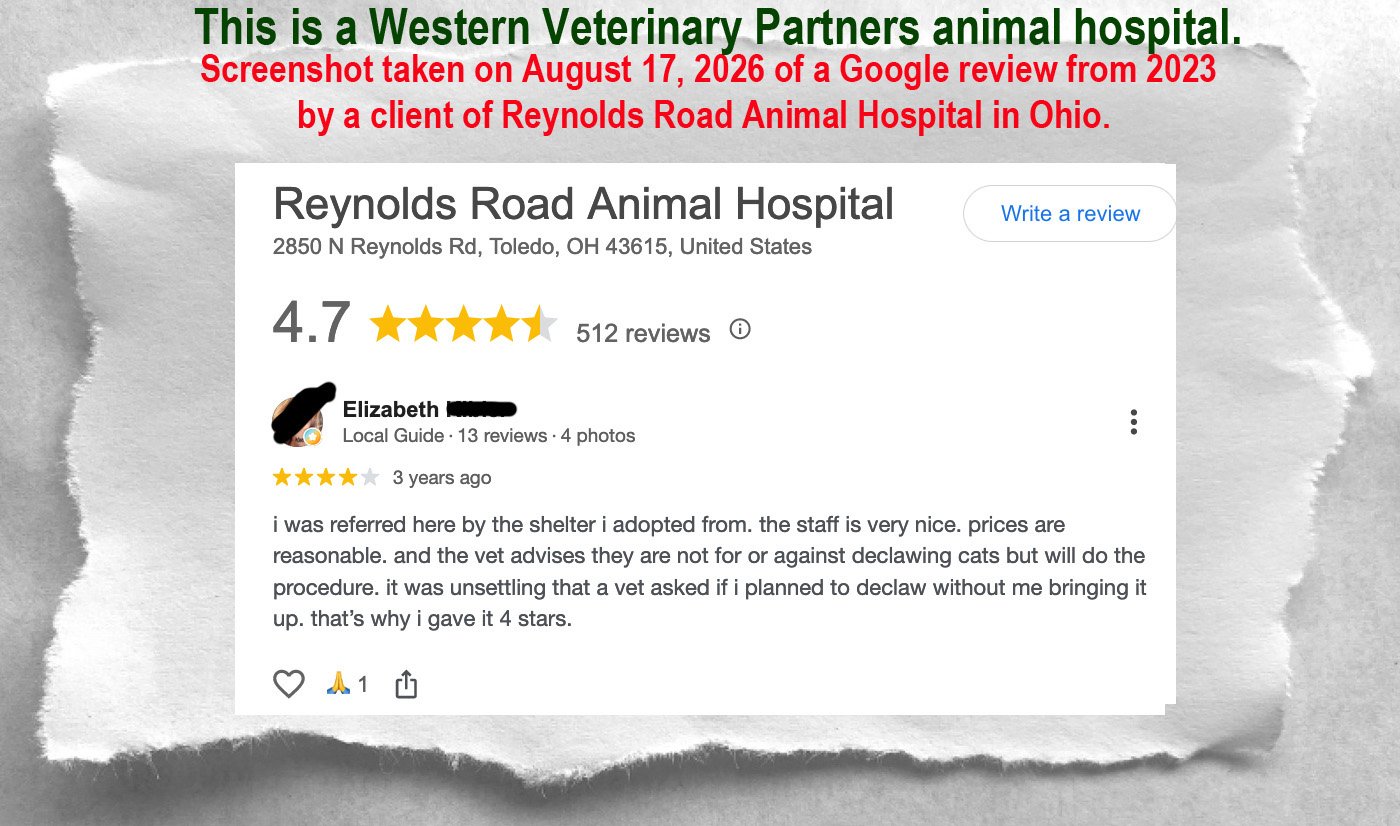
As you can see in this 2023 Google review, one of the veterinarians at this WVP hospital asked that cat owner if she planned to declaw the kitten.
Link to their google review page.
The employee said that the doctors would have to give the cost for the declaw and an exam starts at $60. The employee said that they have a couple doctors who will do a declaw, Dr Savage and Dr Grothaus. https://rrahvet.com/veterinarian-toledo-oh/
Researcher asked if they use a laser for the declaw and the employee said they do not use a laser and said they “cut them off and then they stitch them and glue them.” They said usually there’s an age limit and it’s up to the doctor’s preference.
Researcher asked if they perform declaws regularly and the employee said, “yea, they’ve done some.”
Researcher asked if the cats are ok long term after a declaw and the employee said yes if it’s done at an early age.
February 2026.
Animal HealthCare Center. Lake Worth, Florida
The employee said that a neuter/declaw is about $950 which doesn’t include the blood work.
They said that Dr Dew does their declaws. They have two vets listed on their website. https://animalhealthcare.com/veterinarian-lake-worth-fl/
Researcher asked if the cats are ok long term after a declaw and the employee said, “Yea, absolutely.”
Researcher asked if they do declaws regularly and the employee said they don’t do them super often but “he always does them”, he’s been a vet for 25 years, and it’s not something they see all the time.
MAC Animal Hospital. (Calera, AL)
A neuter/declaw is $260. Researcher asked which vet does their declaws and the employee said that all of their vets are highly recommended and are good with doing a neuter/declaw.
Researcher asked if the cats are ok long term after a declaw and the employee said they weren’t sure and you would have to talk to a vet.
Researcher asked if they do declaws pretty regularly and the employee said, “Every once in awhile, yes.”
Cocoa Veterinary Hospital. (Florida)
The employee said a neuter/declaw is around $1000.
Researcher asked if the cats are ok long term after a declaw and the employee said, “Yea, I haven’t heard anything crazy happening.”
Cohutta Animal Clinic. (Blue Ridge, GA)
They said they do not perform declaws.
Researcher asked why they don’t declaw and the employee said none of their vets want to do them and said, “it’s just really inhumane” and said they don’t believe in it.
They refer to Alpine Animal Hospital in Murphy, NC for declaws and said they perform declaws with a laser.
Researcher asked if it’s inhumane why are they referring people to Alpine Animal Hospital. The employee said, “Well they do laser.”
Another employee was asked if a laser declaw humane and and they said, “no, it’s like taking the tip of your finger off.”
Laurel Road Veterinary Clinic. (N. Venice, Florida)
They do not declaw cats. Researcher asked why and the employee said they don’t have a vet who will do them and they don’t feel it’s in the best benefit for the cat.
Port St John Veterinary Hospital. Florida
The link to their website is https://caringforlifeinc.com/
The employee said that they perform declaws but you have to get an exam for a quote for a neuter/declaw since they don’t do them very often.
They said that Dr Guttery is their vet who does their declaws but you need an exam with her and they are not sure if any other vets will do them. They have three vets listed on their website. https://caringforlifeinc.com/veterinarian-port-st-john-fl/
Researcher asked if the cats are ok long term after a declaw and the employee said as far as they know but they have only seen one or two in the last three years.
Animal Clinic of Muskegon. Muskegon, MI.
2026. The employee said a declaw is from $260- $301. The employee said that their two vets, Dr Lelli and Dr Steffes, can do a declaw. Researcher asked if the cats are ok long term after a declaw and the employee said, “Yea, we don’t do declaws very often” but then said long term down the road they don’t know about the effects of declawing. Researcher asked why they don’t do declaws very often and the employee said their clients prefer not to do them.
2019. A declaw is $185 and a neuter is $108. They said that they don’t do the declaw together and can do both procedures as long as they are two weeks apart. They said that they have two vets who do declaws with a scalpel and they do them everyday.