Story published June 16, 2026
UPDATE AUGUST 4, 2026.
CareVet posted this on their website. “Effective October 1, 2026, CareVet does not perform elective declawing. A declawing procedure may be performed only when a CareVet veterinarian determines that the procedure is medically necessary as part of the diagnosis or treatment of a patient’s medical condition.“
Also, Dr Kent Thornberry sent an update to us on August 4, 2026. “Thank you for reaching out. We are well underway on our change of policy. CareVet has placed our commitment to banning non-medically necessary declaws on our national website under the Pet Parents – Trusted Services section. We are in the process of whole team change implementation involving town halls, communication training,… and will have this fully implemented across our network effective October 1, 2026. We have communicated to our hospitals to discontinue declaws and to look toward alternative options as soon as possible with their clients even in advance of the October 1 effective date. We will continue to drive this to our network in the coming weeks.”
———————————————————————————————————————————————–
CareVet says it will phase out declawing across its hospitals on October 1, 2026.
City the Kitty has asked CareVet to move up the ban or to ask their clinics to voluntarily suspend the procedure immediately, citing ongoing harm and cruelty to cats in many CareVet clinics during the transition period.
CareVet says it will implement a ban on declawing Oct. 1. City the Kitty asked CareVet if they would either move up the Oct. 1st date or call for their clinics that declaw cats to voluntarily halt the procedure ahead of the deadline.
City the Kitty had planned to publish this investigative report on June 16, 2026, after completing a months-long investigation into declawing at CareVet hospitals. However, on June 15, 2026, CareVet’s founder and Chief Veterinary Officer, Dr. Kent Thornberry, emailed us to announce that the company plans to implement a nationwide ban on elective feline declawing effective October 1, 2026.
He wrote:
“On behalf of CareVet, I am sending this email in response to the recent communications we have received from you regarding feline elective declawing. I want to acknowledge receipt of those communications and thank you for your advocacy on behalf of feline welfare — a cause that CareVet shares.
Prior to receiving your communications, CareVet was engaged in internal planning and cross-functional discussions to implement a company-wide policy prohibiting elective feline declawing across all CareVet hospitals based, in part, on the evolving veterinary landscape and the growing body of evidence-based literature regarding elective declawing. You will be pleased to know that October 1, 2026 has been set as the effective date for CareVet’s rollout of this policy. This date provides our hospital teams adequate time to align their practices, educate their clients on humane alternatives, and ensure a smooth and responsible transition that prioritizes both patient welfare and client communication.
CareVet intends to release detailed information regarding this policy publicly on its website on or around August 1, 2026. This public release will provide transparency regarding the scope of the policy, its effective date, and the resources available to our hospital teams and pet parents to support the transition to alternative, non-surgical approaches to managing scratching behavior.
CareVet’s mission has always been rooted in delivering excellence in clinical outcomes and providing care that begins with pets in mind. This policy is consistent with that mission and reflects the values that guide our organization. We believe this approach — prohibiting elective declawing while preserving the veterinarian’s ability to perform the procedure when medically necessary — is both principled and responsible, and aligns with the positions of leading veterinary organizations, including the American Association of Feline Practitioners and the American Animal Hospital Association.
We appreciate your patience as we finalize the details of this policy and prepare for its implementation.”
Dr. Thornberry also stated that CareVet was already engaged in internal planning before City the Kitty’s outreach. However, we first contacted CareVet in December 2022 and followed up in 2023, 2024, and 2025, receiving no response until now. Given that timeline, more than four years appears sufficient to implement at least an immediate pause on declawing across its hospitals.
We welcome CareVet’s decision to end declawing. However, our investigation shows this remains a very urgent issue. Many CareVet clinics still routinely declaw cats, including some performing four-paw declaws and some performing this animal cruelty almost daily or weekly. Every day until October 1 means more cats will undergo this unnecessary, inhumane amputation procedure.
We also found that CareVet’s St. Louis-area hospitals, along with most clinics affiliated with its Medical Advisory Board, have already stopped performing elective declawing, showing that ending the practice immediately is both practical and achievable.
If CareVet views elective declawing as inconsistent with “clinical excellence” and “care that begins with pets in mind,” then a responsible transition should minimize ongoing harm, not extend it.
In follow-up emails, we respectfully asked Dr. Thornberry to either move up the implementation date or direct remaining hospitals to voluntarily pause the procedure now.
A responsible transition should prevent unnecessary pain and long term suffering, not allow it to continue for several more months.
————————————————————————-
Founder and Chief Veterinary Officer, Dr. Kent Thornberry’s Clinical Excellence Vision Undermined by CareVet’s Continued Allowance of Declawing
(City the Kitty first contacted Carevet in December 2022 regarding the company’s declawing position and has followed up annually ever since, without receiving any response.)
“Pets in Mind”—Except When It Comes to Declawing Cats
Carevet presents itself as a modern leader in veterinary medicine and is one of the biggest veterinary group companies in the U.S with more than 240 vet clinics in 30 states. On its website, the company emphasizes:
“Care That Begins With Pets in Mind… we deliver better outcomes for pets and the people who love them.”
“Excellence in Every Clinical Outcome.”
“Care You Can Trust. Our veterinarians bring the best in modern medicine to your pet’s care.”
“Care You Can Count On. Every decision we make is based on what’s best for your pet’s health, happiness and longevity.”
These are sweeping claims from Carevet.
But one procedure that many Carevet clinics perform continues to sit in direct conflict with those promises: elective cat declawing. Our short survey found that around 67% of Carevet clinics are declawing cats.
If “every clinical outcome” is truly held to the standard Carevet advertises, then declawing raises an unavoidable contradiction.
Because declawing is not a medical treatment. It is an inhumane and harmful amputation performed for the owner’s convenience.
A Procedure Increasingly Rejected by Veterinary Medicine
Declawing is the surgical removal of the last bone of each toe. It is most often performed to prevent scratching of furniture or people, not to treat disease.
Veterinary understanding of the procedure has shifted significantly based on strong evidence and data. It is now widely associated with:
- Chronic pain
- Arthritis
- Behavioral changes
- Litter box avoidance
- Increased aggression
- Relinquishment due to behavioral issues
- Long-term reduction in quality of life
At the same time, effective and easy humane alternatives exist, including scratching posts, nail trimming, nail caps, deterrent training, and environmental enrichment.
As a result, many veterinarians refuse to perform declawing entirely, and many other major corporate groups have banned it.
Yet Carevet still allows declawing.
That gap sits at the center of the controversy.
Dr. Thornberry’s “Clinical Outcomes” Standard
The contradiction is especially sharp given how Carevet leadership frames its mission.
Dr. Kent Thornberry, Carevet’s founder and CVO, in a Carevet youtube video, has described clinical outcomes as a core, “near and dear” focus of his work, emphasizing continuous improvement, evidence-based medicine, and identifying gaps in veterinary care.
Carevet has also expanded its internal structure to reinforce that message. Its Clinical Advisory Board is described as a group designed to advance best practices, improve patient outcomes, and shape the future of veterinary medicine.
The company states this work is intended to ensure hospitals remain aligned with “clinical excellence.”
But critics point out a basic tension:
How can a company committed to improving clinical outcomes continue to allow a procedure widely documented to reduce them?
The Premier Center Contradiction
The inconsistency becomes even more apparent within Carevet’s own network.
In February 2025, Carevet announced its Premier Centers, describing them as elite hospitals representing the highest standard of clinical excellence and patient care.
One of those hospitals is Lake Geneva Animal Hospital in Wisconsin, which Carevet promotes as a Premier Center known for “clinical excellence,” advanced treatment options, and high-quality medicine.
Yet when researchers contacted the hospital about declawing, staff said it is no longer performed there and referred inquiries to their sister clinic, Geneva Lakes Animal Hospital in Walworth.
At Geneva Lakes, employees said front-paw declaws are still performed after consultation. Staff identified multiple veterinarians who carry out the procedure and said approval is typically granted if the owner and veterinarian agree. When asked whether doctors ever refuse to perform a declaw, one employee said, “Honestly, I’ve never had them disagree.”
The result is a direct contradiction: one Carevet Premier Center promotes itself under a banner of clinical excellence while directing declaw requests to another Carevet hospital that still performs this inhumane amputation procedure.
Even Within Carevet Leadership Circles, the Practice Is Rejected
The inconsistency becomes more pronounced in hospitals affiliated with members of Carevet’s Clinical Advisory Board.
Across multiple affiliated clinics, staff responses were consistent:
Declawing is described as unethical, unnecessary, or medically inappropriate.
It is linked to arthritis, pain, and long-term behavioral harm.
Many hospitals refuse to perform it entirely.
In several cases, staff explicitly stated they avoid declawing because it is not medically necessary and carries long-term welfare risks.
In one instance, an AI assistant’s response described declawing as widely recognized in veterinary medicine as harmful and increasingly abandoned.
The message across these affiliated sites is clear: modern veterinary practice is moving away from declawing.
Carevet’s policy, however, has not moved with it.
A Network Without a Consistent Standard
Across Carevet hospitals, the approach to declawing is inconsistent:
Some clinics refuse outright.
Some call it unethical.
Some acknowledge medical risks but still offer it.
Some perform it as a routine elective procedure.
This results in a single corporate network applying multiple contradictory standards to the same procedure.
That inconsistency is difficult to reconcile with Carevet’s public messaging about “best-in-class medicine” and “clinical excellence.”
Corporate Messaging vs. Clinical Reality
Carevet’s public communications repeatedly emphasize a unified philosophy:
“Great outcomes start with great teams.”
“Care begins with pets in mind.”
“Every decision is based on what’s best for your pet’s health, happiness and longevity.”
The company has also promoted a “holistic approach” to veterinary medicine under its ownership by Compass Group, which in 2019 described Carevet as guided by five pillars of care focused on patients, teams, and community.
But holistic medicine by definition centers on minimally invasive, humane care that prioritizes patient well-being and stress reduction.
Declawing does not fit that framework. It is invasive, irreversible, and widely criticized within modern veterinary ethics.
The Team Impact
Carevet frequently highlights its commitment to veterinary teams, emphasizing support, well-being, and professional growth.
But declawing also creates a known point of moral stress within veterinary medicine. Many veterinary professionals report moral stress participating in, witnessing, or assisting with the procedure due to its inhumane and harmful nature.
This creates another contradiction:
A company that emphasizes staff well-being continues to allow a procedure many professionals view as ethically troubling and causes them moral stress and injury.
The Core Question for Leadership
The gap between messaging and practice ultimately centers on leadership accountability.
For their founders, Dr. Kent Thornberry and CEO Greg Siwak, the question is not abstract.
It is direct:
If declawing cannot be justified as evidence-based medicine, improved clinical outcome, or “what’s best for a pet’s health, happiness, and longevity,” then why does it remain permitted within Carevet hospitals?
A Promise Still Not Matched by Policy
Carevet has positioned itself as a leader in veterinary excellence, clinical advancement, and improved patient outcomes.
But elective declawing remains allowed in their clinics, even as many affiliated hospitals, advisory voices, and broader veterinary trends move away from it entirely.
That disconnect leaves a growing gap between what Carevet says and what Carevet does.
Until that gap is resolved, the company’s promise of “excellence in every clinical outcome” will continue to collide with the most inhumane and harmful procedures still performed under its brand.
CareVet Clinic Survey
THE METHOD OF THE INVESTIGATION
City the Kitty researchers made a short call to some of the clinics affiliated with Carevet’s Advisory Board and random CareVet clinics to see how they address declawing.
The general questioning went like this: The researcher asked for a price for a spay/neuter and declaw, asked who their declawing vet is, asked what declawing method they use, asked if they perform declaws regularly and if declawing is ok for a cat long term.
We have withheld the names of employees for fear that they might suffer a backlash for their honest answers.
THE RESULTS
Most Concerning Findings at Declawing Clinics
Perhaps the most troubling findings came from CareVet hospitals that continue performing declawing despite growing evidence of harm and despite other CareVet clinics describing the procedure as unethical, unnecessary, or harmful. Investigators found hospitals across multiple states still offering front-paw and even four-paw declaws, with some employees acknowledging that the procedure is an amputation, involves bone removal, can cause pain, arthritis, behavioral problems, or lifelong complications. In several cases, staff downplayed those risks, described declawing as a routine procedure, or indicated that requests are rarely denied. The result is a striking contradiction within the Carevet network: while some hospitals reject declawing on ethical and welfare grounds, others continue to perform and promote the procedure.
CAREVET’S MEDICAL ADVISORY BOARD
Here’s a press release about their medical advisory board.
1) Dr Mike Troop Clinical Advisory Board member. CareVet of Southern Illinois. Marion, IL
The employee said that a neuter/declaw is $552 and said the cat has to stay with them for a couple nights. The employee said, “Here in Illinois we only do the two paw.” They said just in case they get out they need a way to defend themselves. They said that they only have one vet, Dr Greenwell, who does their declaws. (They had 4 vets listed on their website in May 2026, along with Dr Troop’s name but as of June18, 2026 his name is no longer listed. https://www.carevet.com/southern-illinois/meet-our-team/?c=veterinarians)
Researcher asked if Dr Greenwell does declaws regularly and the employee said that she has been with them for a long time and it’s not a new procedure for her. Researcher asked if the cats are ok long term after a declaw and the employee said yes.
2) Dr James Desir. Advisory Board Member,. Carevet of Freeport, Maine.
The employee said they do not declaw. Researcher asked why and the employee said because it is not an ethical practice by their policies. Researcher asked if it’s bad for a cat and the employee said yes and it can be very painful for the cat.
3) Dr Taylor DeWitt. CareVet’s Clinical Advisory Board Member. Bear Creek Veterinary Care. Colorado Springs, CO.
They said they do not do declawing. The employee said that they do not do any surgeries that are not medically necessary. Researcher asked if it’s bad for a cat and the employee said yes, it takes off the first knuckle on their paws and it leads to arthritis and other things.
4) West Fargo Animal Hospital, West Fargo, ND.
https://westfargoanimalhospital.com/meet-our-team/?c=veterinarians
Dr Amy Anderson is the co-owner and Medical Director of this hospital and also a member of CareVet’s CareVet’s Clinical Advisory Board.
- The employee said a neuter is $215 and they do not perform declaws. Researcher asked why they don’t do declaws and the employee said, it is removing the last digit of their finger, it can causes arthritis issues, litter box issues, aggression, and can lead to behavioral issues and pain when they get older.
- Employee said they only do the front declaw and if the cat is under a year it’s $350. They said the cat must stay overnight. They said they have 4 vets who can do the declaws. When asked if the cats are ok long term after a declaw. They said it depends because a declaw does cause a lot of issues down the road but that’s kind of hand in hand with deciding that you want to do that. Researcher asked if that means it’s bad for the cat but they will do it. The employee said, “Yep, basically.”They said that declawing is seen as a cosmetic procedure like ear cropping and it can cause issues with the cat not going into the litter box because their feet hurt since you are removing an entire knuckle. Researcher said but they do them? Employee said, “We do still perform declaw procedures.”
5) Dr Chris DeWitt. Clinical Advisory Board. Medical Director at Williamsburg Veterinary Clinic, VA
The researcher called to ask for the cost of a neuter/declaw and this clinic’s AI assistant, Marin, answered. Marin stated that the clinic does not offer declawing because it is not recommended, can be painful, and can cause long-term health and behavioral problems for cats. Marin said their veterinary team follows current humane care guidelines that prioritize the cat’s health and well-being and instead recommends safe alternatives such as nail trims and other solutions for scratching behavior. When asked about carevet’s corporate policy, Marin said she could not speak for corporate decisions but acknowledged that many veterinarians no longer offer declawing because it is widely recognized as inhumane and harmful and that veterinary medicine is moving away from declawing to protect cats’ long-term welfare. In other words, even Carevet’s own AI assistant recognizes that declawing is not in the best interest of cats and promotes humane alternatives instead.
RANDOM CAREVET CLINICS
Carevet is based in Missouri and these are some of the clinics in that state.
6) Wright City Veterinary Clinic. MO
Carevet promotes this clinic on their website and says this about it, “Providing trusted pet wellness care for families in Wright City, MO since 1978. Care you can count on. We understand your pet is part of your family and we will do everything we can to ensure they live a long and healthy life. Our team stays up to date on modern medicine so we can ensure your pet receives the best care possible.” https://www.carevet.com/locations/mo/wright-city-veterinary-clinic/
The researcher asked for the cost of a spay/declaw and if they do them together and said the cost for both starts at $466.
The employee said Dr Nolan Butcher does their declaws and said, “He’s our only doctor that does them still.”
They have 7 vets listed on their website. https://wrightcityvetclinic.com/meet-our-team/?c=veterinarians
Researcher asked why the other vets won’t do them and the employee said, “A lot of doctors have stopped doing declaws” and said that that’s why Dr Butcher requires an exam first to discuss “if it’s a good idea for the pet or not.”
Researcher asked if Dr Nolan Butcher does declaws regularly and the employee said, “Yes” and said he’s their only doctor that does them “so he does them regularly.”
Researcher asked if a declaw is ok for a cat long term and the employee said, “It depends” and said that’s why he has an exam to discuss the surgery and aftercare.
7) Warrenton Veterinary Clinic. MO
The researcher asked for the cost of a neuter/declaw and the employee said they need an exam first and it’s around $466 and said their vet comes in once a week for the surgeries. The researcher asked if the cats are ok long term after a declaw and the employee said their cats were declawed with a laser and they are fine but they don’t use a laser for the declaws at this clinic.
An employee said, “We only do the front” and said a spay/declaw is around $500. The employee said that Dr Butcher is the only vet who does their declaws. Researcher asked if the cats are ok after a declaw and the employee said, “They can be pretty painful after a declaw, but yes.”
8) Cape Small Animal Clinic. Cape Girardeu, MO
Carevet promotes this clinic on their website and says this about the clinic, “Trusted pet wellness care for families in Cape Girardeau, MO. Care You Can Count On. We understand your pet is part of your family, and we’re committed to helping them live a long and healthy life. Our team stays current on modern medicine and follows evidence-based practices to support stronger clinical outcomes for every pet we see.” https://staging-carevetdev.kinsta.cloud/carevet/locations/mo/cape-small-animal-clinic/
The researcher asked for the cost of a declaw/neuter and the employee asked, “Are you looking to get those surgeries done at the same time or separately?” The employee said normally they do them at the same time.
The employee asked, “Would you want just two of those paws or all four?”
They said that a 2 paw declaw is $381 and a 4 paw declaw is $481.85 and a neuter is $293.
They said that all their doctors do declaws and mentioned, Dr Loni, Dr Chaney,and Dr Brian. https://capesmallac.com/about-us/
Researcher asked if the cats are ok long term after a declaw and the employee said it can be painful and tender on their paws for quite awhile including on their whole lifetime, it’s a big surgery for them, some can have side affects, and it’s almost like amputating your finger at the first digit. But then said, “most of them do pretty good with it.”
Researcher asked if they do declaws regularly and the employee said they do them, “fairly often.”
9) Bootheel Animal Clinic. Sikeston, MO.
This clinic has the same vets as Cape Small Animal Clinic.
Carevet promotes this clinic on their website and says, “Trusted pet wellness care for families in Sikeston, MO. We understand your pet is part of your family, and we’re committed to helping them live a long and healthy life. Our team stays current on modern medicine and follows evidence-based practices to support stronger clinical outcomes for every pet we see.” https://www.carevet.com/locations/mo/bootheel-animal-clinic/
Researcher asked for the cost of a neuter/declaw and the employee asked, “Just the front paws” and “Are you wanting to do just two?”
The employee said that a neuter/2 paw declaw is around $330 and a neuter/4 paw declaw is around $430 and they use a scalpel.
The employee said that Dr Brian Heuring, Dr Loni Patke and Dr Chaney do their declaws. https://bootheelanimalclinic.com/about-us/
Researcher asked if the cats are ok long term after a declaw and the employee said when they are declawed at a young age they do better than after they are fully grown but said it’s an amputation and they can have arthric problems down the road. They said the ones they’ve done they don’t have people call them, and said they do well in recovery. They said it’s hard to say long term since their clients don’t always keep in touch after, but they said there’s always a risk and they can develop arthritis down the road.
Researcher asked if they do declaws regularly and the employee said, “We do, I would say almost weekly.”
10) Crain Veterinary Center. Grain Valley, MO.
Carevet promotes this clinic on their website and says, “Trusted pet wellness care for families in Grain Valley, MO. Care You Can Count On. Our doctors and dedicated staff are here for all of your pet’s health and wellness needs.” https://staging-carevetdev.kinsta.cloud/carevet/locations/mo/crain-veterinary-center/
Researcher asked for the cost of a neuter and declaw. The employee said, “If we do a front declaw with a neuter the total price is $255” and said if you want all four paws done with a neuter it’s $290.
They said that all of their doctors can do a declaw and they use a scalpel.
Researcher asked if the cats are ok long term after a declaw and the employee said, “Yea, we don’t really see any problems with them” and said sometimes healing can take a few weeks but other than that they are fine and the don’t usually see any issues.
Researcher asked if they do declaws regularly and the employee said, “Oh yea, probably at least one a day.”
11) Vet Stop Animal Hospital. MO
Two locations in St. Peters and New Town.
Carevet promotes this clinic on their website and says, St. Peters-“ Trusted pet wellness care for families in St. Peters, MO. Care You Can Count On. Vet Stop Animal Hospital of St. Peters, MO has been servicing the local community for over twenty years. Our veterinary experts prioritize the health and happiness of every pet that walks through the door.” https://www.carevet.com/locations/mo/vet-stop-animal-hospital-st-peters/
New Town- “Trusted pet wellness care for families in St. Charles, MO. Care You Can Count On. Vet Stop Animal Hospital of St. Peters, MO has been servicing the local community for over twenty years. Our veterinary experts prioritize the health and happiness of every pet that walks through the door.” https://www.carevet.com/locations/mo/vet-stop-animal-hospital-newtown/
June 9, 2026. City the Kitty reached out to this Vet Stop clinic in an email and asked if they perform declawing in both their locations. An employee replied back, “We do offer declawing at both locations for established patients.”
St. Peters, MO. 2023. Employee said that a declaw is around $150-200 with a neuter but a different cost if the declaw is separate. They said that all their vets can do declaws but they Dr Smith does a lot of their declaws. Researcher asked if a declaw is ok for a cat and the employee said, “Yea!” They said they’ve had cats with complications but the majority of the time everything seems fine. They said that the cats that had complications are fine today.
13) Carevet at Amity Woods Animal Hospital, Kansas City, MO.
This is on their website. “Our experienced team of veterinarians is dedicated to ensuring the well-being and health of your pet, offering a wide range of services to keep them happy and healthy.” https://www.carevet.com/amity-woods/meet-our-team/?c=veterinarians
- The employee said you need an exam first to see if they will do the declaw and they might be able to do a declaw/neuter as it depends on what your cat’s health looks like to handle both procedures. They said the only doctor they have that they have that will still do a declaw is Dr Sambol and it’s up to him if he will do it. https://www.carevet.com/amity-woods/meet-our-team/?c=veterinarians (They have two vets listed on their website.)
The employee said they have 3 vets and one won’t do declaws at all and the other will only do a declaw if it’s “completely 100% medically necessary.” They said they like to discuss with an owner what the recovery process is because it’s an intense procedure and it’s removal of bone. They need you to understand the aftercare for the cat’s life.
- The employee said that a two paw declaw is $930 and a 4 paw declaw is probably a little bit more. They said that both their vets can do declaws, they don’t get very many declaws, and that it’s not very common procedure. Researcher asked if the cats are ok long term and the employee said, “Yea, from what I know, they are just fine.”
14) CareVet at Shoal Creek. Kansas City, MO (This is the sister clinic to Carevet at Amity Woods)
https://www.carevet.com/shoal-creek
The employee said they do not declaw cats. Researcher asked why. The employee said that they have seen too many complications in the healing process and their doctors don’t want to put cats through that anymore.
15) Jones Animal Health Clinic. Crystal City, MO
The employee said they do not perform declaws there because their doctors aren’t trained in it. Researcher asked if it’s bad for a cat and the employee said it is overall and that it’s an amputating the toe so it’s not ideal for the cat.
16) Finder Animal Hospital, St Louis, Mo
The employee said that they do not declaw cats. Researcher asked why and if it’s bad for cats and the employee said it’s not something that is usually done anymore and it’s become illegal in some states.
17) Webster Grove Animal Hospital and Animal Wellness Center.
The employee said they do not declaw cats as it is against the law in St. Louis.
RANDOM CAREVET CLINICS IN AMERICA
18) Pine River Vet clinic, Richland Center, WI
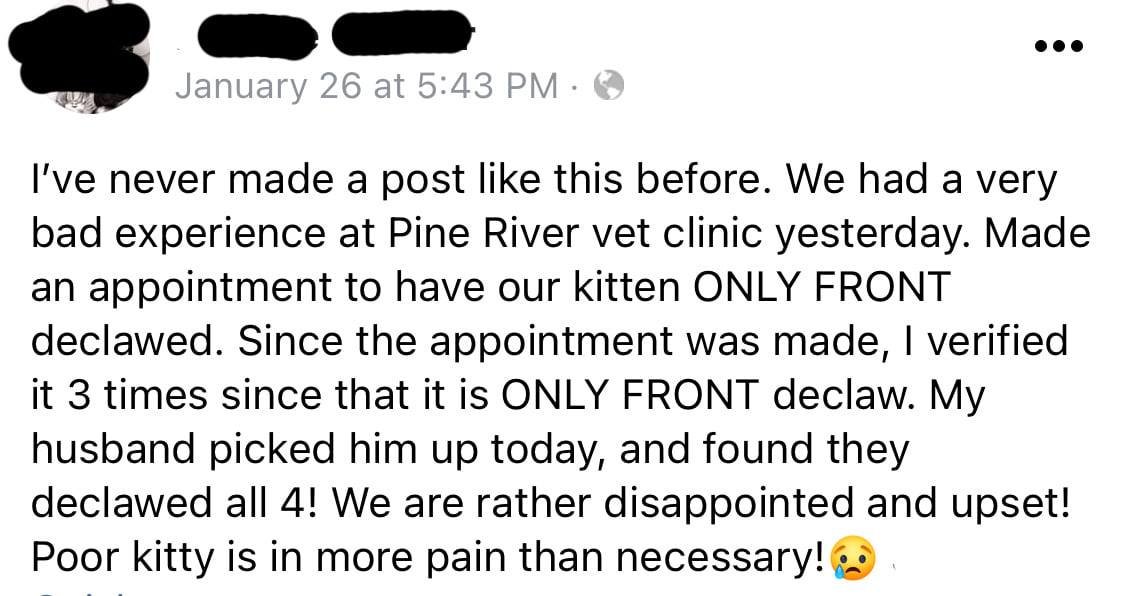
Here’s a facebook post from January 2026 about this Carevet clinic accidentally declawing a cat on all four paws instead of two paws.
—————————————————————————————————————-
————————————————————————————————————-May 2026. The employee said you need to get a “meet and greet” with the vet who does their declaw, Dr. Sherri Roberts, before she will determine if she will do the declaw. They said a neuter is around $289 and a declaw is around $400 extra. They said she would do the declaw as long as she thinks the cat will be ok for it. Researcher asked if the cat is healthy enough for it will she do it, and the employee said yes. They said she won’t do a four paw declaw.
2022. Our researchers made a quick call to ask for the cost of a declaw at this clinic and the employee asked, “Was it just for the front feet?” A 2 paw declaw is $285 and a 4 paw declaw is $364 and they said that Dr Frydenlund does declaws regularly and has been doing them for a long time.
They said they use a laser, they change the bandages in the morning before they send the cat home, and they give pain meds for 3 days. When asked if a declaw is ok for a cat long term, they said, “Yea, we haven’t had problems.”
19) Animal Medical Care Center and Cat Hospital. Niles, OH.
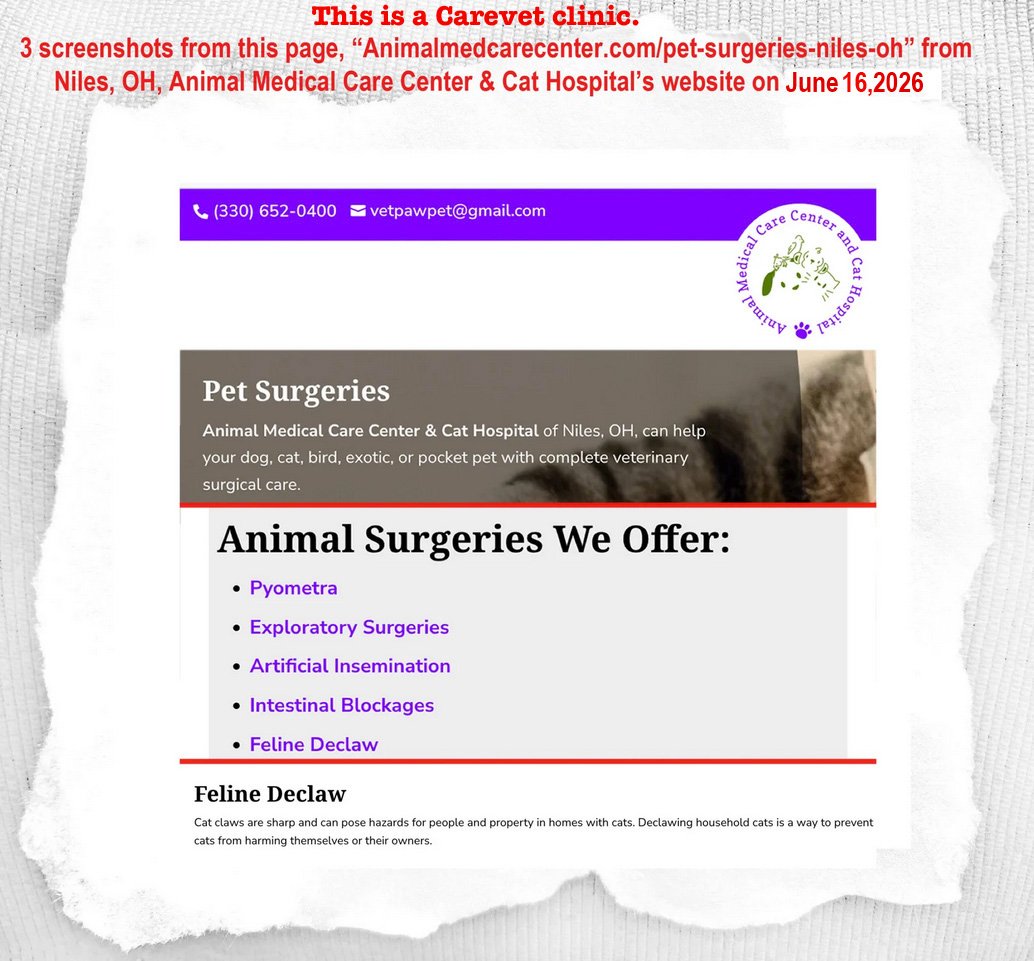
https://animalmedcarecenter.com/pet-surgeries-niles-oh/
June 2026. Researcher asked for the cost of a neuter and declaw. The employee said that their vet, Dr Singh is out ill. They said he might come back in July. Researcher asked if anyone else does them and the employee said that most vets will not do declaws and in Pennsylvania they outlawed them. Researcher so the vet who is working there doesn’t do declaws and he didn’t specialize in that kind of surgery and has been practicing for 8 years. Researcher asked if declaw is bad for a cat and the employee said no, just if they get out they have no way to defend themselves except their teeth. The employee said a lot of people have their cats declawed because they don’t want their furniture tore up. Researcher asked if there are any long term problems with a declaw and the employee said, no, not the way that Dr Singh performs them. The employee said his declaw method is he “cuts at the knuckle” with a scalpel. The employee said she has been there for 10 years and he’s done them for all those years and she hasn’t seen any issues yet.
Nov. 2025.
This clinic said, “Ensuring the health and well-being of your small pets is our priority at Animal Medical Care Center and Cat Hospital” on a Feb. 26, 2025 Facebook post.
The employee said it’s $125 for neuter $395 for front declaw up to a year old. Researcher asked if the cats are ok long term after a declaw and the employee said sometimes they are ok, there could be pain, or be depressed, and it is an amputation. They said Dr. Singh performs their declaws.
20) Lake Geneva Animal Hospital. A Carevet PREMIER CENTER
The employee said that they don’t do declaws. They said to check with their clinic, Geneva Lakes in Walworth.
Researcher asked why they don’t perform declaws and the employee said they don’t do them anymore, and said, “we don’t have the equipment, but our sister clinic in Walworth does.”
Researcher if the equipment they use is a laser and the employee said, “I think so.”
Researcher asked if a declaw is ok for a cat and the employee said, “Oh sure. People still do them.”
This is what it says about Lake Geneva on Carevet’s website job listing. “Lake Geneva Animal Hospital is proud to be recognized as a CareVet Premier Center—an elite hospital known for clinical excellence, advanced treatment options, and a collaborative team environment. This thriving, nine-doctor practice offers high-level services including acupuncture, laser therapy, dentistry, orthopedic and soft tissue surgery, and more. With top-tier equipment, a loyal client base, and a strong mentorship culture, it’s an exceptional place for both new graduates and experienced DVMs to thrive, grow their skills, and practice high-quality medicine in a supportive and forward-thinking environment..” https://careers.carevet.com/veterinarians/jobs/1954?lang=en-us
21) Geneva Lakes Animal hospital. Walworth, WI. (Sister clinic to Lake Geneva Animal Hospital.)
The employee said a neuter is $430 and a declawing they require a declaw consult so they can talk to you about the pros and cons of declawing and said “we only do front declawing” and a neuter/declaw is $1400. They said their doctors, Dr Stratton, Dr Chris Welch, and Dr Kelly Roy do their declaws. (They have 4 vets listed on their website.)
Researcher asked if they will do the declaw after the consult and the employee said yes if they think it’s a proper thing to do for your cat and said “if you and the doctor agree that we’re declawing your cat” they will schedule the procedures. Researcher asked when do the doctors disagree to doing a declaw and the employee said, “Honestly, I’ve never had them disagree” but said they aren’t the doctor.
22) Berry Animal Clinic. Decatur, AL
A neuter is around $100 and a declaw is $108. They said they don’t do the 4 paw declaws because it’s considered inhumane in the vet society and most clinics won’t do the back paws.
Researcher asked if a declaw is ok for the cat long term and the employee said as long as the cat is under a year old. They said that their vets, Dr Berry, Dr English, and Dr Emily can do the declaw. They said they don’t do declaws very regularly.
—————————————————————————————————–
23) West Branch Veterinary Services. MI
The employee said that they do not declaw cats anymore. Researcher asked why and the employee said that Michigan banned the rear declaw and their doctors decided they don’t want to do the fronts. They said it’s very difficult on the cat, a lot of recovery time, and very painful for them.
24) Our Family Vet. Bullard, TX.
Website says, Our Mission. To help families experience the power of the human/animal bond by providing clinical, surgical, and wellness services that will help pets grow healthy and live enjoyable lives with their human counterparts.
- The employee said they do not perform declaws because right now they don’t have a vet who will do them. They said it’s like cutting off the tips of their toes and some vets won’t do them.
- Employee said that they can’t give an estimate and need an exam first for a cost. They said that Dr Alexander does their declaws. Researcher asked if he does declaws regularly and the employee said, “Oh yea, we do quite a few.” Researcher asked if the cats are ok long term after the declaw and the employee said, “Oh yea. They spend a couple nights with us and we keep an eye on them.”
They said it’s better to do the spay/neuter/declaw at the same time so that they are only under anesthesia once.
25) Our Family Vet, Jacksonville, TX.
- The employee said that they do not declaw cats. Researcher asked why and the employee said because their doctor doesn’t like to do them because it causes issues for the cat down the road with arthritis. The vet that performed their declaws in the past is not listed on their website. https://ourfamilyvettx.com/meet-our-team/?c=veterinarians
- They said that Dr John Alexander does their declaws and he does them often. They said that you need an exam to get a cost for a declaw
26) Carmichael Road Animal Clinic. Montgomery, AL
https://www.carmichaelrdanimalclinic.com
The employee said that Dr Benefield does their declaws. They would have to write up an estimate for a neuter/declaw. Researcher asked if he would do a 4 paw declaw with a neuter and the employee said yes.
27) East Montgomery Animal Hospital. Montgomery, AL
The employee said that their declawing vet, Dr Benefield would have to write up an estimate for a neuter/declaw. He is the same declawing vet at Carmichael road Animal clinic.
Researcher asked if the cats are ok long term after a declaw and the employee said it does take a long time to heal and they have only been there for a couple of declaws. They keep them at the hospital a couple of days to make sure they are healing ok. They said they have had a couple of declaws in the past year.
28) Care Animal Hospital. Arlington Heights, IL
The employee said that a neuter is $370 and a 2 paw declaw is $1600. They employee said Dr Haase does their declaws. They have 5 vets listed on their website.
He lists all the surgeries he’s done on the website. https://carevets.com/meet-our-team/?c=veterinarians
Researcher asked if the cats are ok long term after a declaw and the employee said, “yea for the most part.”
Researcher asked if Dr Haase does declaws regularly and the employee said, “Less so now it’s getting less popular, but he’s done a lot of them” and “He does do them regularly.”
29) CareVet of Middletown. Franklin, OH
Website: www.carevet.com/middletown
The AI assistant said, “I am sorry but our doctors do not perform declaw procedures” and then said they could provide recommendations for clinics in the area that offer it. Then Marin said to search local area for clinics that still perform declaws or cat only practices or larger animal hospitals as they sometimes provide specialized services. Marin said many practices no longer offer declawing due to animal welfare concerns.
30) Carevet by Interstate. N. Little Rock, AR
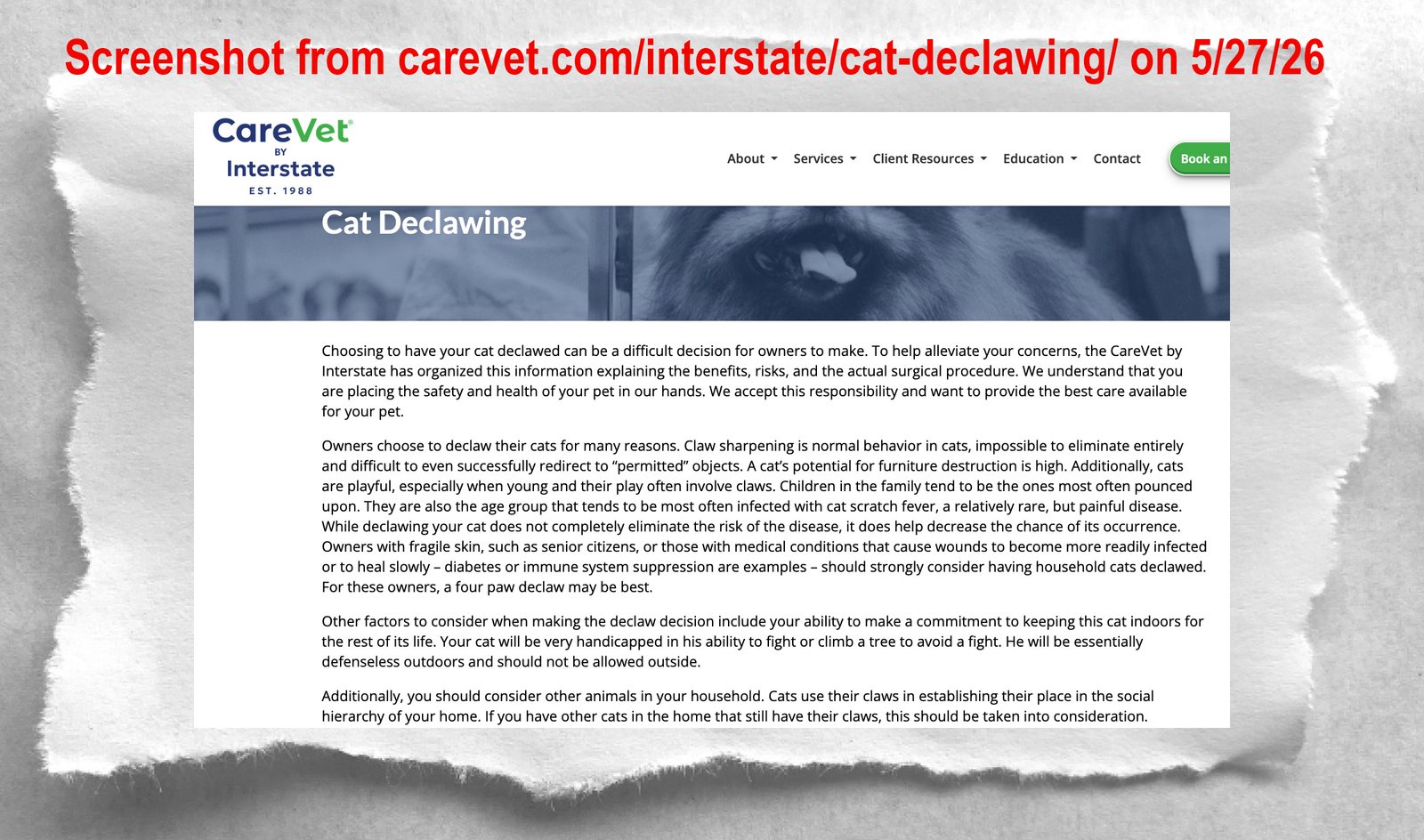
Link to this declawing info. https://www.carevet.com/interstate/cat-declawing/
The researcher asked for the cost of a neuter/declaw and the employee asked, “Would you want all four or just the front two?” A neuter is around 200.
A 2 paw declaw is $639 and an all 4 declaw is $879 and the employee said, “You do get a $90 discount when you do the neuter and the declaw at the same time.” So a neuter/4 paw declaw is $989.
They said they have one doctor who does their declaws, Dr Meurer. https://www.carevet.com/interstate/meet-our-team/?c=veterinarians
Researcher asked if the cats are ok long term after a declaw and the employee said yes. They said that he uses a laser and the healing is better and the surgery goes a lot quicker with the laser.
Researcher asked if they perform declaws regularly and the employee said, “this is pretty regular procedure for us.”
CAREVET by Interstate’s declawing info.
“Cat Declawing
Choosing to have your cat declawed can be a difficult decision for owners to make. To help alleviate your concerns, the CareVet by Interstate has organized this information explaining the benefits, risks, and the actual surgical procedure. We understand that you are placing the safety and health of your pet in our hands. We accept this responsibility and want to provide the best care available for your pet.
Owners choose to declaw their cats for many reasons. Claw sharpening is normal behavior in cats, impossible to eliminate entirely and difficult to even successfully redirect to “permitted” objects. A cat’s potential for furniture destruction is high. Additionally, cats are playful, especially when young and their play often involve claws. Children in the family tend to be the ones most often pounced upon. They are also the age group that tends to be most often infected with cat scratch fever, a relatively rare, but painful disease. While declawing your cat does not completely eliminate the risk of the disease, it does help decrease the chance of its occurrence. Owners with fragile skin, such as senior citizens, or those with medical conditions that cause wounds to become more readily infected or to heal slowly – diabetes or immune system suppression are examples – should strongly consider having household cats declawed. For these owners, a four paw declaw may be best.
Other factors to consider when making the declaw decision include your ability to make a commitment to keeping this cat indoors for the rest of its life. Your cat will be very handicapped in his ability to fight or climb a tree to avoid a fight. He will be essentially defenseless outdoors and should not be allowed outside.
Additionally, you should consider other animals in your household. Cats use their claws in establishing their place in the social hierarchy of your home. If you have other cats in the home that still have their claws, this should be taken into consideration.
A declaw or onychectomy is the surgical removal of the 3rd phalanx of all of the digits. To help reduce post operative pain and complications, we only do the procedure using CO2 laser – the latest in cutting edge technology. It is performed usually only on their front paws. When your pet is checked into the clinic for surgery, the doctor first does a complete exam. The pet is then given a “pre-med” injection of sedatives and other medication to help relieve fear and stress, make recovery smoother, and reduce pain after the procedure. After the sedative has taken effect, the pet is placed under complete anesthesia using injectable drugs. One or both front legs may have hair clipped off to make IV injections or catheter placement less traumatic. A tube is placed in the airway to protect it and to administer gas anesthesia, exactly as is done in a human hospital. Monitoring devises are set up as well as thermal support equipment. Your pet is monitored during the procedure using an esophageal thermometer and ECG unit, a blood pressure monitor, a respiratory alarm, and a pulse oximeter and capnograph that measure oxygen and carbon dioxide levels in the blood. The paws are sterilely prepped, and then the entire 3rd phalanx, including the nail and nail bed is surgically removed on all front digits. The incisions are closed, and your pet’s feet bandaged. Pain medications are administered. You will be called once your pet is in recovery and is awake enough to have his/her endotracheal tube removed. Your pet will recover in an ICU unit and be monitored closely.
We do require that all cats undergoing a declaw procedure spend the night at our clinic. This allows us to keep the pet’s feet bandaged overnight, to minimize any activity, and to monitor the pet for any post-operative bleeding. You will be able to pick up your pet the day after surgery, any time between noon and closing.
Although declaw surgeries are considered routine, any surgery and anesthetic episode has risk involved. At the CareVet by Interstate, we use the latest in drug protocols and anesthesia monitoring to minimize the risks. Additionally, we always use CO2 laser for declaw surgeries to minimize post operative pain. Risks associated with a declaw include:
- Anesthesia complications – Although most pets undergoing declaw surgery are relatively young, we still recommend pre-anesthetic blood work to identify any underlying medical condition that would increase the risk of anesthesia and surgery. We also recommend an IV catheter and fluids to provide us access to the bloodstream and maintain blood pressure should a problem occur.
- Infection – Any time a surgical incision is made on the body, there is a risk of infection. We only perform this surgery using strict sterile technique to reduce this risk. Antibiotics are sent home if needed at the discretion of the veterinarian.
- Bleeding –Bleeding can occur during and after the procedure for a number of reasons. We recommend, as part of the pre-anesthetic blood work, a test to help assess clotting ability. We monitor the pet closely during and immediately post-surgery for any bleeding. We apply tourniquets during surgery to minimize bleeding intra-operatively. We are now able to offer laser surgery. This option greatly decreases the amount of bleeding and pain post-operatively. We also apply pressure bandages post-operatively to minimize bleeding.
- Nerve dysfunction – This is very rare complication that can occur when tourniquets are applied to the limbs to minimize bleeding. The risk of this problem is eliminated by laser surgery. Very small kittens are at higher risk for this problem.
A successful surgery, with no complications, requires the cooperation of both the veterinary staff and the owner. The CareVet by Interstate strives to provide the best care available before, during, and after surgery for your pet. We need your help to provide this level of care. Instructions for your pet will include:
- Do not feed your cat after 9:00 pm the night before surgery. He/She can continue to have water throughout the night.
- Have your cat at our office no later than 8:30 am the morning of surgery. We do our surgeries early to allow us to monitor their recovery all day.
- Thoroughly consider these options –IV catheter, pre-anesthetic blood work, laser surgery, and fluids.
- Keep your cat warm and dry after surgery.
- Do not allow your cat to run, jump, or otherwise put stress on the incisions. He/She may need to be crated or confined to prevent this. Caution should be exercised for 1 week after surgery.
- Cats must not use regular litter for 1 week. You may use shredded newspaper, a commercial product of pelleted newspaper (Yesterday’s News), or dried peas in place of litter for 1 week. This is essential to minimize risk of infection.
The doctors and staff of the CareVet by Interstate have organized this letter to help answer any questions you may have concerning your pet’s surgery. However, if you have other questions, please call us. We have also included a handout on optional services provided by our hospital during surgery to maximize the care we provide. You will be asked to accept or decline these services upon arrival for surgery check-in.
Thank you for entrusting the doctors and staff of the CareVet by Interstate with the well-being of your pet.”