Sign our petition to Associated Veterinary Partners.
Why does Associated Veterinary Partners Co-founder and COO Dr. Bill Wagner continue to allow declawing in AVP’s hospitals when the procedure may be contributing to the very ethical conflict, moral distress, and moral injury among veterinary team members that he has spent years urging the profession to address?
Many veterinarians, veterinary technicians and assistants report severe emotional distress and injury over declawing.
•Front-desk staff required to schedule a procedure they know is inhumane and wrong.
•Techs and assistants managing post-op cats who are bleeding, terrified, unable to walk normally, and often ripping off bandages—sometimes leaving blood throughout cages overnight which they have to clean up.
•Veterinarians who oppose declawing are pressured to defer to colleagues or clinic policies that violate their ethics.
•Teams overwhelmingly against declawing yet still forced to participate, witness, or facilitate it. Some are told to not advise against declawing or the humane alternatives as they risk being fired.
Story- https://citythekitty.org/is-the-angst-of-declawing-contributing-to-veterinarian-suicide/
AVP Leader Warns About Moral Injury But Stilll Allows Declawing In His Company
By City the Kitty News
Associated Veterinary Partners (AVP) is a veterinary group company that owns and operates 24 vet clinics across 13 states.
The company says it was founded to give veterinarians an alternative to traditional corporate ownership by preserving clinical autonomy, supporting veterinary teams and practicing “gold-standard medicine.” Associated Veterinary Partners says, “We are true to our path: Our mission is to advance the lives of pets, pet parents, and veterinary healthcare workers together.”
Its co-founder and chief operating officer, Dr. Bill Wagner, has become one of veterinary medicine’s most outspoken leaders on the profession’s mental health crisis.
In a 2023 article on Not One More Vet’s (NOMV) website, Wagner wrote that veterinary professionals suffer not only from burnout but also from moral injury—the profound psychological distress that occurs when people are forced to act against their ethical beliefs. He argued that veterinary medicine must address the systemic causes of moral injury rather than simply helping people cope after the damage is done.
AVP has publicly embraced that philosophy. The company says it was founded because its leaders were dissatisfied with traditional corporate veterinary groups and wanted to build a model “free from the constraints of private equity funding.” Wagner has also written that when corporate veterinary businesses focus primarily on short-term financial returns, “quality, patients and employees all lose.”
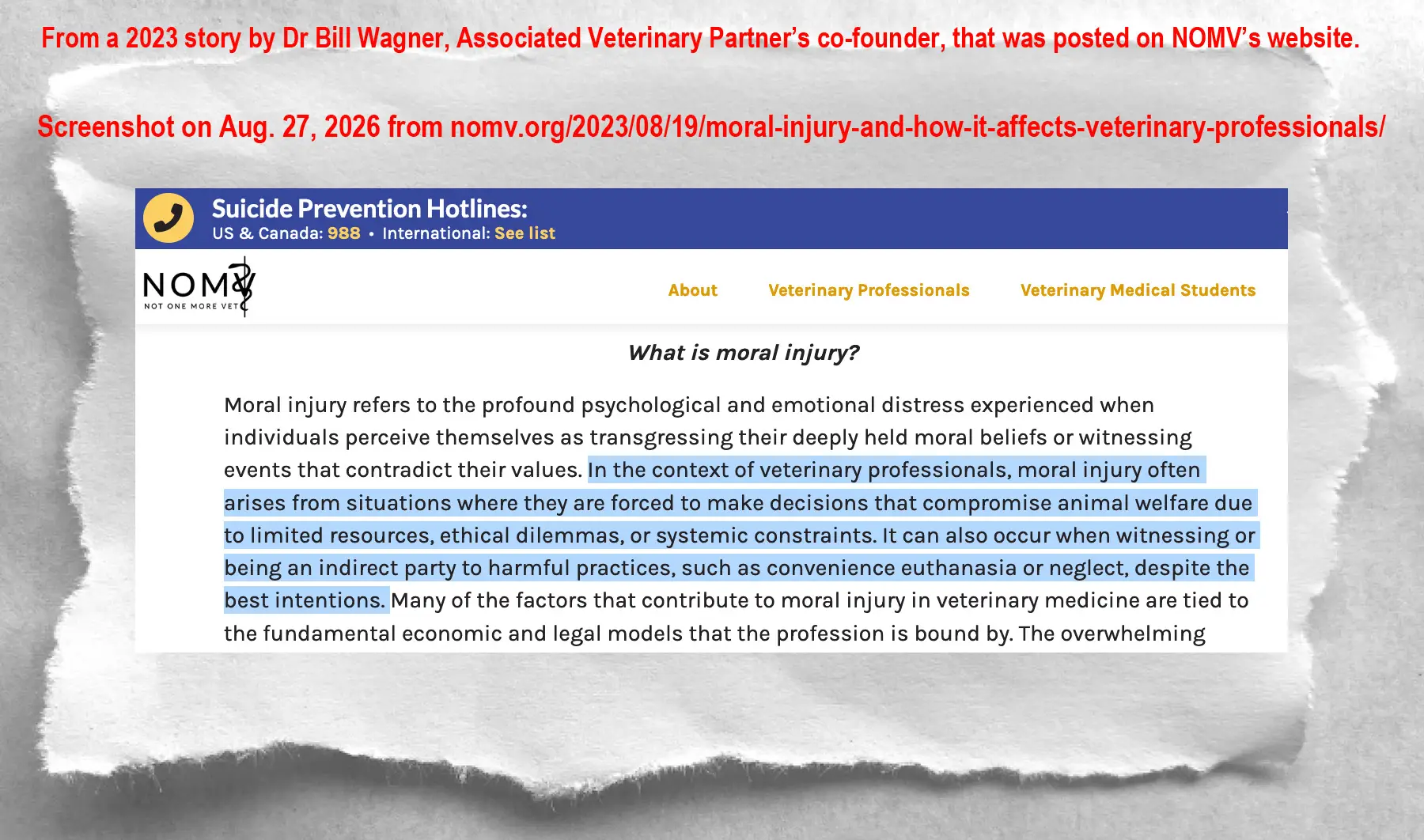
Wagner also says in the story, “In the context of veterinary professionals, moral injury often arises from situations where they are forced to make decisions that compromise animal welfare due to limited resources, ethical dilemmas, or systemic constraints. It can also occur when witnessing or being an indirect party to harmful practices, such as convenience euthanasia or neglect, despite the best intentions.”
AVP has partnered with NOMV, the nation’s leading nonprofit focused on veterinary mental health, and was named the organization’s Sponsor of the Year in 2024. On AVP’s website, company leaders describe AVP as “an agent of change” committed to gold-standard medicine, clinical excellence and removing obstacles that prevent veterinary professionals from succeeding.
But when City the Kitty asked Wagner whether AVP’s continued allowance of declawing is one of those preventable systemic obstacles, he never answered.
Repeated Questions Received No Response
On Dec. 30, 2025, and again on Jan. 14, 2026, City the Kitty sent Wagner detailed emails requesting comment for this investigation.
The nonprofit asked how allowing elective declawing aligns with AVP’s commitment to veterinary well-being, gold-standard medicine and clinical excellence.
Among the questions were:
- Does AVP recognize that elective declawing may create moral stress or moral injury for veterinarians and veterinary team members who believe the procedure is harmful?
- Has AVP heard from employees who are uncomfortable performing, assisting with or scheduling declaw procedures?
- Would ending elective declawing reduce ethical conflict within AVP hospitals?
- If protecting veterinary professionals is central to AVP’s mission, why continue allowing a procedure that many veterinarians refuse to perform?
Wagner did not answer any of the questions.
Employees at AVP Declawing Clinics Describe How It’s Bad For A Cat
City the Kitty investigators surveyed nine randomly selected AVP hospitals in late 2025.
Six of the nine clinics said they still perform elective declaws.
Again and again, employees described the surgery in terms remarkably similar to those used by animal welfare advocates.
At Walled Lake Veterinary Hospital in Michigan, an employee said declawing amputates a cat’s first knuckle, removes its primary means of defense if it gets outdoors and can lead to behavioral changes.
When asked why only one veterinarian performs declaws, the employee said the other veterinarians simply “don’t want to.”
Asked why one doctor continues performing the surgery if it is harmful, the employee sighed and said it ultimately comes down to the doctor’s personal preference.
At Dawson Veterinary Clinic in Minnesota, employees described declawing as “very invasive,” said they discourage owners from choosing it and acknowledged declawed cats should never be allowed outdoors. Yet they also said the clinic performs “a fair amount” of declaws.
At Adams Animal Care in Nebraska, an employee acknowledged, “We are cutting off the last part of their toes,” adding that there is always the potential for arthritis and that it is probably better if cats keep their claws.
At Greenock Farm Veterinary Hospital in North Carolina, an employee called declawing “a pretty severe thing,” explaining that it permanently affects cats because “they’re cutting off the end of the knuckle.”
At Tecumseh Animal Clinic in Nebraska, staff described declawing as “a big procedure” because it removes the end of the digit.
At Heritage Animal Hospital in Kentucky, employees said they regularly perform declaws but generally do not recommend removing a cat’s back claws because cats use them for grooming and scratching in the litter box.
Some AVP Vet Clinics Do Not Declaw Cats
Not every AVP hospital still performs declaws.
Employees at Hartland Animal Hospital in Wisconsin said their veterinarians stopped because the procedure is invasive and can create long-term problems.
At Fort Harrison Veterinarians in Indiana, employees said their doctors are uncomfortable performing declaws because the procedure amputates a cat’s first knuckle and is no longer recommended.
At Syler Veterinary Clinic in Texas, employees described declawing simply as “toe amputation” and “cruel.”
The survey suggests AVP itself is divided.
Some veterinarians refuse to declaw because they believe it harms cats.
Others continue performing the surgery.
The Kind of Ethical Harm Dr Wagner Has Warned About
Those divisions are significant because they mirror the very type of ethical conflict Wagner has publicly described as causing moral injury.
Within AVP hospitals, veterinarians who refuse to declaw may work alongside colleagues who still perform the surgery. Veterinary technicians, assistants, receptionists and other team members may still be expected to schedule declaw procedures, prepare patients, assist during surgery or provide postoperative care, even if they personally believe the amputation is harmful.
For professionals who believe declawing unnecessarily harms cats, participating in those procedures can create the very ethical conflict Wagner has warned contributes to burnout, compassion fatigue and professionals leaving veterinary medicine.
Based on City the Kitty’s survey AVP survey, it appears likely that at least some veterinary professionals within AVP experience ethical conflict over declawing.
Unlike many causes of moral stress in veterinary medicine, critics note that this one is preventable.
Other Veterinary Companies Have Chosen a Different Path
Wagner has repeatedly argued that veterinary organizations should remove systemic barriers that harm veterinary professionals rather than simply asking employees to endure them.
Several large veterinary organizations have applied that same principle to elective declawing.
In recent years, major veterinary corporate groups have adopted company-wide bans on declawing across hundreds of hospitals. Those policies eliminate the need for veterinarians, technicians and other team members to participate in a procedure many consider ethically troubling. 6 states and many cities in America have also enacted laws prohibiting declawing for non-medical reasons (for the cat), reflecting a broader shift within the profession.
Unlike many workplace stressors, declawing is not an unavoidable part of veterinary medicine. It is a corporate policy choice.
City the Kitty asked Dr Wagner whether AVP has considered adopting a company-wide declaw ban, not only to protect cats, but also to eliminate what may be a preventable source of moral stress for veterinary teams.
He did not respond.
NOMV Also Declined to Address the Issue
After Wagner did not respond, City the Kitty contacted Not One More Vet (NOMV), the nonprofit organization dedicated to supporting veterinary professionals’ mental health.
The nonprofit was contacted because NOMV has published educational resources about moral injury and ethical conflicts in veterinary medicine, including specifically referring to convenience euthanasia as a source of injury. Wagner’s own article on moral injury appears on NOMV’s website.
City the Kitty asked whether NOMV believes declawing is also a source of moral injury and whether it has heard from veterinary professionals struggling with the issue.
The nonprofit also asked whether NOMV would:
- recognize declawing as a source of moral stress;
- develop educational resources addressing declaw-related moral injury;
- collect anonymous stories from veterinary professionals affected by declawing;
- offer guidance to teams working in clinics that still perform declaws; and
- publish a guest article written by a veterinarian explaining how declawing can contribute to moral stress and moral injury. (No response to this question.)
City the Kitty said such a resource could validate veterinary professionals’ experiences, encourage them to seek support and help reduce a preventable source of ethical conflict.
NOMV declined to answer those questions and replied:
“NOMV’s mission is to support the veterinary industry team members with mental health and well-being. If any team member is impacted by a procedure, etc. our services are available free of charge.
Your questions reach beyond our scope and thus we are unable to answer.”
The response did not address whether NOMV considers declawing a source of moral injury, whether it has heard from veterinary professionals affected by the issue or whether it would consider publishing educational material about it.
A Preventable Source of Moral Stress?
Dr. Wagner has argued that veterinary medicine must confront the systemic causes of moral injury instead of merely treating its consequences.
AVP says it was founded to free veterinary professionals from harmful corporate constraints, improve workplace culture and remove obstacles to success.
When City the Kitty presented Wagner with evidence that some AVP veterinarians refuse to perform declaws while others continue offering them and asked whether that inconsistency may be contributing to moral stress within his own company the nonprofit didn’t receive a reply.
If declawing is contributing to moral stress for even some veterinary team members within Associated Veterinary Partners, as City the Kitty’s survey could suggest, it represents a preventable source of ethical conflict that could be eliminated with a single company-wide policy.
For a leader who has urged the veterinary profession to confront the systemic causes of moral injury, the question remains unanswered: Why does Co-founder and COO, Dr Bill Wagner, of Associated Veterinary Partners continue to allow an inhumane amputation procedure that may be creating the very ethical conflict and harm to veterinary professionals that he has spent years warning about?
—————————————————————————————————————–
ASSOCIATED VETERINARY CLINICS AND DECEMBER 2025 DECLAWING SURVEY
1) Walled Lake Veterinary Hospital. MI. https://walledlakevet.com
The researcher asked for the cost of a neuter/declaw and the employee asked, “Would you like front foot or four foot?”
A neuter/front foot declaw is $731 and a neuter/all four paw declaw is $818, they said that they only have one vet who does their declaws, Dr Steven Burns. (They have 5 vets listed on their website but Dr Burns is not on the list.)
Researcher asked if the cats are ok long term after declaw and the employee said it depends on the cat and some have behavioral changes afterwards. Employee said they perform declaws occasionally.
The researcher asked why they only have one vet who does declaws and if it’s because the other vets don’t want to or they don’t know how to. The employee said the others don’t want to.
Researcher asked why the others won’t do a declaw and if it’s bad for a cat and they employee said yes and they said you are taking away their defense mechanism if they ever get outside. They said when you declaw a cat it’s taking off their first knuckle and it’s an amputation, not just removing the nail.
Researcher asked if it’s bad for a cat then why is Dr Burns doing them.
The employee sighed and said cats can live without their claws and it’s a lifestyle choice whether you want to do it. They said some vets do declaws and some don’t and said it’s a personal preference choice.
The employee said that some vets say it’s good for a cat and some say it’s bad for a cat and it’s a toss up, and you will get a different answer all the time.
2) Tecumseh Animal Clinic. NE. https://tecumsehanimal.com/
The researcher asked for the cost of a neuter/declaw and the employee said it’s between $500-$600. They said all 3 of their doctors can do declaws and they use a scalpel.
Researcher asked if the cats are ok long term after the declaw and the employee said they haven’t had any issues with them.
Researcher asked if they do declaws regularly and the employee said yes but said they don’t do them if the cat is over a year old as much since it’s hard on them.
They said it’s a big procedure and you are taking the end of their digit off.
3) Dawson Veterinary Clinic. MN. https://dawsonveterinaryclinic.com
The researcher asked for the cost of a neuter/declaw and the employee said it’s $400. They said Dr Mariah and sometimes Dr Rachel perform their declaws. (They have 3 veterinarians listed on their website.)
Researcher asked if the cats are ok long term after the declaw and the employee said it’s kind of controversial thing, they can’t be outdoors, and said “we don’t really necessarily promote declaws” but they understand that people want them and they will still do them.
Researcher asked if they do declaws regularly and the employee said yes. Researcher asked if those cats are ok long term and the employee said yes.
4) Hartland Animal Hospital. WI. https://hartlandanimalhospitalwi.com
The employee said they do not perform declaws. Researcher asked why and they said their doctors have chosen not to do them because it’s an invasive procedure and can cause further issues for the cat. Researcher asked if their vets are against declaws and if it’s bad for a cat and the employee said yes.
But they said if the owner is adamant about getting a declaw done, then they recommend looking into other clinics to have it done.
5) Ft. Harrison Veterinarians. Indianapolis, IN. www.fortharrisonvets.com
The employee said they do not perform declaws and researcher asked why and they said that their doctors do not like to do declaws and don’t feel comfortable doing them. They said that declawing is not recommended and that’s why a lot of clinics have stopped doing declaws.
They said that declawing involves cutting off their first knuckle. They recommended Paws and Purrs for a declaw but that clinic said they do not declaw cats and it’s amputating the cat’s first digit and it is not considered a humane procedure.
6) Heritage Animal Hospital. Morgantown, KY https://heritage-vets.com/
The employee said that a neuter/declaw is $305.60 and they only have two doctors, Dr Joy Wills and Dr Steve Hamptons, and they both can perform a declaw.
Researcher asked if the cats are ok long term after the declaw and the employee said, “Typically, yes.”
Researcher asked if they do declaws regularly and the employee said yes. They said that they typically do not recommend declawing the back paws and researcher asked why and the employee said because it allows them to scratch in the litter box, scratch their body, and said “they don’t claw with those claws.”
7) Greenock Farm Veterinary Hospital. Midland, NC https://greenockvets.com/
The employee said the declaw is from $782-$862 and a neuter is $250-$330 and they only have one doctor, Dr Manwarren, who does them and she has to have a reason to do them. (They have 5 vets listed on their website.)
The employee said a declaw is “a pretty severe thing” because they are cutting off the end of the knuckle on a cat and it affects them for the rest of their lives and have to remain indoor cats forever. They said it’s an elective procedure and owner’s choice and ultimately it’s up to the doctor if they will perform it. They said there are various reasons for the declaw.
Researcher asked if the cats are ok long term after the declaw and the employee said the cats can potentially develop arthritis because their knuckles are cut off at the bone and it’s an amputation.
Researcher asked if they do declaws regularly and the employee said it’s not common that they do a neuter/declaw at the same time and said usually Dr Manwarren just does the declaw separately because it’s a pretty severe procedure.
8) Syler Veterinary Clinic. Athens, TX https://sylervetclinic.com/
The employee said they do not declaw cats and researcher asked why and they said it’s a toe amputation and it’s cruel.
9) Adams Animal Care. Adams, NE https://adamsanimal.com/
The researcher asked for the cost of a neuter/declaw and the employee asked, “Are we just doing the front feet?” A neuter/front paw declaw is around $540 and a neuter/all four paw declaw is around $625. They said all 3 of their vets can perform a declaws.
Researcher asked if the cats are ok long term after the declaw and the employee said, “We do the declaw surgery and a lot of places don’t” and said everybody has different views on declaws and said they do provide the service.
Researcher asked if a declaw is bad for a cat and the employee said some people think that the amputation of the last digit view that as not a necessary thing and other people are fine with it because it allows the cat to live inside without being destructive.
Researcher asked again if a declaw is bad for a cat and the employee said, “We are cutting off the last part of their toes” and said there’s always potential of arthritis and it’s probably better if they can keep their claws but they do offer the service.
Researcher asked if their veterinarians think a declaw is ok for the cat and the employee employee replied with a pause and said “yes.” (Their voice was heavy with reluctance.)
Researcher asked if they do declaws regularly and the employee said, “Yea, we do.”
City the Kitty nonprofit sent an email to AVP and Dr Wagner on December 30, 2025, Jan. 14, 2026, and June 29, 2026 and received no reply.
Then we sent this follow-up on August 27, 2026.