
Story published on April 15, 2026
Petition to the Minnesota Veterinary Medical Association. https://www.change.org/p/minnesota-veterinary-medical-association-tell-the-truth-about-declawing-support-a-ban
Exposed: 7 GOP Legislators Were Duped by MVMA.org’s Declawing Deception While 7 Democrats Saw the Facts and Truth — Republicans Kill The MN Anti-Declaw Bill, Ensuring Many Innocent and Healthy Cats in Minnesota Will Be Barbarically Mutilated and Suffer for Life.
In 2025, MVMA spokesman Dr. Trevor Ames told lawmakers “very few veterinary practices offer elective declawing as a service currently.” (Dr. Trevor Ames served as Dean of the University of Minnesota College of Veterinary Medicine from 2008 until August 5, 2019. We reached out to him to ask him to provide the data that backs up his statement but have not received a reply.)
In 2026, MVMA spokesman Dr. Rob Memmen, co-owner of AAHA Accredited Gehrman Animal Hospital, repeated that message, claiming only “about 30%” of veterinarians still perform declawing in MN, that the profession has “appropriately regulated itself,” and that clinics offering declawing are decreasing.
Our survey found that 61% of Minnesota veterinary clinics still perform declawing—directly contradicting those claims.
Here’s our story.
——————————————–
The Minnesota Veterinary Medical Association (MVMA) was the decisive force that stopped Minnesota’s 2026 anti-declawing bill HF1857, sponsored by Rep. Andy Smith (DFL-Rochester), on March 18, 2026, keeping declawing legal in the state despite the organization’s own policy acknowledging that elective declawing offers no medical benefit and is associated with significant negative welfare outcomes.
The MVMA says on their Facebook page says, “We support and empower veterinary professionals, advance animal well-being, and promote public health. Serving our members and the profession since 1897!”
As the only organization to formally oppose the legislation, the MVMA bears direct responsibility for helping defeat the bill and persuading seven Republican lawmakers — Chair Rep. Paul Anderson, Co-Vice Chair Rep. Bobbie Harder , Rep. John Burkel, Rep. Steve Gander , Rep. Steven Jacob, Rep. Bryan Lawrence, and Rep. Nathan Nelson to vote no, blocking protections that would have spared cats from this very harmful and inhumane amputation procedure.
As a result of that opposition, declawing remains a routine and financially significant procedure at many veterinary clinics across Minnesota. Our survey of 85 random Minnesota veterinary clinics found that 61% still perform the procedure, despite cats facing risks of permanent pain, lameness, chronic complications, and long-term behavioral effects
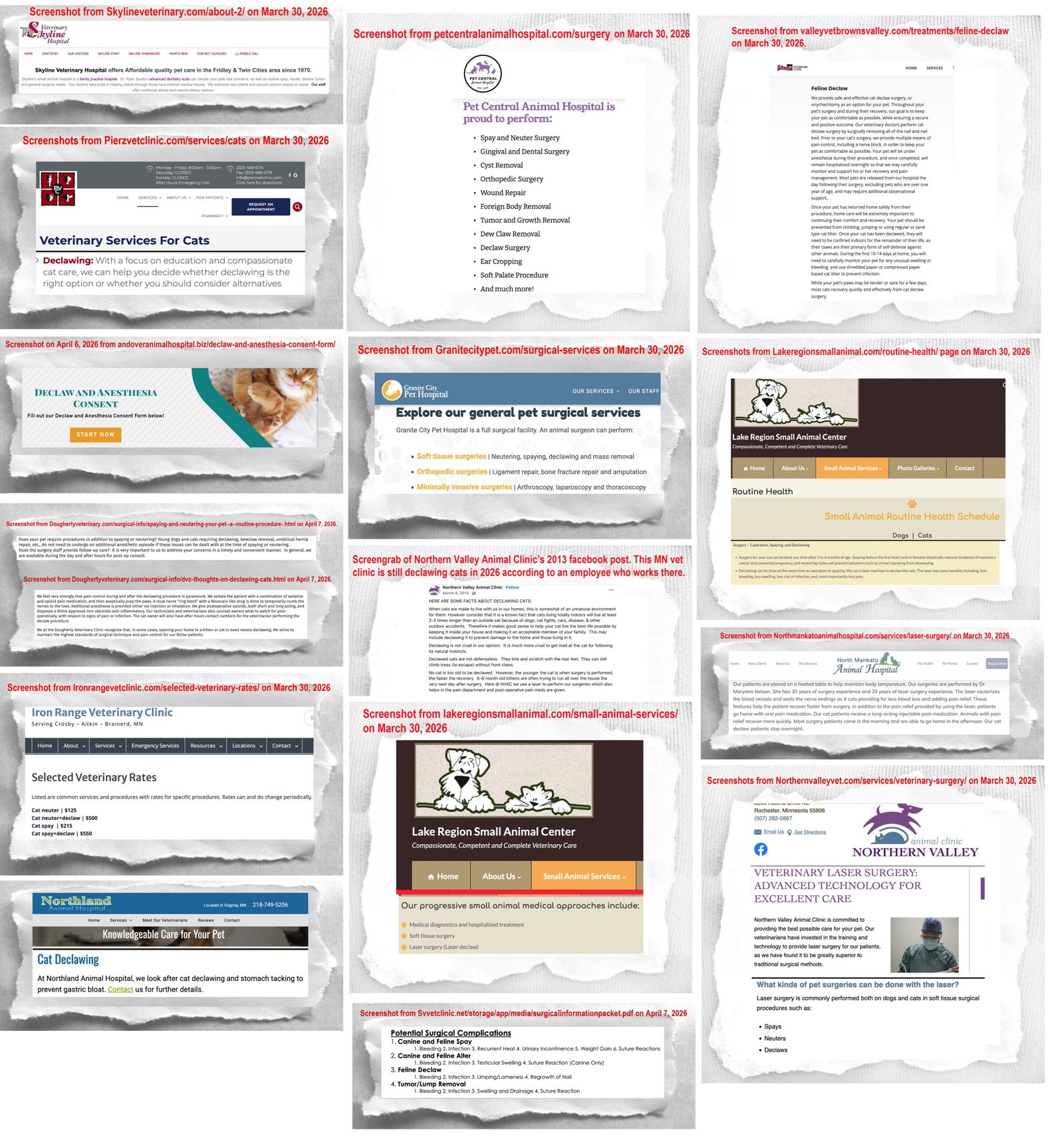
Some clinics still openly advertise declawing on their websites and claim cats “do fine” long term, despite the well-documented risks and even the MVMA’s own acknowledgment of harm.
Most shocking, despite repeated claims from the MVMA that declawing is declining, limited to a minority of veterinarians, and infrequently performed, our investigation found that many Minnesota clinics still offer it regularly, reassure owners that cats do fine long term, fail to present humane alternatives, and continue to profit from this easy, routine, and harmful inhumane amputation procedure.
Meanwhile, seven Democratic lawmakers , Co-Vice Chair Rep. Andy Smith, Co-Chair Rep. Rick Hansen, Rep. Esther Agbaje , Rep. Luke Frederick, Rep. David Gottfried, Rep. Fue Lee, and Rep. Samantha Vang voted in favor of the bill, because of the need to protect cats from this unnecessary and inhumane amputation procedure.
Here’s more about this bill. https://www.house.mn.gov/SessionDaily/Story/19010
Here’s the video of the hearing for this bill.
Committee Co-Chair and Co-Vice Chair Repeated MVMA’s Talking Points Before Blocking the Bill
The MVMA’s influence was clearly reflected in the remarks made by both committee co-chairs just before the vote.
Rep. Paul Anderson , co-chair of the House Agriculture Finance and Policy Committee, directly echoed Dr. Rob Memmen’s testimony, stating, “I like the advice of Dr. Memmen that consultation with the pet owner and looking at all aspects of the case and being able to use your judgment along with the pet owner. I don’t think a ban is necessary as long as it’s a declining practice.” He then instructed members to “vote your conscience.”
Co-Vice Chair Rep. Bobbie Harder delivered a similar message to the committee, saying she would “agree with the veterinarian,” describing declawing as a “case-by-case basis” and “sort of like a last resort as we have heard,” while adding that she did not want to “be in between a pet owner and the veterinarian.”
Although the veterinarian she referenced was not the MVMA’s spokesperson, her remarks repeated the same central narrative advanced by the MVMA: that declawing is rarely performed, used only as a last resort, and should remain a matter of veterinary discretion rather than legal protection.
Her comments also exposed a troubling disconnect within the profession itself, suggesting that even some veterinarians may still believe declawing is now uncommon, despite survey findings showing that nearly 61% of randomly selected Minnesota clinics still offer the procedure.
Together, the GOP legislator’s statements show how the MVMA’s messaging and the false perception that declawing is declining and rare helped shape the committee’s decision to reject the bill.
Critically, this also raises concerns that legislators relied on incomplete and flawed survey data and deceptive testimony in making a decision that ultimately kept this inhumane and harmful amputation procedure legal in Minnesota.
Contradictions at the Heart of the MVMA
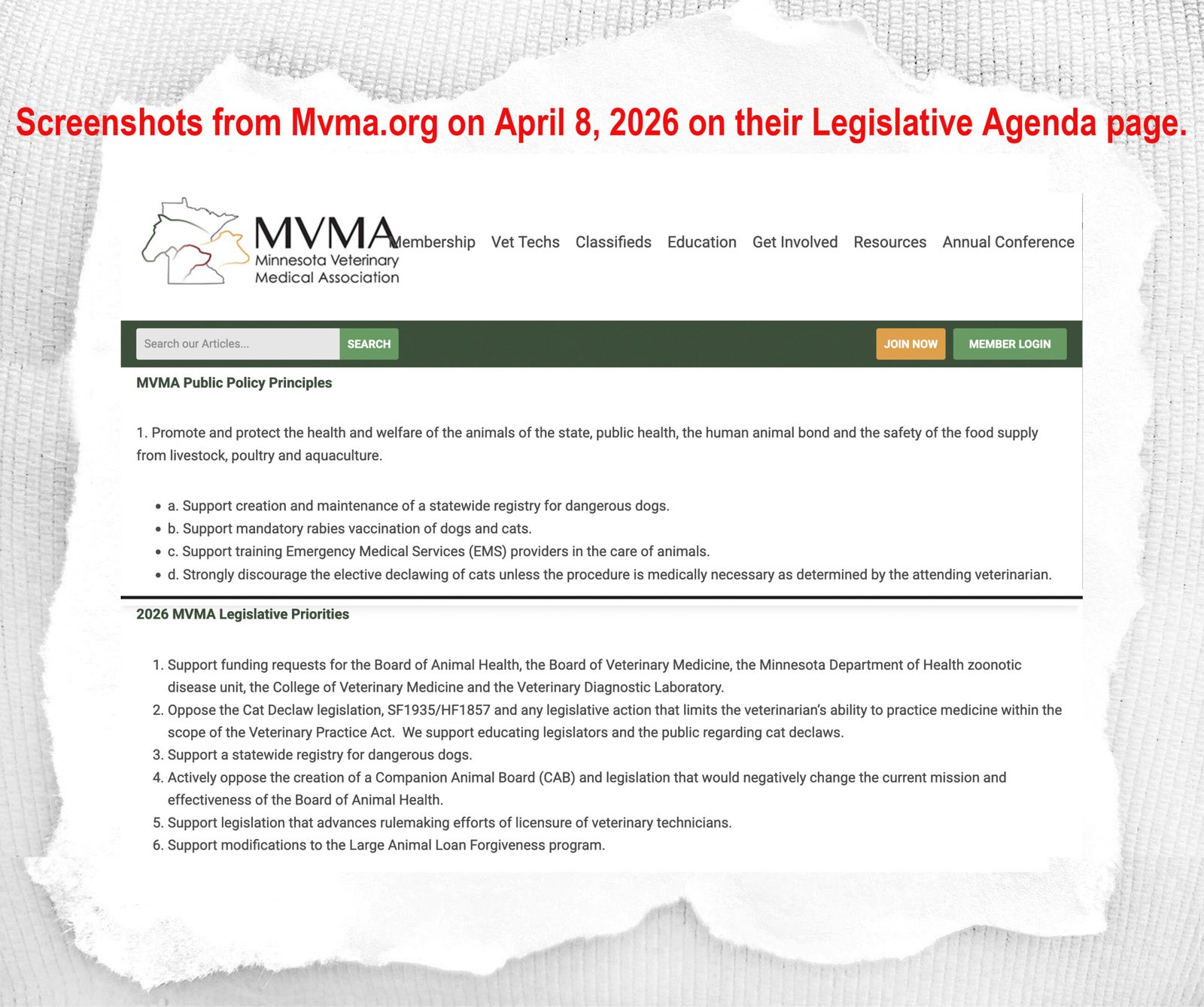
The MVMA lists among its 2026 legislative priorities that it will “Oppose the Cat Declaw legislation… and any legislative action that limits the veterinarian’s ability to practice medicine within the scope of the Veterinary Practice Act.”
Yet the organization’s Public Policy Principles state it exists to “Promote and protect the health and welfare of the animals of the state” and to “strongly discourage the elective declawing of cats unless the procedure is medically necessary as determined by the attending veterinarian.”
Acknowledging the Harm While Offering False Reassurances
During the March 24, 2025 hearing on this bill, MVMA representative Dr. Trevor Ames openly acknowledged the intent of the legislation, testifying, “The MVMA certainly supports the intent of this bill regarding elective declawing of cats but is opposed to it in its current form. The MVMA believes the civil liability portion of this bill is not needed for a number of reasons.” (This hearing starts at the 41 minute mark and Dr Ames testimony is at the 48 minute mark.)
He also assured lawmakers that “very few veterinary practices offer elective declawing as a service currently.” Senator Aric Putnam, chair of the committee, then asked Ames, “Is it fair to characterize the MVMA’s perspective that the prohibition is not problematic but the penalties are?” Ames responded, “Correct.”
In the 2026 hearing, MVMA spokesperson Dr. Rob Memmen reinforced that narrative, telling legislators there had been “a huge increase in the number of our veterinarians no longer performing the procedure over the last 15 or so years,” that “currently about 30%” still offer declawing while “70% are not,” and that the profession had “appropriately regulated itself moving away from this procedure.” He further claimed “a decreasing number of veterinary clinics are offering to perform this procedure entirely” and argued that consultation with pet owners and case-by-case judgment made a legal ban unnecessary.
These reassurances conflict not only with the MVMA’s own policy, which states that elective declawing “provides no animal health benefits and is strongly associated with negative animal health and welfare outcomes” but also with the facts uncovered in our investigation.
Survey Exposes Major Gap Between MVMA Claims and Statewide Reality
A CitytheKitty.org survey of 85 randomly selected Minnesota veterinary clinics found that 61% still perform declawing, directly contradicting the MVMA’s testimony that the practice is declining and limited to about 30% of responding small-animal veterinarians.
The MVMA says it represents more than 2,000 members — about two-thirds of Minnesota veterinarians — yet its claim that only 30% still declaw was based on just 783 survey responses.
Our survey also found that many clinics still offering declawing often have only one or two veterinarians willing to perform the procedure, which shows that even if fewer individual veterinarians perform declaws, the procedure is still commonly available in a majority of veterinary clinics across the state.
This means the 30% figure reflects only the veterinarians who chose to respond, not the statewide profession the MVMA relied on to argue that declawing is uncommon. As a result, that figure may significantly understate the true scope of the practice.
Because declawing is increasingly recognized as cruel and harmful, some veterinarians who still perform it may also have been unwilling to respond candidly or to respond at all to the MVMA’s survey.
Even more striking, many of the declawing veterinarians identified in the CitytheKitty.org survey are younger veterinarians, directly undermining the MVMA’s claim that younger vets are no longer performing declaws. Many are also not listed as MVMA members on their website, further suggesting the association’s data does not reflect statewide reality.
Most importantly, even if fewer veterinarians are willing to perform declaws, that does not mean fewer cats are being declawed. Owners seeking the procedure can still go directly to the clinics and veterinarians that continue to offer it, concentrating demand among those still willing to perform these amputations.
As a result, despite repeated claims that the practice is declining, many cats across Minnesota remain at serious risk.
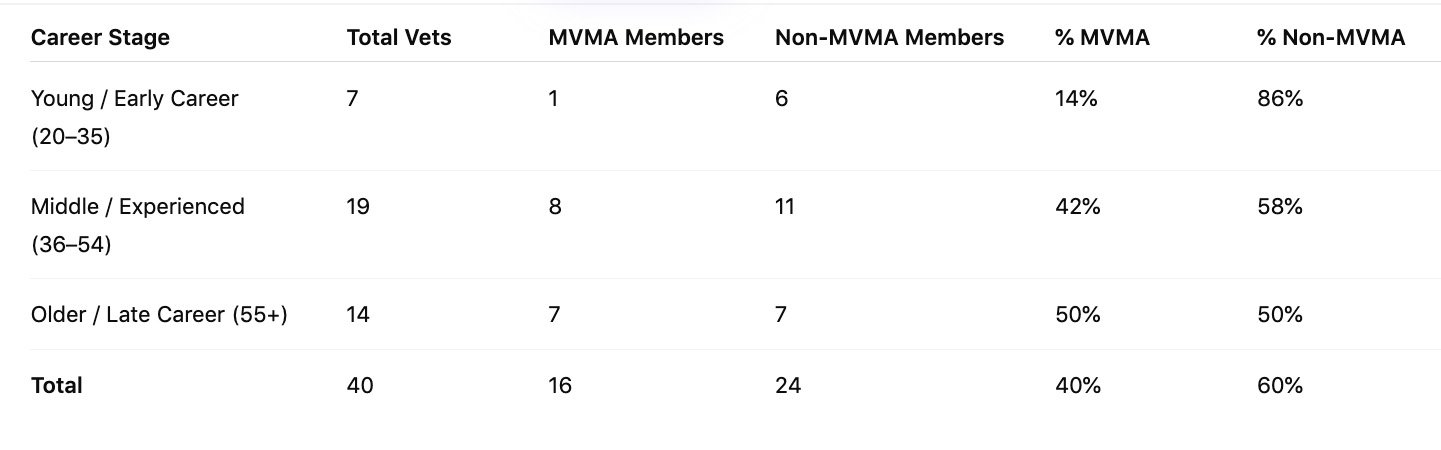
*Data from CitytheKitty.org’s 2026 survey of 85 vet clinics in Minnesota.
Ethical Vets Stop, Unethical Vets Profit
While many Minnesota veterinarians have voluntarily stopped declawing, the majority of veterinary clinics in the state still perform the procedure, with some doing it routinely — continuing to profit from an inhumane and unnecessary amputation. In many of these clinics, only one or two veterinarians perform the surgeries, forcing colleagues and staff to work in an environment that condones the mutilation of healthy cats.
Veterinary professionals enter this field to heal animals, not harm them, and being required to witness or assist in these procedures can cause severe moral stress and lasting moral injury. Here’s our story about this serious issue. https://citythekitty.org/is-the-angst-of-declawing-contributing-to-veterinarian-suicide/
The damage extends far beyond the clinic. Shelter and animal welfare workers are often left caring for declawed cats later surrendered or abandoned because of chronic pain, behavior problems, or complications caused by the procedure itself.
Declawing not only inflicts permanent pain and lifelong suffering on cats, but also takes an emotional toll on compassionate professionals and further erodes the integrity and reputation of the veterinary profession. Ethical veterinarians who refuse to declaw are often the ones left treating the arthritis, chronic pain, behavioral issues, and other long-term consequences, exposing the devastating harm this practice causes to both animals and the people dedicated to protecting them.
Dr Ron Gaskin, a no-declaw veterinarian and PawProject.org director in MN, testified in support of this bill in this hearing. His testimony is at the 5 minute mark in this YouTube video of the hearing.
Dr. Gaskin also performs reconstructive surgery on the paws of declawed cats in MN who are suffering from complications of this mutilating amputation procedure. He said, “It usually took a few days for me to recover emotionally,” describing the emotional impact of seeing the severe suffering these cats endure and then having to subject them to additional corrective surgeries in an effort to relieve pain caused by their mutilated paws.
Many cat owners were also never fully informed that declawing is an inhumane amputation or warned about its lifelong consequences, leaving many to later experience profound guilt and distress after learning the harm and suffering that was done to their beloved cats.
Education and Consent Promises Fall Short
The MVMA claims that their veterinarians educate clients on declawing alternatives, but many clinics that declaw cats fail to fully disclose permanent harm or discuss humane options such as nail trims, caps, or enrichment.
Many employees at clinics that declaw cats even assure owners that cats are fine long term after the procedure.
National Organizations Misrepresented

In testimony to legislators, MVMA spokesperson Dr. Rob Memmen claimed the MVMA’s declawing policy aligns with national organizations like the American Animal Hospital Association (AAHA) and the American Veterinary Medical Association (AVMA), which “strongly discourage” declawing unless medically necessary. He stressed:
“If you look at the American Animal Hospital Association or the AVMA’s position you’ll find very similar language… strongly discouraging type of language, not necessarily prohibiting language. I think we’re very consistent with what some of these national organizations are recommending.”
Memmen omitted critical context: the AVMA.org exists to serve its member veterinarians, many of whom still declaw cats, and its policy reflects member interests rather than strict animal welfare standards. Here’s why the AVMA won’t completely condemn declawing. https://citythekitty.org/avmas-credibility-in-crisis-leaders-with-financial-ties-to-declawing-shape-policy-prompting-calls-to-rename-it-the-american-veterinary-money-association/
AAHA.org operates differently, they focus on accrediting as many hospitals as possible, including those that declaw, which maximizes revenue from member hospitals; AAHA said their voluntary 2025 declawing standard will not be mandatory for 1–3 years, with their member support. AAHA has over 4500 Accredited Animal Hospitals. Here’s all you need to know about AAHA and declawing. https://citythekitty.org/why-does-aaha-org-choose-profits-over-the-welfare-of-innocent-cats/
In reality, the broader veterinary profession is moving decisively toward full prohibition. Twelve major veterinary organizations—including the Feline Veterinary Medical Association, Fear Free Pets, VCA Animal Hospitals, and National Veterinary Associates—have already banned declawing entirely, reflecting a clear consensus that the procedure is inhumane and should no longer be performed.
Antiquated Excuses for Cruelty Still Persist
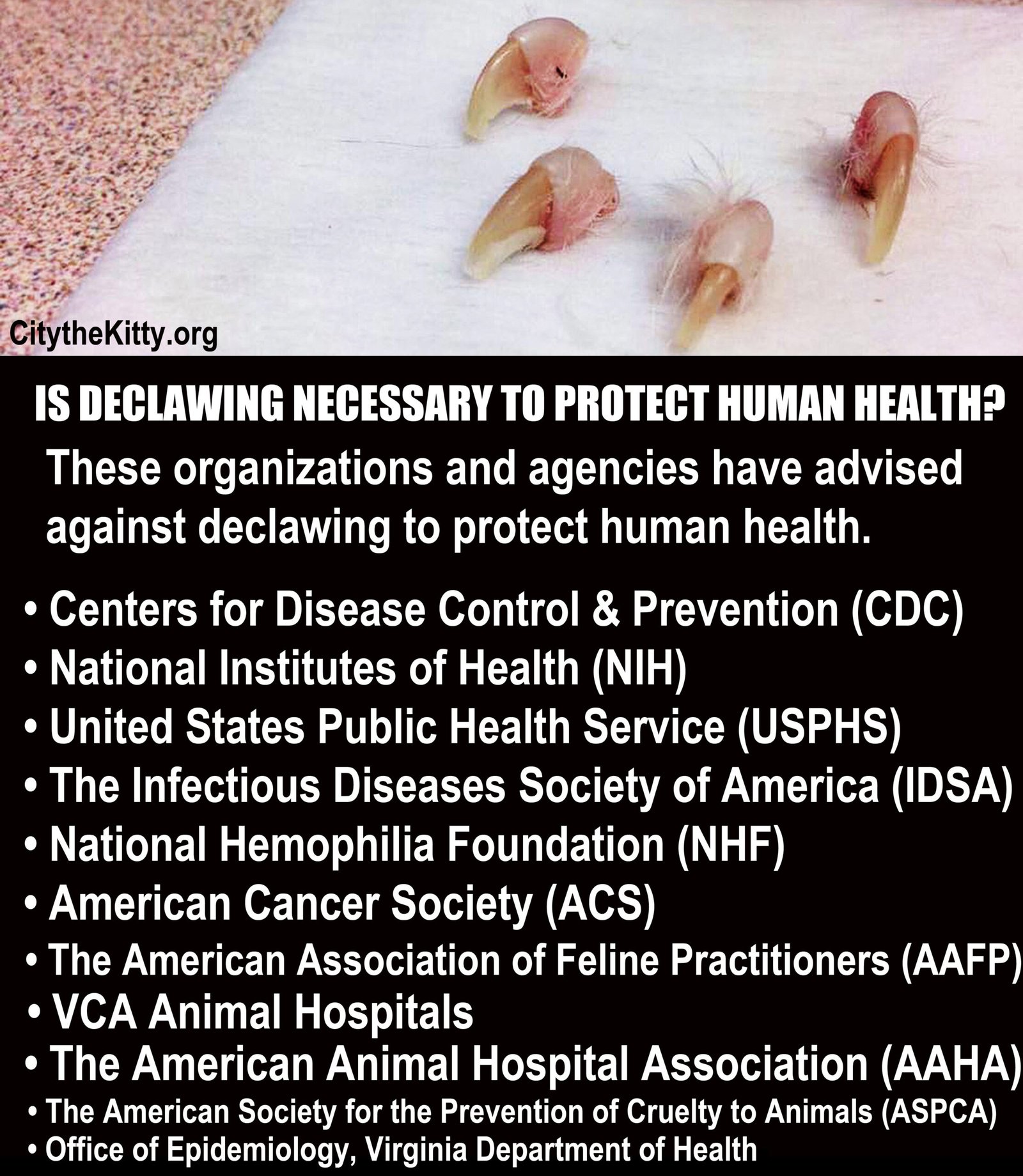
The MVMA continues to defend outdated justifications for declawing, suggesting it may be appropriate for elderly, disabled, or immune-compromised owners, or when behavior interventions fail. Yet no human health, veterinary, or animal welfare organization recommends or condones declawing for human health reasons. You can read all the facts about this issue in #11 in our Facts vs Myths section.
In fact, these arguments ignore the evidence: declawed cats are more likely to bite, and bites pose a far greater risk to people than scratches. They also frequently develop aggression and litter box issues, increasing the risk of abandonment and euthanasia.
While modern anesthesia and pain management may reduce short-term surgical pain, they do nothing to prevent the lifelong consequences — including chronic pain, arthritis, lameness, and behavioral problems.
In April 2026, this reality was underscored when a University of Minnesota College of Veterinary Medicine employee at Lewis Small Animal Hospital was asked in a phone call if they perform declawing and whether they would declaw for a human health issue such as diabetes, thin skin, or bleeding concerns.
The employee explained they only declaw when medically necessary for the cat and responded plainly when asked why they won’t declaw a cat for an owner with a health issue: “Because there are other solutions out there.”
Voluntary Measures Are Insufficient
The MVMA argues that self-regulation makes legislation unnecessary, yet declawing remains routine, openly advertised, and profitable at many veterinary clinics across Minnesota.
Even more troubling, the MVMA does not provide educational brochures or clear public information on its website for cat owners or member veterinarians about the inhumane nature of declawing or the humane alternatives available.
This exposes the failure of voluntary measures: without legal protections, cats remain vulnerable to an unnecessary and inhumane amputation procedure that continues despite growing recognition of its lifelong harms.
Only Legal Prohibition Can Protect Cats
For more than 70 years, cats in Minnesota have remained unprotected from an inhumane amputation procedure despite overwhelming evidence of lifelong physical and behavioral harm. The MVMA’s contradictory policies, misleading testimony, and influence over lawmakers expose the failure of self-regulation. Only a legal ban can end this cruelty and prevent more cats from being subjected to a procedure that should have been banned decades ago.
————————————————————————————————————————–
Here’s our 2026 survey of 85 veterinary clinics in Minnesota.
THE METHOD OF THE INVESTIGATION
City the Kitty researchers made a short call to random veterinary practices throughout Minnesota to see how they address declawing.
The general questioning went like this: The researcher asked for a price for a spay/neuter with a declaw, asked who their declawing vet is, asked what declawing method they use, asked if they perform declaws regularly and if declawing is ok for a cat long term.
We have withheld the names of employees for fear that they might suffer a backlash for their honest answers.
THE RESULTS
This data tells a very different story from what the MVMA.org spokesman, Dr Rob Memmem, told lawmakers.
Of the 85 Minnesota veterinary clinics surveyed, 51 clinics, about 61%, said they still perform declawing, while 30 reported that they no longer do. Three clinics provided conflicting information about whether they currently offer the procedure and have not responded to our outreach to clarify. One clinic does not declaw but refers to their sister clinic for it.
Most alarming, many clinics reassured researchers that cats are fine or generally do well long term after declawing, and many admitted they perform the procedure regularly, weekly, or on an ongoing basis.
These results sharply contradict testimony portraying declawing as a declining practice, rare, and limited to last-resort situations.
1) Marshall Animal Clinic. Marshall, MN
MVMA’s President Jessica Fox works at this clinic.
The employee said that a neuter is $239.74 and said “to do a front paw declaw at the same time” it costs $520.54. They said they only do the front declaws and require a consultation with the doctor before they will perform a declaw.
The employee said they have two vets who perform declaws, Dr Tracey Westegaard and Dr Karly Ruppert. They have 6 vets listed on their website. https://www.marshallanimalclinic.com/our-doctors.html
Researcher asked if the cats are ok long term and the employee said that’s why they have a consult before the declaw and said there’s been some evidence that declawing causes behavior things later on. They said they like to go over the options before the do a declaw the employee said.
Researcher asked if they do the declaw after the consult and the employee said yes.
2) Inver Grove Heights Animal Hospital.
MVMA Vice President, Dr Lukas Wallerich.
The employee said they no longer do declaws. Researcher asked why and the employee said the doctors didn’t care to do them so they discontinued that procedure. Researcher asked if it’s bad for the cat and the employee said yes, it’s cutting off the first knuckle of the cat’s paw, there can be nerve complications, and other things, so they chose to not do them any longer.
We also received a reply back to our email as to if this clinic performs declawing. “We no longer do declawing at our clinic. We have been phasing out of declawing cats for several years. We feel it is unnecessary trauma we concern it an elective procedure, not medically needed.”
3) Gehrman Animal Hospital. Minnetonka, MN.
Past MVMA President Dr Rob Memmem, co-owner of this animal hospital, testified to the 14 House members of the Agriculture and Finance Committee.
In 2024, City the Kitty nonprofit reached out to this clinic to congratulate them on being an American Animal Hospital Association Practice of the Year finalist and to thank them for not declawing cats. The email also invited the clinic to share its reasons for not performing declawing so that its humane stance could be included in a story and shared with followers ahead of the voting. This animal hospital never replied to the email. The nonprofit also reached out to this animal hospital on March 26, 2026 to ask them if they declaw cats and never received a reply.
In early March 2026 one of our researchers asked this clinic for the cost of a neuter/declaw and the employee said that they do not perform declaws, they don’t advise getting your cat declawed, and said you would have to get a declaw done somewhere else.
Researcher asked why they don’t declaw and the employee said that it’s a discussion in the veterinary profession that the aftercare and process is pretty hard and painful for cats so it’s not advised. They said there’s more debate on if it’s unethical as well.
What motivated Dr Rob Memmem to fight to keep declawing legal in MN when his animal hospital does see the need to offer declawing for any reason?
4) Eastlake Animal Clinic. Minneapolis. MN
MVMA Director Dr Travis Anderson works at this clinic.
They responded back to our email and said, “We do not perform declawing at our clinic. Declawing is inhumane, unnecessary and known to cause long term pain.”
5) Shoreview North Oaks Animal Hospital. Shoreview, MN.
MVMA’s Secretary/Treasurer. Dr Paul Draheim works at this hospital.
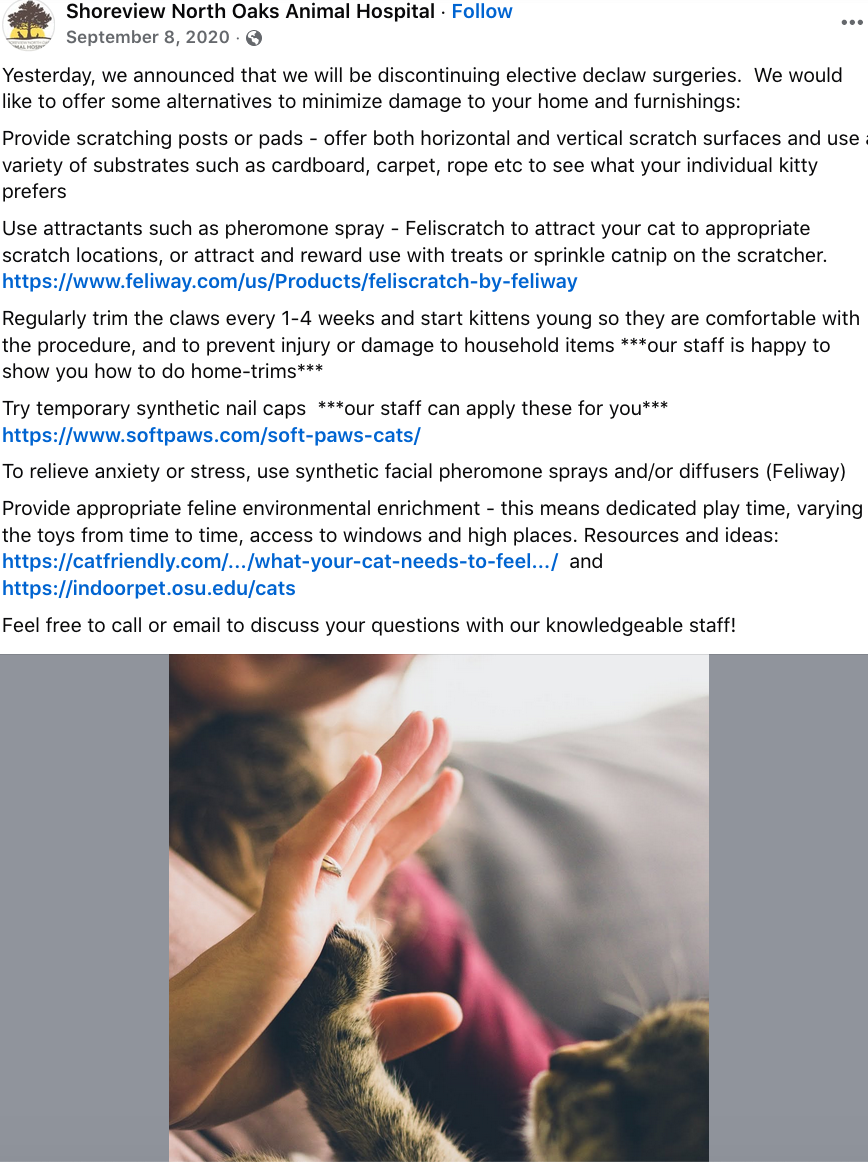
This animal hospital announced in a Facebook post that they were discontinuing elective declawing in September 2020.
We reached out to them to ask if that means that they won’t declaw cats at all unless it’s for a medical reason for the cat or will they still be offering declawing if the cat owner has a medical issue like diabetes, thin skin, immune-compromised issues, etc but never received a response.
6) Grand Avenue veterinary center. St Paul.
MVMA Director and Past President, Dr. Ann Brownlee owned this clinic but sold it to Dr. Heather Taylor and Dr. Jen Seidl took ownership as co-owners. The employee said that they don’t declaw and said it’s illegal. Researcher asked why it’s illegal and they said that it causes a lot of trauma to the cat, it’s an amputation, it causes a lot of issues later in life, and it’s inhumane.
Dr Brownlee said this in a March 2026 Minn Post news story, ““It’s kind of falling off on its own,” Ann Brownlee, a veterinarian and chair of the group’s governmental affairs committee, said in an interview. “Our profession doesn’t really want to have interference, governmental or legislative, in what we do. We believe that we have the knowledge and background to make the appropriate decisions for the animals that we work with and our clients.”
7) Pet Central Animal Hospital. Minneapolis, MN
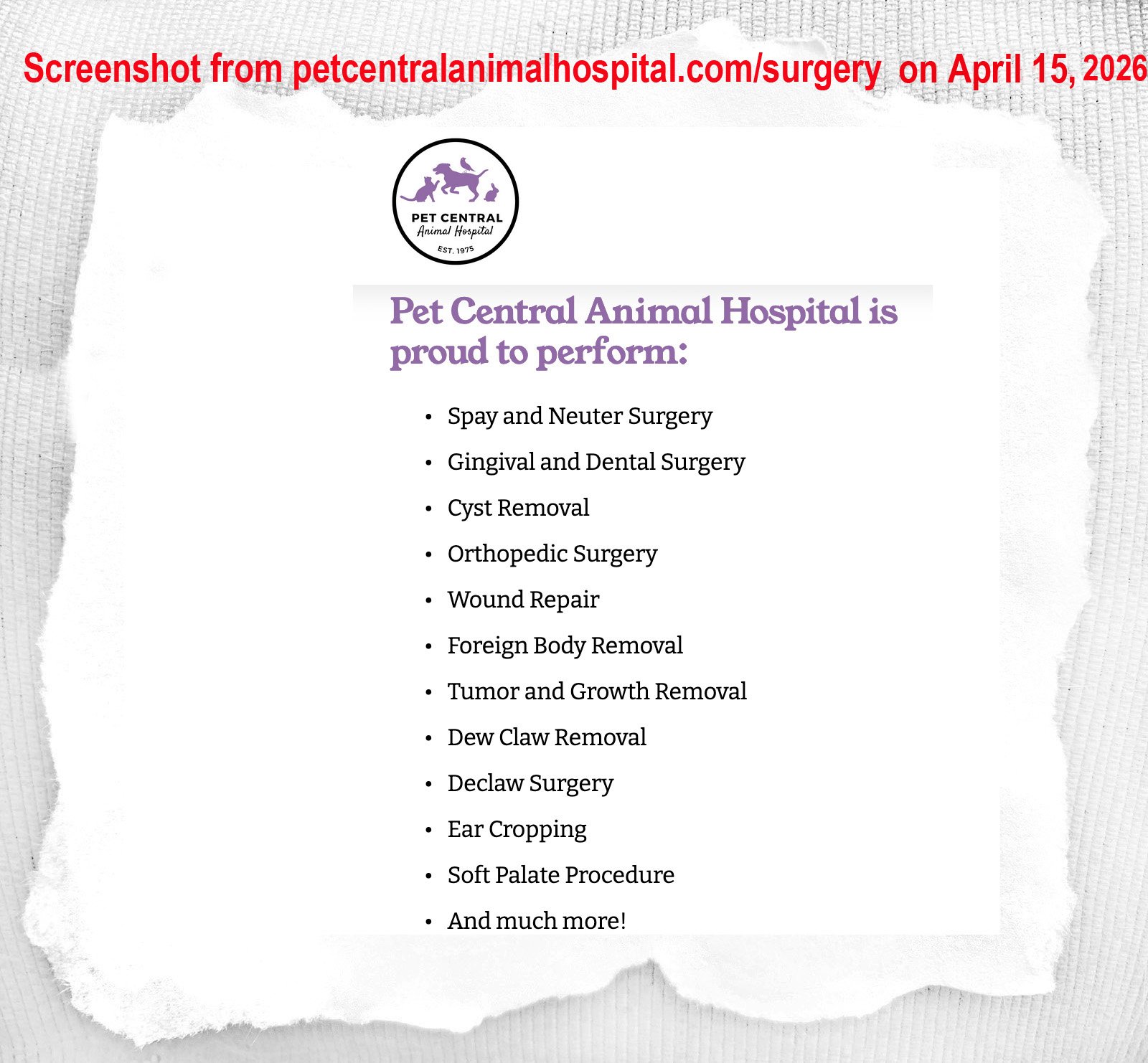
Pet Central’s PROUD TO PERFORM page- https://www.petcentralanimalhospital.com/surgery
The employee said Dr Hilary Faas, their Medical Director, performs their declaws. The employee said that their declaws are not cheap. A spay/declaw is $1300 and a neuter/declaw is $1200.
They have eight vets listed on their website. https://www.petcentralanimalhospital.com/about-us
The researcher asked if the cats are ok long term after a declaw and the employee said yes, they are fine.
Researcher asked if they do them regularly and the employee said that they don’t see a lot of them but they do them and said not a lot of people want to declaw their cats.
Researcher asked if it’s bad for a cat. The employee said, “It can be.” They said that a declaw is removing their fingernails permanently so it’s going to be painful when it’s first done.
Animals, Inc. Veterinary. 5 veterinary clinics and they are all Vetcor clinics.
8) Watkins Vet Clinic. (Animalsincvet.com vet clinic)
The employee said that they only do the front paws and a neuter/declaw is $550-$675. Employee said they have a couple vets who will do the declaw and said, “We don’t do a lot of them just because it is becoming more and more illegal in Minnesota” and said there’s a certain age limit that you can do it.
The employee said that they only have one vet who does their declaws, Dr Daniel Milender. They have 10 vets listed on their website. https://animalsincvet.com/veterinarians
They said Dr Angie at their sister clinic, Lifelong Veterinary Clinic does declaws with a laser.
9) Kimball Vet Clinic. (Animalsincvet.com vet clinic)
The employee said they “only do fronts” and said the cat can’t be more than 1 year of age and has to be less than 10 lbs. A neuter/declaw is $630. They said they have several doctors that can perform a declaw.
Researcher asked if the cats are ok long term and the employee said, “Yea, we don’t like to do it ”, said it’s like amputating our fingers off at the first joint, and said the cats usually resort to biting.
They said if the cat is going to be indoor only “we would do declawing” but then said “but we do not recommend it” and said the cats have early onset arthritis and other behavioral issues.
Researcher asked if they use a laser and they said they don’t but said their sister clinic, Lifelong Vet Clinic, uses a laser. Researcher asked if the laser is better for a declaw and the employee said it depends and it can be easier, but in the long run, the post op, behavioral issues and the other issues are still the same.
10) Litchfield Vet Clinic. Litchfield, MN. (Animalsincvet.com vet clinic)
Researcher asked for the cost of a neuter/declaw for a 5 month old cat and the employee said that a neuter/declaw is $505 plus $40-$50 for pain meds and said they only do the front. They said that Dr Dan and Dr Miranda can do their declaws. They have 10 vets listed on their website. https://animalsincvet.com/veterinarians
Researcher asked if the cats are ok long term and the employee said, “Yea” and asked if it’s for a 5 month old.
Researcher asked if they perform declawing regularly and the employee said yes.
Researcher asked if they perform 4 paw declaws and the employee said they aren’t sure if any place does 4 paw declaws anymore and most places will only do the front declaws.
They said a lot of places do not perform any declaw procedure and researcher asked why and the employee said and soon a lot of places won’t do declaws anymore because it’s “kind of inhumane.” They mentioned learning how to trim the cat’s nails and use nail caps.
11) Lifelong Vet Clinic. Hutchinson, MN . (Animalsincvet.com vet clinic)
Facebook post where cat owners in MN recommended Lifelong vet clinic for a declaw.
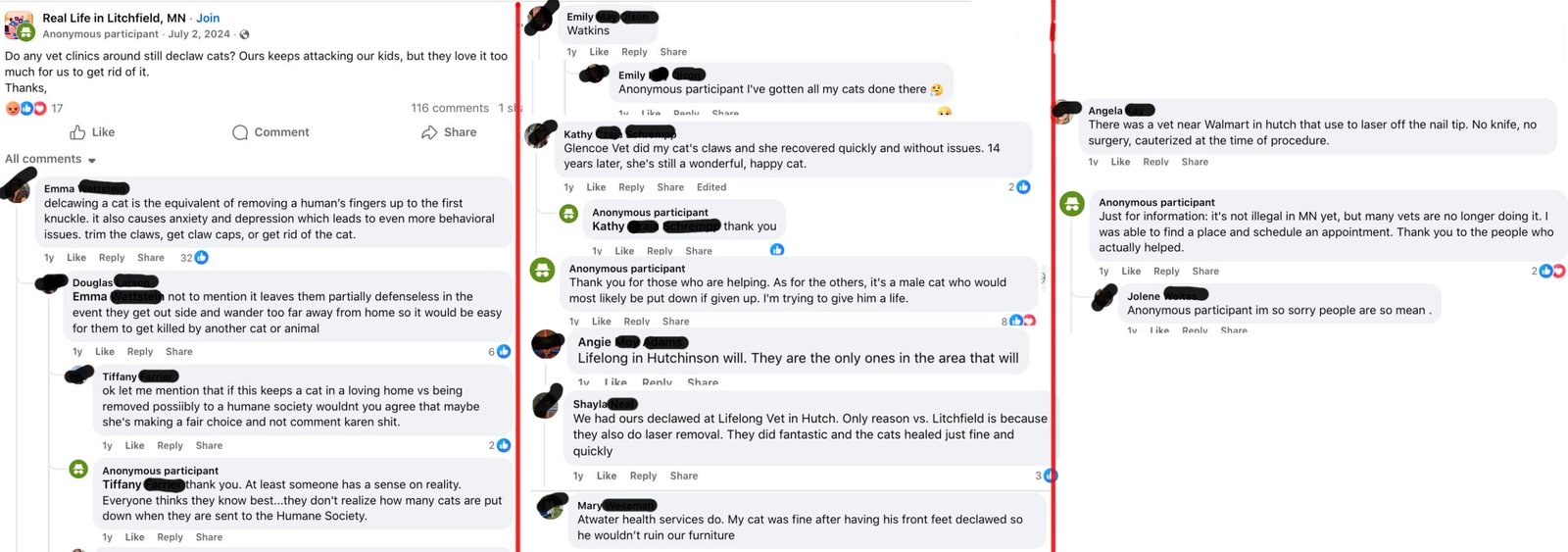
The employee said that a neuter/front declaw is around $608 with pain meds and Dr Angela Gearey does their declaws. They have 10 vets listed on their website. https://animalsincvet.com/veterinarians
Researcher asked if they use a laser and the employee said yes. Researcher asked if the cats are ok long term after the declaw and the employee said, “Oh yes, absolutely, absolutely, yes.”
The employee said the cats tend to do very well and said, “That laser is much less invasive.”
Researcher asked if Dr Gearey does declaws regularly and the employee said, “She does, yes, absolutely.”
The employee said that they don’t do very many 4 paw declaws but a neuter/4 paw declaw is around $700. They said they typically try to leave the back claws for grooming or if they get out for defense and typically do the 4 paws for a medical reason.
12) Maple Lake Veterinary Clinic. Maple Lake, MN. (Animalsincvet.com vet clinic)
We sent Maple Lake vet clinic an email asking them if they declaw cats but didn’t hear back.
Litchfield Vet Clinic said their sister clinic, Maple Lake Veterinary clinic declaws cats but said they don’t use a laser. Watkins Veterinary Clinic said that their sister clinic, Maple Lake Veterinary Clinic performs declaws but said they don’t use a laser.
—————————————-
13) North Mankato Animal Hospital.North Mankato, MN
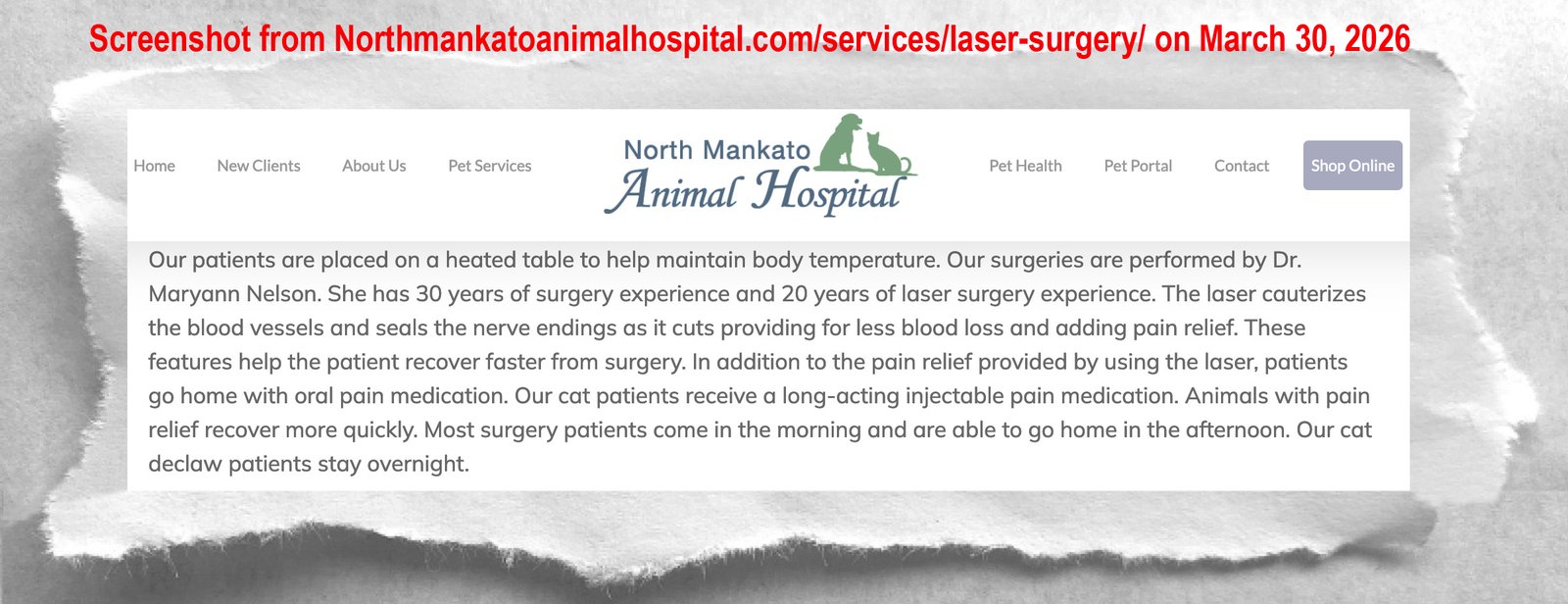
Link to this https://northmankatoanimalhospital.com/services/laser-surgery
They said that a neuter/declaw is around $720. They said that Dr Nelson, their owner, performs their declaws. https://northmankatoanimalhospital.com/meet-our-team/
Researcher asked if a declaw is ok for a cat long term and the employee said Dr Nelson has her cats declawed and they seem to be doing ok.
They employee said they use the laser that cauterizes blood vessels and nerve endings and there’s less pain and less bleeding, they only do the front paws, they have therapy laser sessions to “jump start the healing” and decrease inflammation, and give pain meds.
Researcher asked if she does declaws regularly and the employee said, “She sure does.”
They said Dr Nelson wants the cat to be a year old or less and less than 10 lbs for a declaw.
14) Kelley Animal Hospital. Lexington, MN. This is a Vetcor clinic.
They said that a neuter/declaw is $900. They said they only do the front claws and for cats under 6 months old. They said they only have one vet who performs their declaws, Dr Debbie and said they will only do a declaw for established patients. They have 6 vets listed on their website. https://kelleyanimalhospital.com/veterinarians
Researcher asked if the cats are ok long term and the employee said, “We wouldn’t do it any older than 6 months and it depends on that” and said there are some other recommendations they can send to you.
Researcher asked why don’t the other vets perform declaws and the employee said it’s something that’s being phased out and it’s not a routine procedure anymore.
15)Valley Veterinary Clinic. (Browns Valley, MN)
Their website says, “High-quality animal care” and “We provide safe and effective cat declaw surgery, or onychechtomy as an option for your pet. Throughout your pet’s surgery and during their recovery, our goal is to keep your pet as comfortable as possible, while ensuring a secure and positive outcome. Our veterinary doctors perform cat declaw surgery by surgically removing all of the nail and nail bed.”
There’s no mention that declawing is the amputation of the last toe bone and claw.
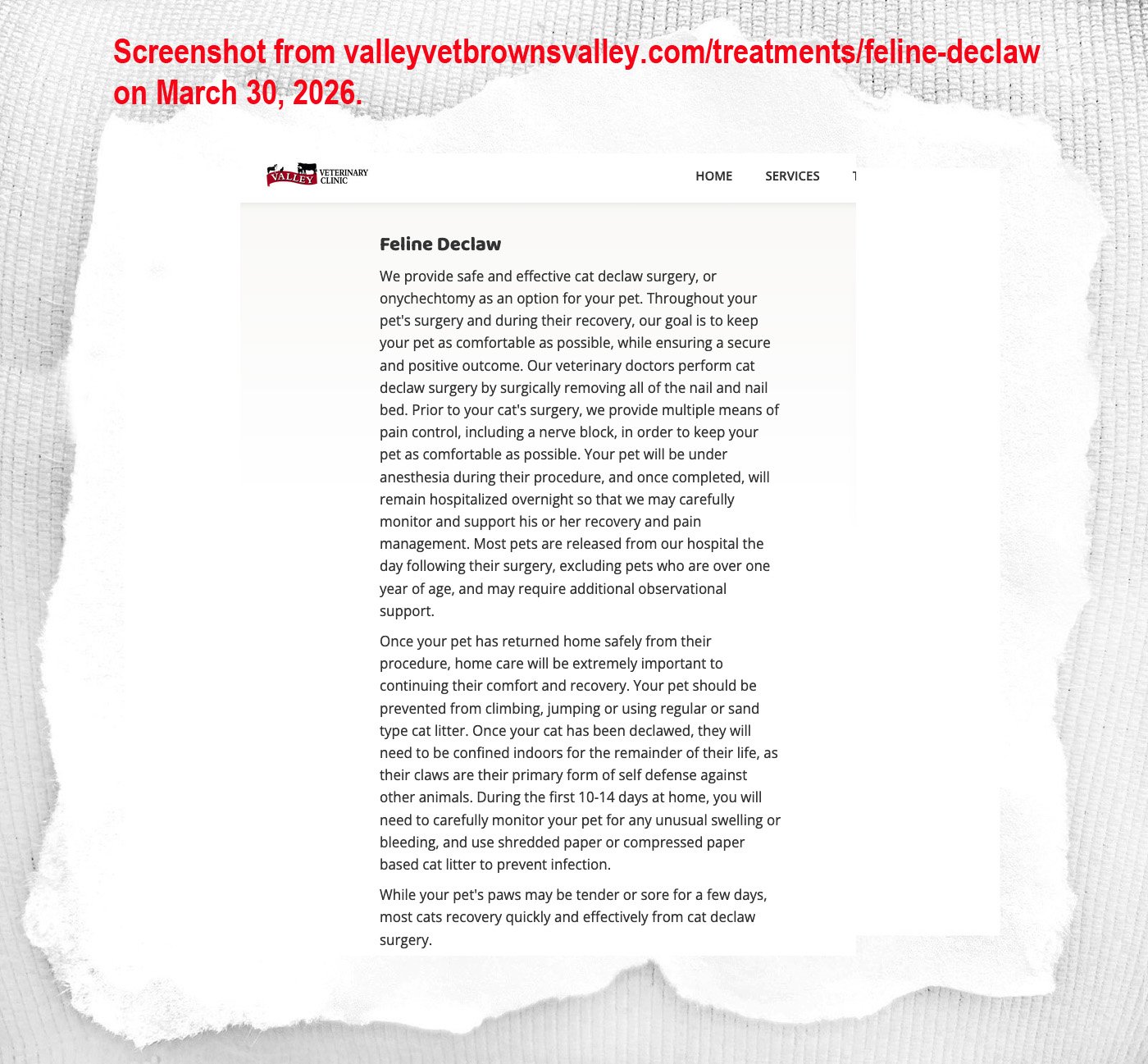
Link to this declawing info. https://www.valleyvetbrownsvalley.com/treatments/feline-declaw
Researcher asked for the cost of a neuter/declaw. The employee said, “We only do the front paw declaws.” They said that a neuter/declaw is $240- $300. They said Dr Paula Heinje does their declaws. (They only have one vet listed on their website.)
Researcher asked if the cats are ok long term after a declaw and the employee said yes. Researcher asked if she does them regularly and the employee said yes, they have them come in “every now and then.”
16) Lake Region Small Animal Center. Elbow Lake, MN.
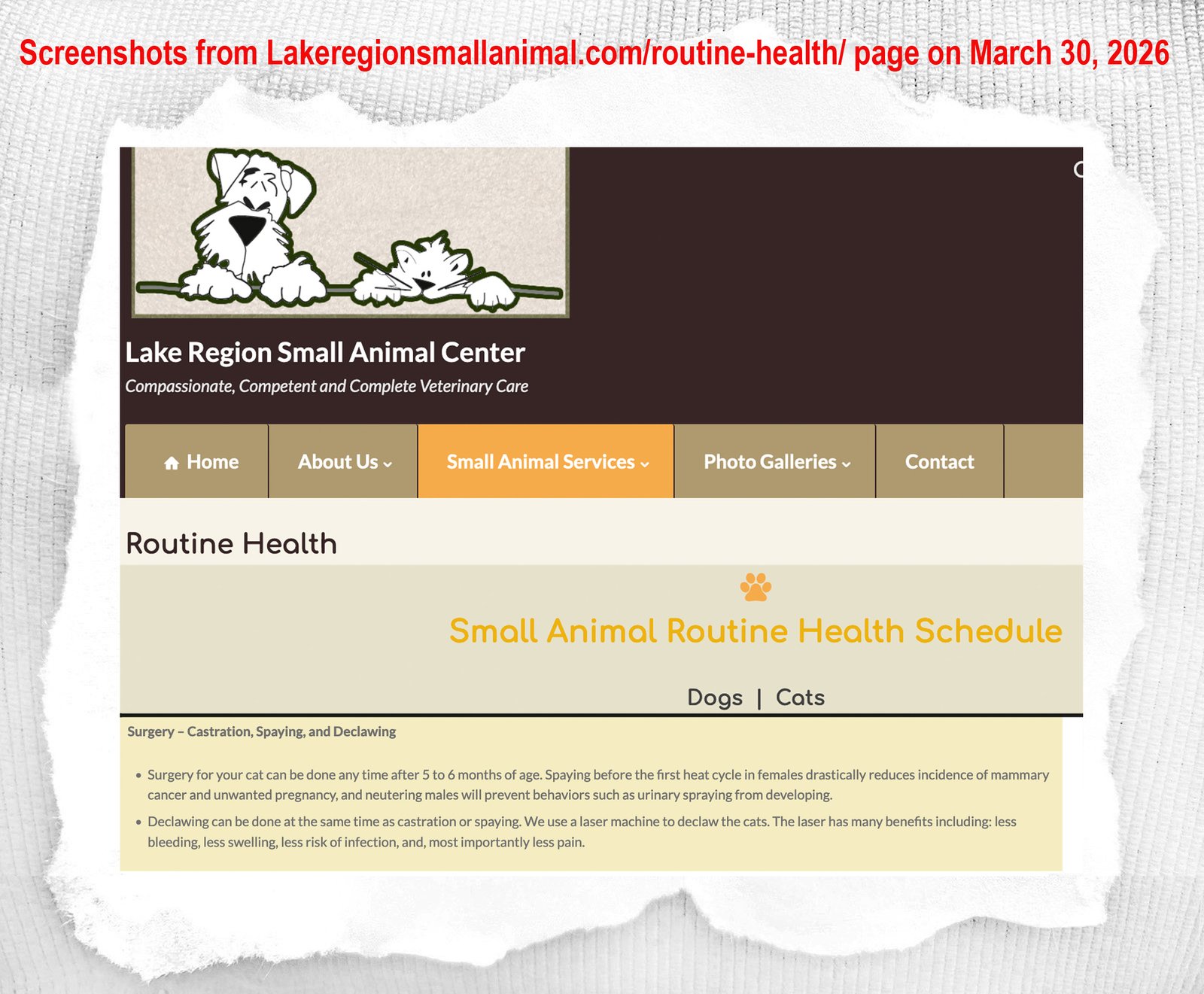
Link to Lake Region’s Routine Health/Declawing page- https://lakeregionsmallanimal.com/routine-health/
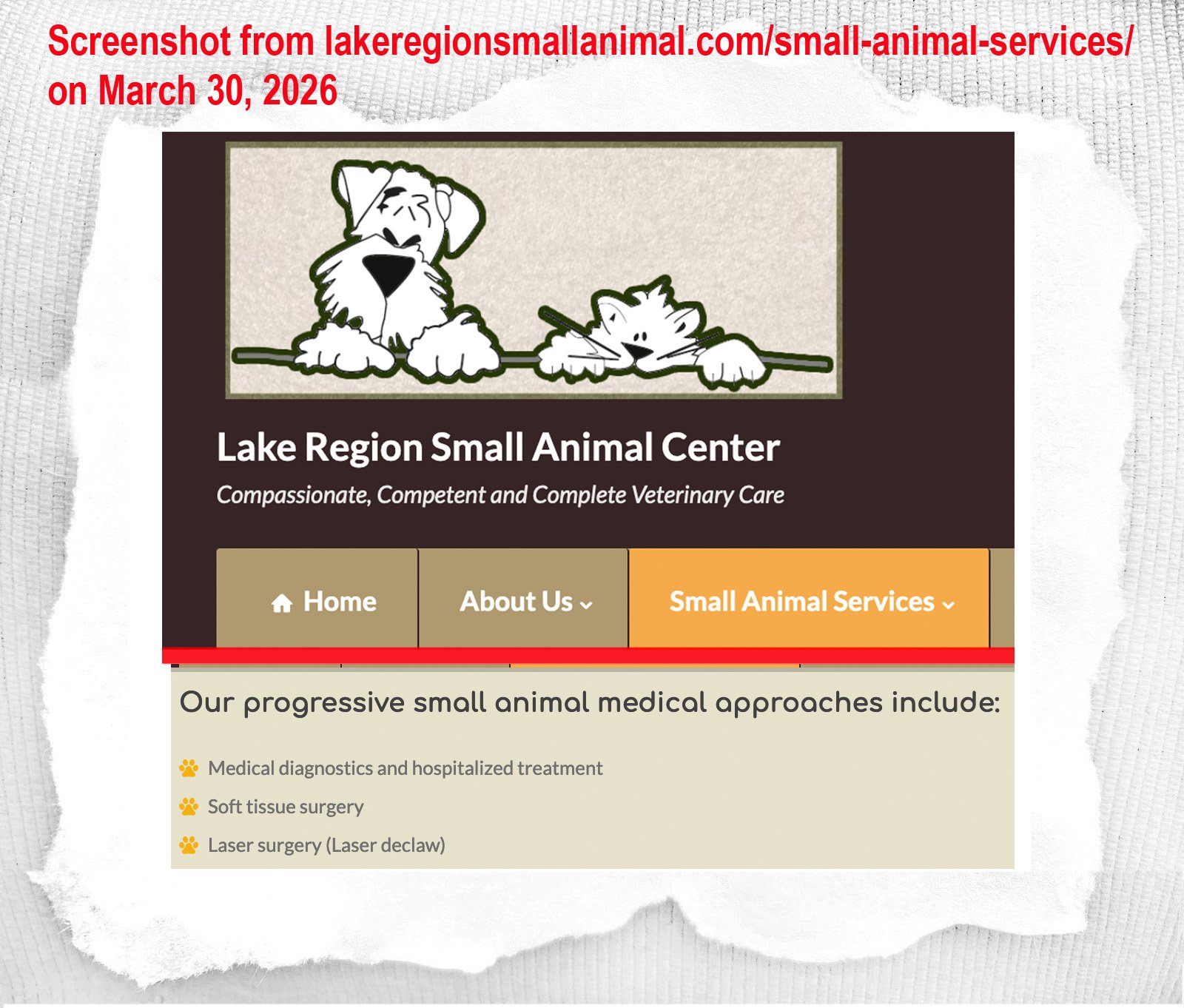
Link to Lake Region’s declawing page-https://lakeregionsmallanimal.com/small-animal-services/
Researcher asked for the cost of a neuter/declaw and the employee gave the cost of a neuter and said, “and declaw, we only do fronts” and said it’s $220 for the neuter/declaw.
They said that Dr Rachel does their declaws. They have 3 vets listed on their website.
The researcher asked if the cats are ok long term after a declaw and the employee said, “That just kind of depends,” and said they won’t declaw after a certain weight and age, the cats are more likely to have issues if they are older, and they have to be under 12 lbs.
Researcher asked if they use a laser for the declaw and if that’s better and the employee said, “Yes laser is better, there’s less pain and inflammation.”
Researcher asked if they perform declaws regularly and the employee said, “Yes.”
17) St. Charles Veterinary Clinic. St Charles, MN
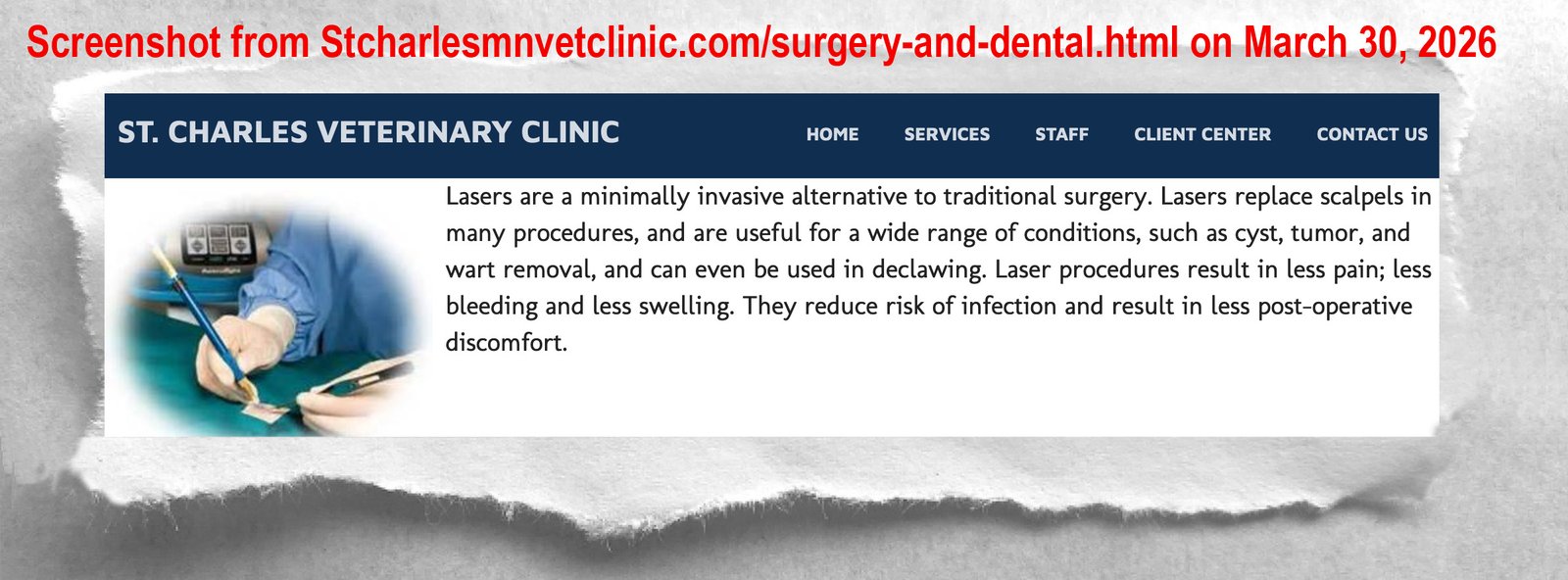
Link to St. Charles Veterinary Clinic’s declawing info –https://www.stcharlesmnvetclinic.com/surgery-and-dental.html
Researcher asked for the cost of a neuter/declaw and the employee said that a neuter is around $300 and a “front feet declaw” is an additional $115 if you are doing it at the same time as a neuter. A neuter/declaw around $450.
Researcher asked what doctor performs their declawing and the employee asked the researcher if they live in the area and then the employee hung up the phone.
18) Granite City Pet Hospital (St. Cloud, MN)
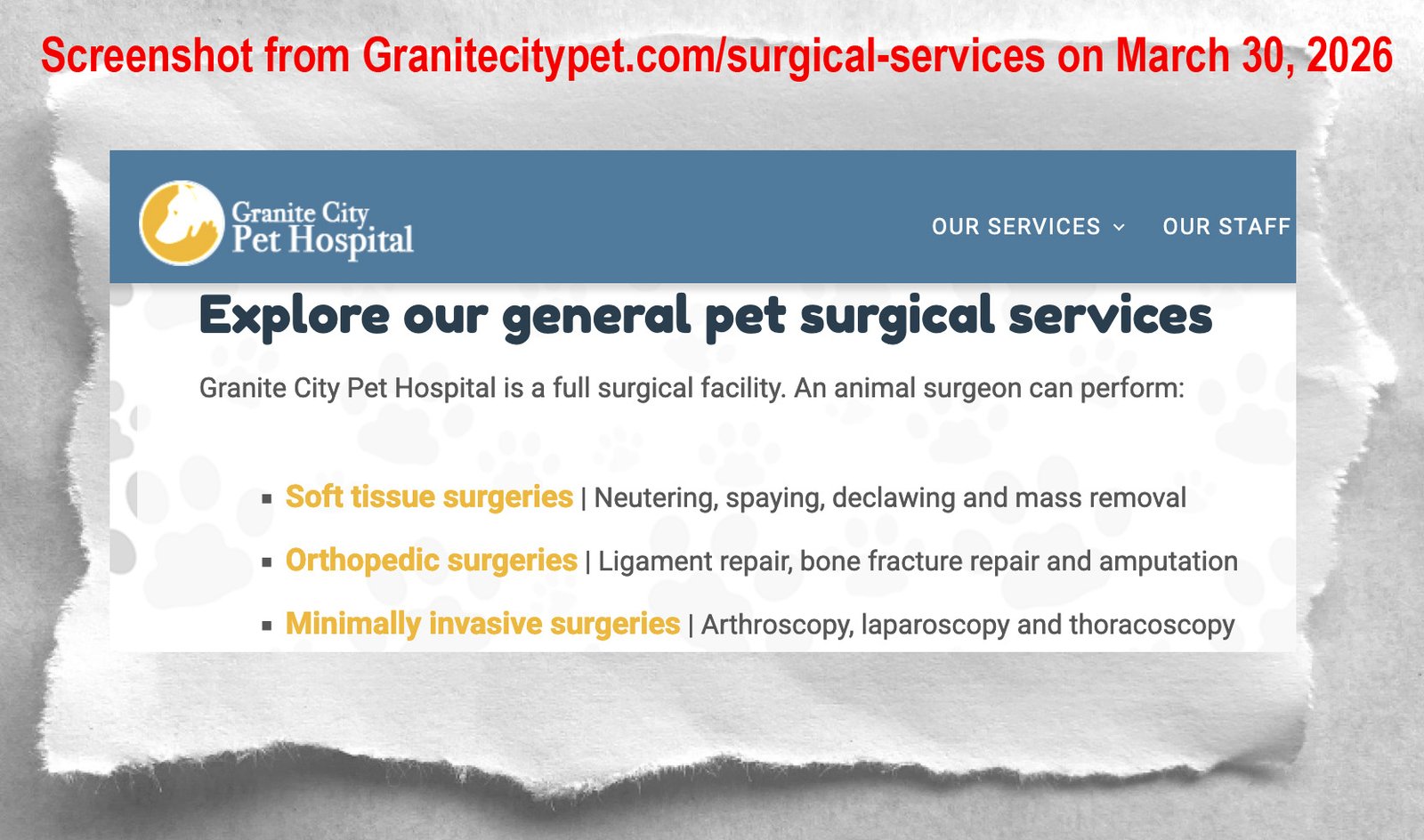
Link to their declawing info- https://granitecitypet.com/surgical-services
Their website says, “Keep your pet happy and healthy.”
The employee said that a neuter/declaw is from $700.13- $740.
They said that they only do the front declaws and Dr Nelson is the one who does them.
Researcher asked if he does declaws regularly and the employee said, “So it is a pretty regular surgery” and said it is often done with a neuter or spay.
The researcher asked if the cats are ok long term after a declaw and the employee said they have had plenty of cats declawed there and they’ve never heard of complications.
19) Lake Animal Hospital. White Bear Lake, MN
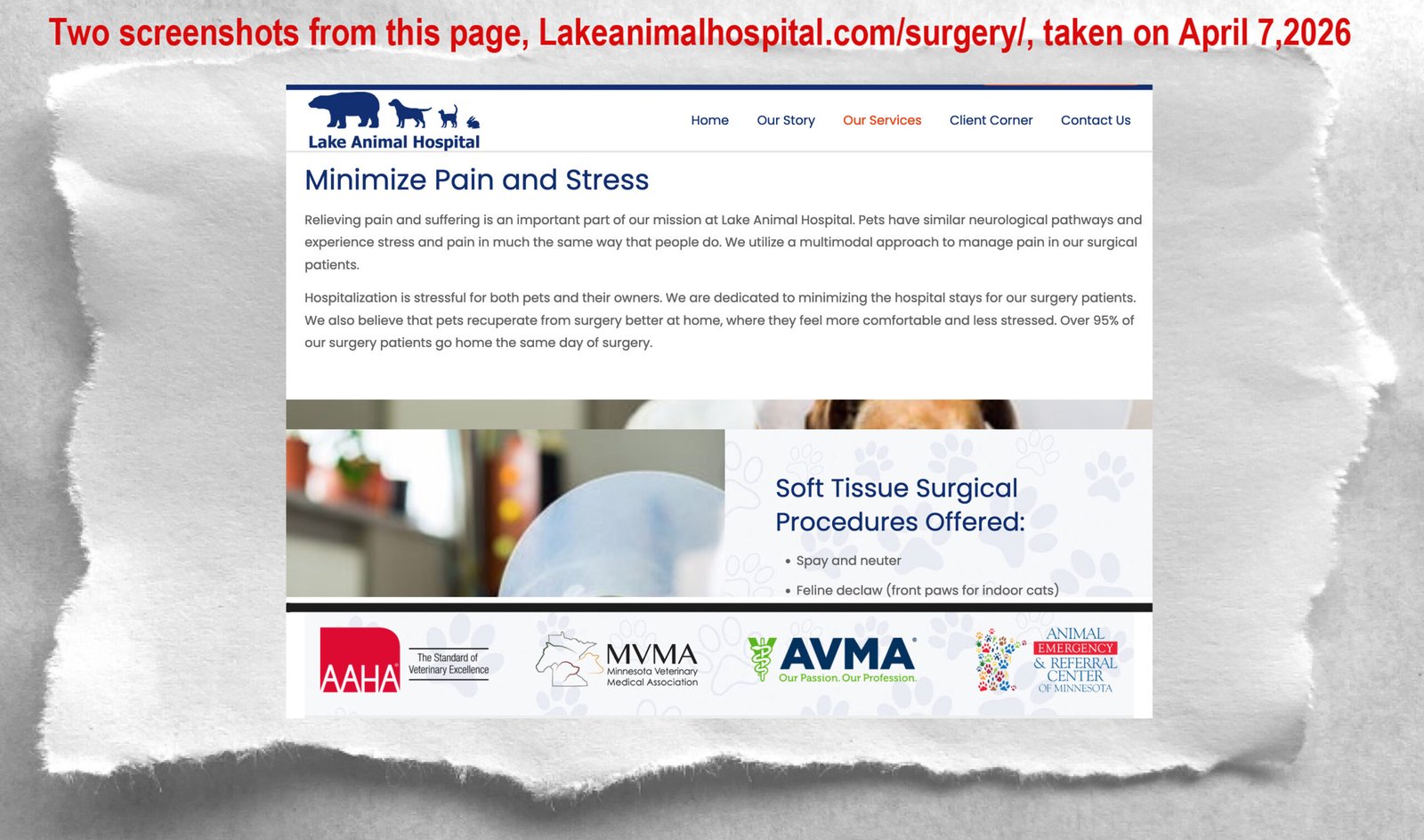
This is an AAHA Accredited Animal Hospital. They also have the MVMA and AVMA logo on their website.
Their website says things like, “At Lake Animal Hospital, we work hard to create an environment filled with hope and healing for you and your pet” and “Our Medicine, Our goal is to help pets live longer, happier, and healthier lives” and “We are an American Animal Hospital Association (AAHA) accredited clinic, and our team has made a commitment to adhere to the highest standards of veterinary care.”
Researcher asked for the cost of a neuter/declaw and the employee said, “For declaws, we have a package for that” and said the cat would stay there for two nights. A neuter/ two paw declaw is around $590.
The employee said that Dr Bosman does their declaws. They have 8 veterinarians listed on their website and Dr Ally Bosman is listed as their Medical Director. https://lakeanimalhospital.com/veterinarians/
Researcher asked how Dr Bosman does her declaws and the employee asked her and said, “She uses a technique with a tool called a Rescoe” and said it’s comparable to a clipper. (This is the old school and most inhumane and mutilating method.
Researcher asked of those cats seem to be ok long term after the declaws and the employee said, “We have a lot of patients here that have gotten the procedure done” and said they seem to be doing fine.
Researcher asked if she does declaws fairly often and if the cats seem to be ok and the employee said, “She does and yes.”
They said they don’t do the 4 paw declaws and researcher asked why and the employee said that cats need to be able to scratch themselves and it helps with balance.
(A cat’s front paws bear about 60% of a cat’s body weight during normal standing and walking. Front paws are primary for stability, direction control, braking, and fine balance during walking, landing from jumps, and everyday movement. Back paws provide power and propulsion but also assist with overall stability, especially during high-speed movement, jumping, or turning. Because cats carry more of their weight on those front paws and rely on them heavily for balance and grip, amputating their toe bones, claws, and associated structures can affect how they walk, jump, land, and maintain stability long-term. Many cats compensate by shifting weight or altering gait, which can lead to joint stress or behavioral changes.)
20) Dawson Veterinary Clinic. Dawson, MN
Their mission on their website says, “Our goal is to partner with you to ensure that your pet has as many happy, healthy years as possible, and we are proud to offer high-quality medical, dental, and surgical care for dogs and cats.” and say they are dedicated to providing high-quality veterinary care and their commitment to excellence sets them apart.
The employee said that a neuter/declaw is around $400 and they do not do the back paws. They have two vets who do their declaws, Dr Mariah and Dr Rachel. They have 3 veterinarians listed on their website.
The researcher asked if the cats are ok long term after a declaw and the employee said, “Yea, but it is a very invasive procedure” and said they really try to discourage people from doing it because it is pretty hard on the cat and the cat can never be outside. They said sometimes it can be a “preference thing” and some places are trying to steer away from away from it completely.
Researcher asked if they perform declaws regularly and the employee said, “We do a fair amount of them, yea.”
21) Rainy River Veterinary Hospital. International Falls, MN
The employee said they no longer declaw cats. They said that the laser they have there isn’t ideal for a declaw. Researcher asked if a declaw is bad for a cat and the employee said, “Not necessarily” and repeated that the laser they have isn’t the correct type for a declaw.
22) St Francis Animal Hospital. Roseville, MN
They said they do not declaw cats. Researcher asked why and the employee said because it causes a lot of health issues and ends up being very painful.
23) Morris Veterinary Center PSC.
They have a laser surgery section on their website that says, “What Type of Procedures Can a Laser Perform?
The most widely recognized procedure among pet owners is the feline laser declaw. Additional procedures include but are not limited to spays, neuters, the removal of cysts, tumors and warts, as well as specialized internal procedures.”
Link: https://morrisvetcenter.com/companion-animal/surgery/laser.html
We reached out to this clinic on their website’s contact form to ask them if they declaw cats but have not received a reply.
24) Southdale Pet Hospital. Edina, MN
They do not declaw. Researcher asked why and the employee said because it’s an invasive procedure and they see a lot of negative consequences after they are declawed.
25) Cannon Valley Veterinary Clinic (Northfield, MN)
They do not declaw. Researcher asked why and the employee said because it’s hard on a cat and their doctors aren’t doing them anymore. They said it’s removing the first knuckle, it’s pretty painful, some cats don’t bounce back after it and they stopped performing them at the beginning of this year.
26) Iron Range Veterinary Clinic. Aitkin, MN
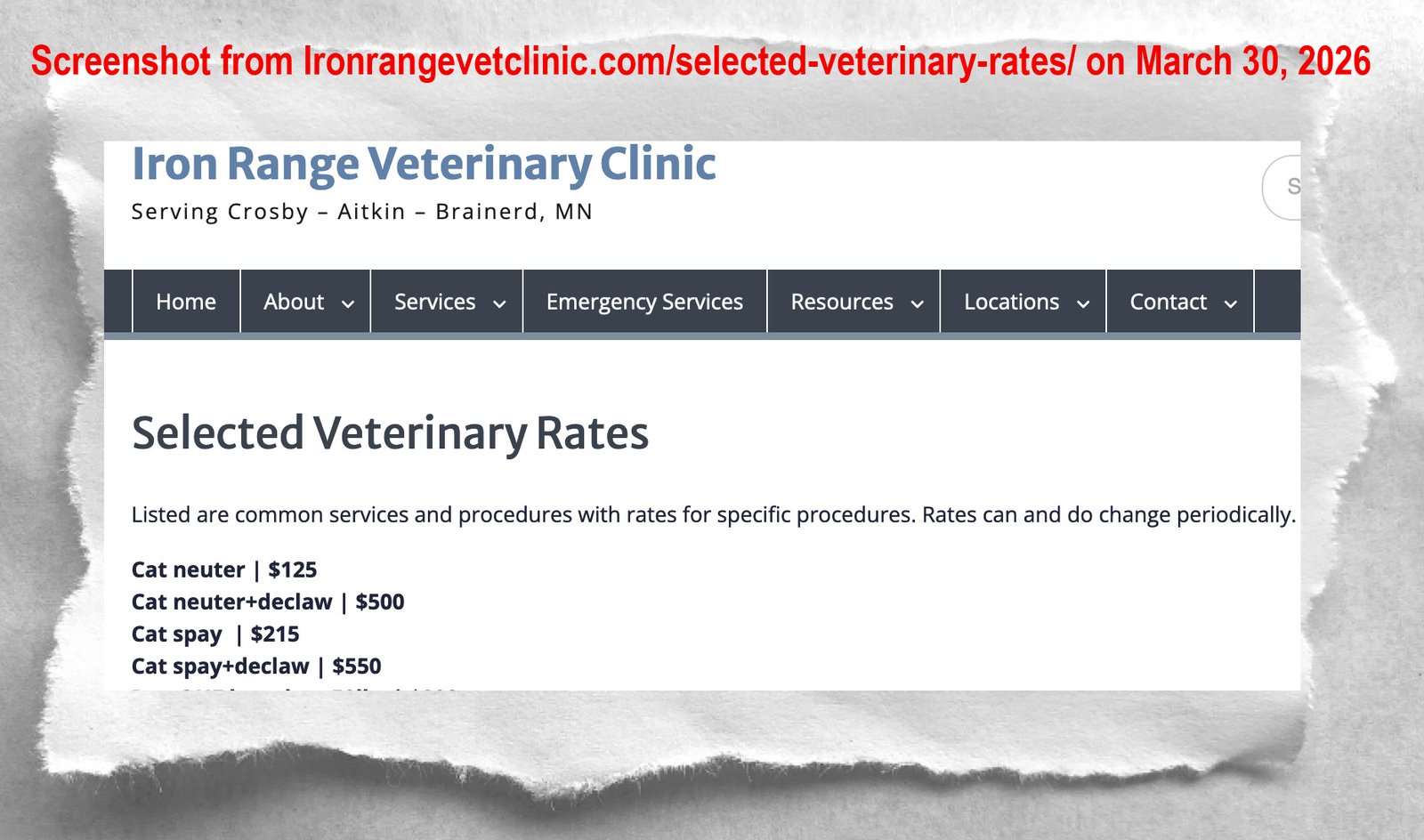
Link to Iron Range Veterinary Clinics declawing rates- https://ironrangevetclinic.com/selected-veterinary-rates/
The employee said that a neuter/declaw is $530 and said they have 3 vets who can do the declaw, Dr Stahl , Dr Skubal, and Dr Peterson. They have 4 vets listed on their website. https://ironrangevetclinic.com/about/
The researcher asked if the cats are ok long term after a declaw and the employee said, “Yes.”
27) Summers Ridge Veterinary Clinic. Janesville, MN.
This is a Heartland Veterinary Partners clinic.
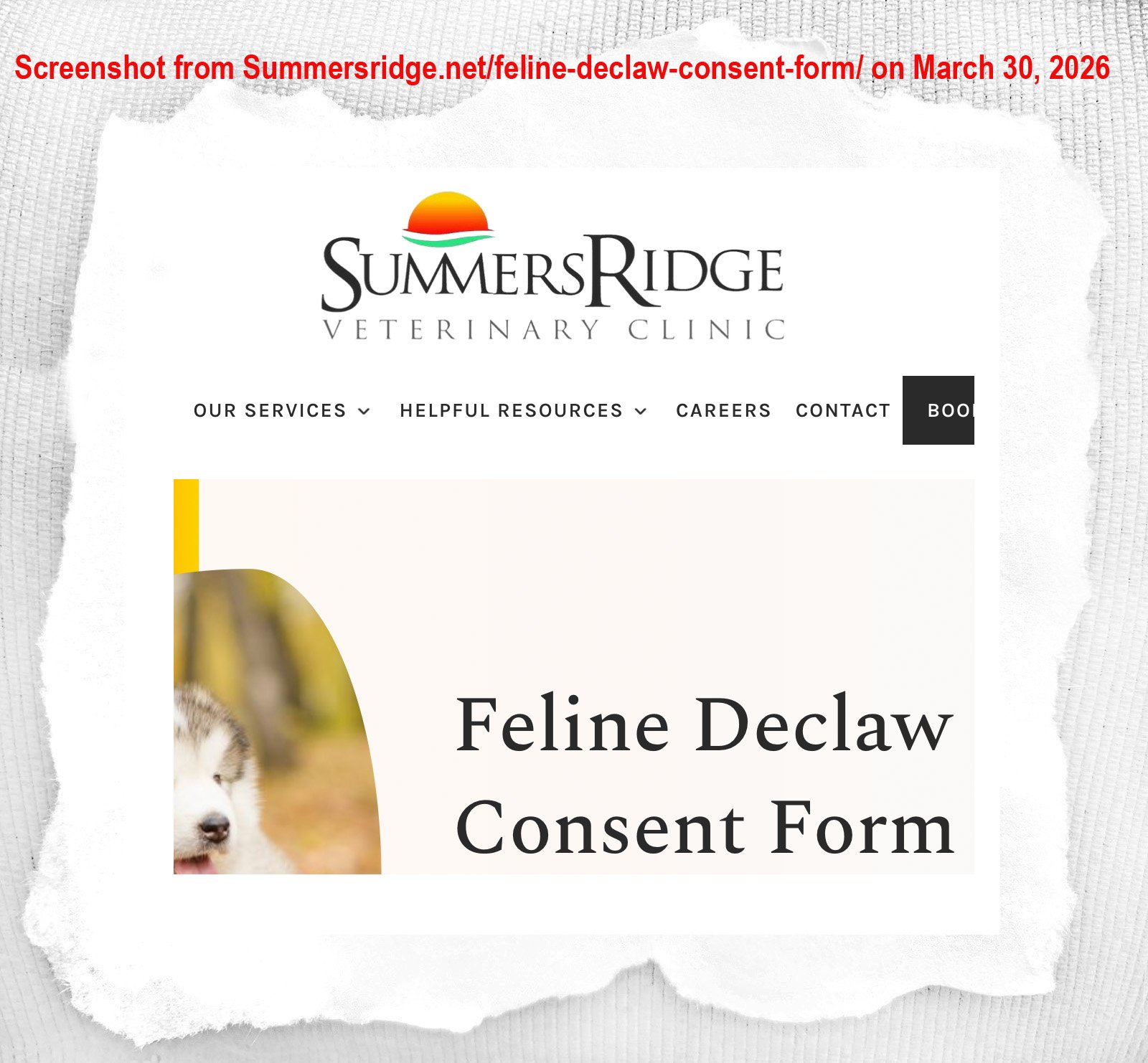
Link to Summers Ridge Veterinary Clinic’s “Feline Declaw Consent Form.” https://summersridge.net/feline-declaw-consent-form/
The researcher asked for the cost of a neuter and the cost of a declaw and the employee said, “We typically do them at the same time as a neuter” and said it’s around $443 for the neuter and declaw. The employee said that Dr Adam does their declaws. (They have 5 vets listed on their website. https://summersridge.net/veterinarian-janesville-mn/ )
Researcher asked if she does declaws regularly and the employee said yes.
Researcher asked if a declaw is ok for a cat long term and the employee said, “It depends on the cat” and said some of them do really well with it and normally the younger you do it the better they are.
They use a tool called a Bovie and said “it cauterizes as we cut.”
28) Pierz Veterinary Clinic (Pierz, MN)
Discusses declawing under cat services: “With a focus on education and compassionate cat care, we can help you decide whether declawing is the right option…” https://www.pierzvetclinic.com/services/cats
Researcher asked for the cost of a neuter/declaw and the employee asked, “Are you doing the neuter and declaw together?”
The employee said you can save money if you do them together and said they “only do the front paws.”
A neuter/declaw is $555.
They said that Dr James (AVMA and MVMA member) performs their declaws. They have two vets listed on their website. https://www.pierzvetclinic.com/about-us/staff/veterinarians
Researcher asked if he does declaws regularly and the employee said, “Yea we see quite a bit of them.”
The researcher asked if the cats are ok long term after a declaw and the employee said it depends and the cats can have issues but it depends on how they “react to the surgery and how they heal.”
29) Paws and Claws Pet Hospital. Maple Grove, MN.
They said that a neuter/declaw is $690 and said Dr Robert Melco is their vet who does them.
The researcher asked if the cats are ok long term after a declaw and the employee said there is definitely research that says they have problems later in life but said he uses laser and said it is supposed to be better than the way they did it with the roscoe and blade. They said it’s definitely a big procedure because they cut back to the 2nd knuckle and it’s an amputation.
Researcher asked if he does declaws regularly and the employee said, “Yes, on healthy, not overweight cats” and said they must be young, healthy, and at an appropriate weight.
30) Countryside Animal Hospital. Dundas, MN
The employee said that a neuter/front declaw is around $1100-$1400. They said two of their doctors can perform a declaw, Dr Treblehorn and Dr Wass and they use a laser. They have 3 vets listed on their website. https://www.countrysideanimalhospital.com/about-us/team/
The researcher asked if the cats are ok long term after a declaw and the employee said, “Yea we haven’t had really any problem with that.”
Researcher asked if they perform declaws pretty regularly and the employee said, “Yep, yep, we do.”
31) Andover Animal Hospital. Andover, MN
Their website says, “We put your pet’s health first” and “Andover Animal Hospital is a full-service veterinary hospital dedicated to providing the highest standard of care for your beloved pets.”
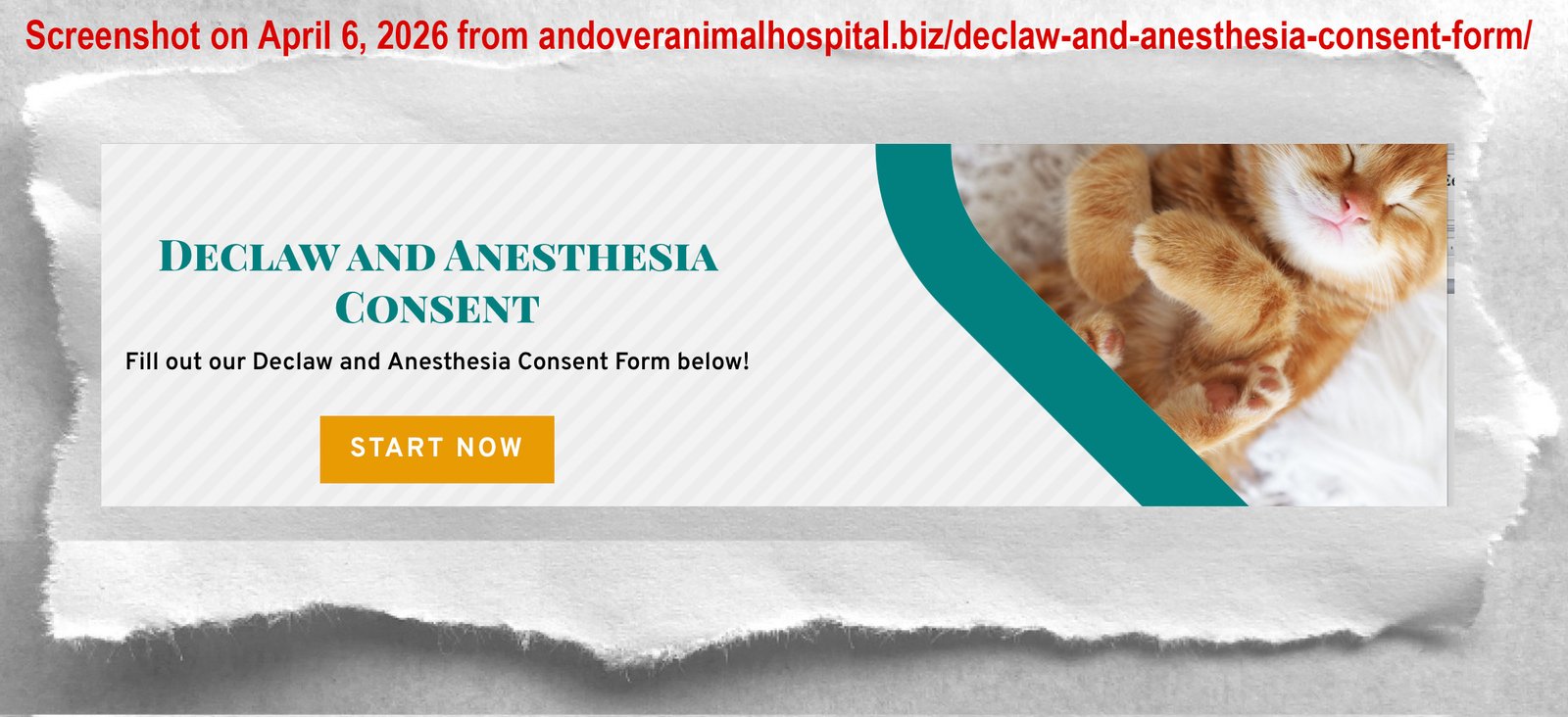
The employee said they only do the front claws and a neuter/declaw starts at $855.
They said that they only have one vet who does the declaws, Dr Christina Froemming. They have 9 vets listed on their website. https://andoveranimalhospital.biz/nw-andover-mn-veterinarians/
Researcher asked if he does declaws regularly and the employee said, “She does do them semi-regularly.”
The researcher asked if the cats are ok long term after a declaw and the employee said there are risks with a declaw, some cats have residual pain, they have to re-learn to walk because it’s amputating up to the first knuckle.
They said that Dr Froemming uses a laser which cauterizes the incisions and that helps with healing time. They said they only do the 4 paw declaws if it’s for the health of the cat.
32) Northland Animal Hospital (Virginia, MN)
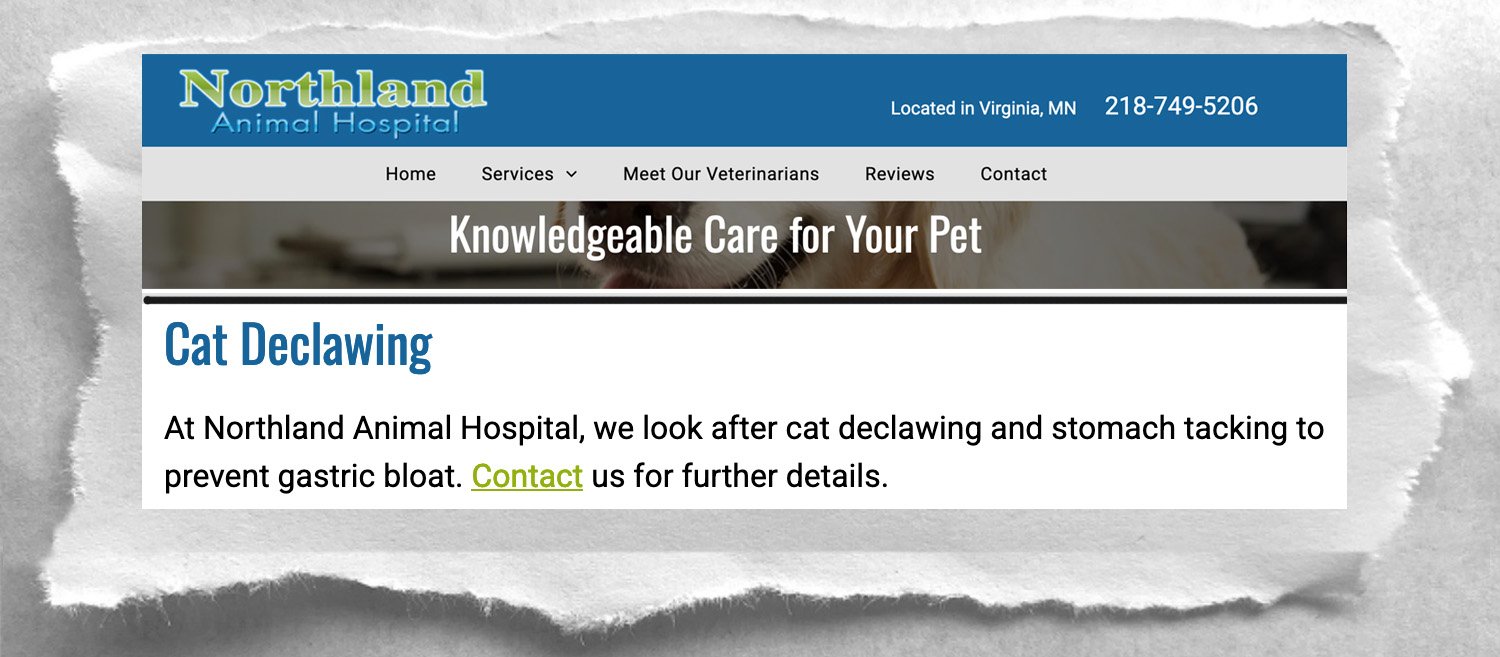
Link to “Cat Declawing” in their preventative surgeries section. http://www.northlandanimalhospitalvirginia.com/preventative-surgeries
Researcher asked for the cost of a neuter/declaw and the employee asked, “Just front two?”
A neuter/2 paw declaw is around $550 and a neuter/4 paw declaw is $700. They said all three of their vets can do a declaw.
Their website says, “Caring Professionals you can rely on.” http://www.northlandanimalhospitalvirginia.com/meet-our-veterinarians
The researcher asked if the cats are ok long term after a declaw and the employee said they can’t think of any that had immediate issues but said they can have arthritis in the paws.
Researcher asked if they declaws regularly and the employee said they don’t do them very often but they do them.
33) Skyline Veterinary Hospital (Fridley,MN)

Link to Skyline declawing page: https://skylineveterinary.com/about-2/
The employee said that a neuter/declaw is around $800-$900. They require lab work to be done first and said that they have two doctors who can do declaws. They only have two vets listed on their website. https://skylineveterinary.com/our-doctors/
The researcher asked if the cats are ok long term after a declaw and the employee said, “Ideally if you can get around declawing and just cut the claws” that’s what you want to do, but said if there are medical reasons for humans where scratching is going to be really dangerous, then yes you would want to declaw and said the cats “do ok.”
Researcher asked if they declaws regularly and the employee said, “Yea, they both have experience.”
34) Como Park Animal Hospital, St. Paul, MN.
This is an AAHA Accredited Animal Hospital.
We sent an email to this hospital on March 30th to ask them if they declaw cats and did not receive a reply.
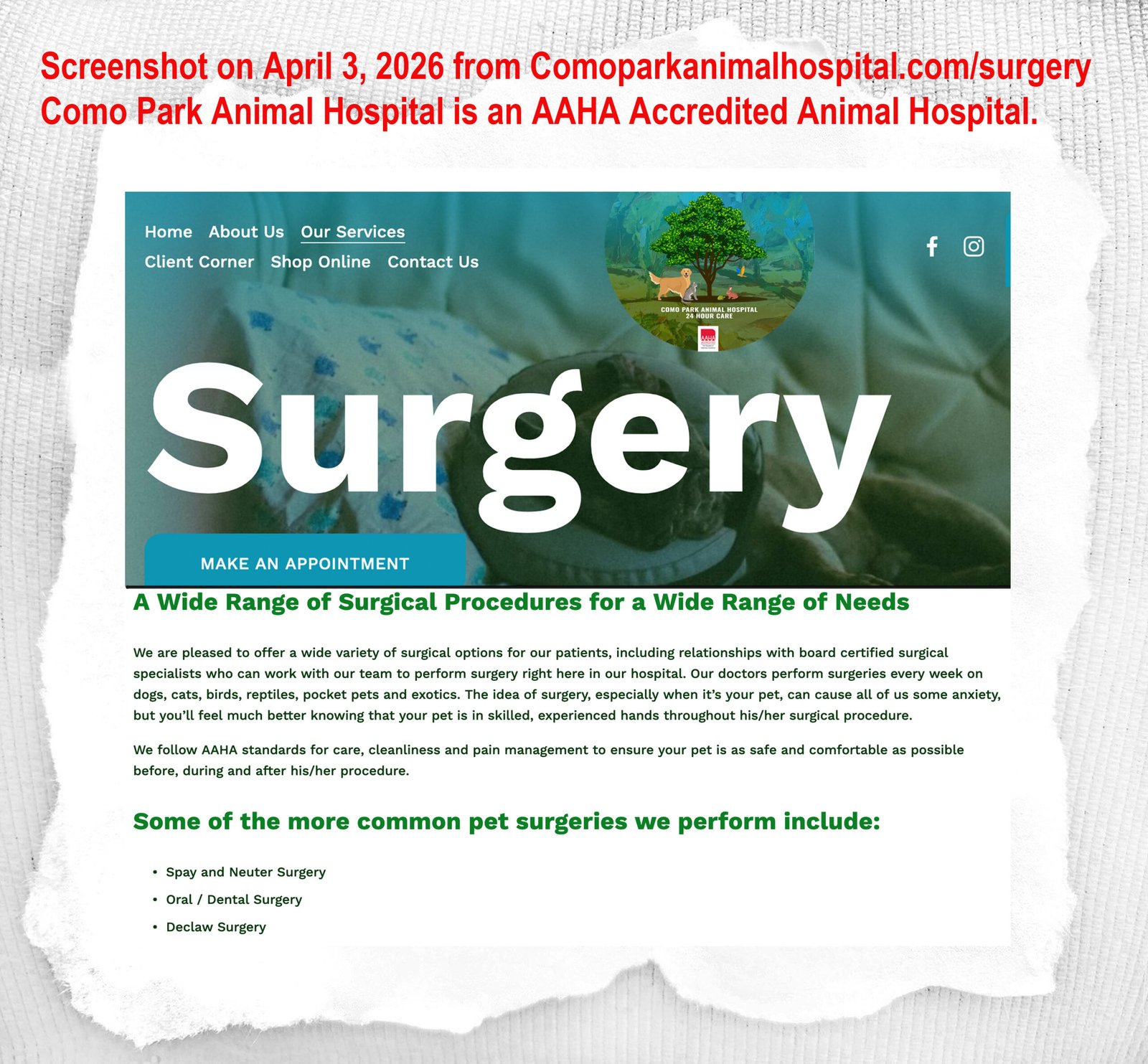
Link to Como Park’s declawing info- https://www.comoparkanimalhospital.com/surgery
The employee said that they do not declaw cats anymore because it will soon be illegal in MN. Researcher asked if a declaw is bad for a cat and the employee said yes, their nails kind of hold the structure of their foot and over time it goes all the way up to work on their shoulders and causes back aches and all that.
35) River Hills Pet Care Hospital. Mankato, MN
The employee said they do not declaw cats. Researcher asked why and they said because it’s inhumane.
We also sent this hospital an email and asked if they declaw cats and their response, “We are part of The Pet Vet Care Centers and have adopted their policy for declawing.”
36) Valley Animal Hospital. Thief River Falls, MN
The employee said that a neuter/declaw is $450. The employee said they do not perform four paw declaws anymore.
The employee said Dr Burnett does their declaws.
Researcher asked if they declaws pretty regularly and the employee said, “Yes, well, not too often but yes we can do them.”
The researcher asked if the cats are ok long term after a declaw and the employee said yes.
37) Animal Care Clinic Bemidji, MN
They do not declaw. Researcher asked why don’t they declaw and the employee said that most vets don’t do them anymore because it’s taking of their first digit from their front feet and it is kind of debilitating.
38) Detroit Lakes Animal Hospital. Detroit Lakes, MN
This animal hospital posted this on their Facebook page in 2022.
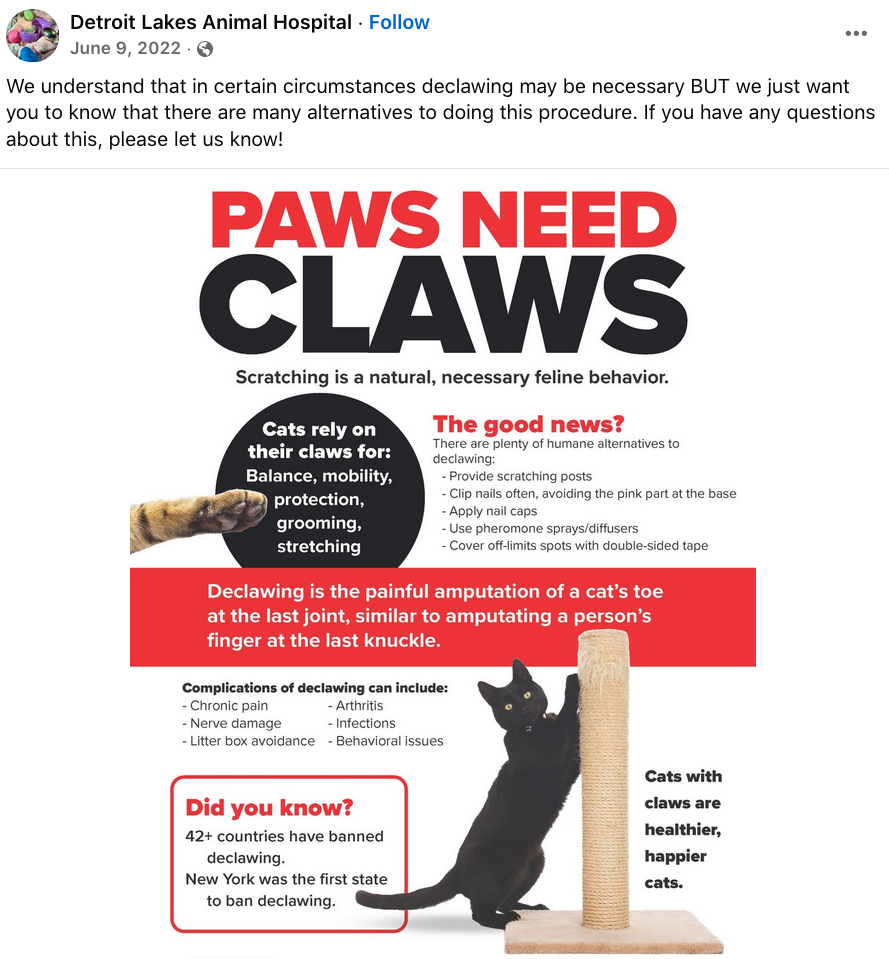
The employee said they don’t declaw. Researcher asked why they don’t declaw cats and the employee said a lot of places don’t and researcher asked if it’s bad for a cat and the employee said, “yes, it’s not good.”
We sent an email to them in April 2026 to ask if they declaw cats and what are the circumstances where they feel a declaw is necessary and this is what they said, “We no longer do declaws as we believe it’s inhumane. The only medical circumstance we may find declawing necessary would be a severe paw injury that our professional veterinary medical team based on thorough physical examination.”
39) Headwaters Veterinary Center. Bemidji, MN
The employee said that a neuter/declaw is around $400-$500. Researcher asked for the cost of a 4 paw declaw and the employee said that they don’t do the 4 paw declaws.
Researcher asked why they don’t do the 4 paw declaws and the employee said, “Because it’s very painful.”
The employee asked if researcher is a client and the researcher said no and then the phone line was disconnected.
40) Arrowhead Animal Clinic. Grand Rapids, MN
The employee said they do not declaw anymore because it’s considered inhumane.
41) North Country Veterinary Clinic. Grand Rapids, MN.
This is a National Veterinary Associates (NVA) clinic and NVA banned declawing in their clinics on Feb. 1, 2026.
The employee said they can’t give a quote for a declaw because they don’t always do them and it’s up to the doctor’s discretion and you need an exam first.
They said both their surgeons do declaws if they deem the cat is a good candidate and they have to check out the cat to see if they are healthy enough and then they will tell you if they will do the declaw. They have 3 vets listed on their website. https://www.northcountryveterinaryclinic.com/staff
They said typically they don’t do declaws anymore because it’s a very difficult surgery to recover from and it is considered inhumane in a lot of areas.
42) Crookston Pet Clinic. Crookston, MN
The employee said they don’t perform declaws and researcher asked why and the employee said it’s cutting off the first part of their toes, it’s causes arthritis and pain as they age, and there are other options.
43 )Town & Country Animal Clinic. Park Rapids, MN
The employee said that they do declaws on a case by case basis, it’s an amputation, and they will discuss nail trims.
44) Root River Vet Center. Preston, MN
They said that a neuter is from $150-$310 and a declaw is $150 and their vet Dr Froese does their declaws.
They said if they will do an exam first and as far as doing the declaw, it depends on the health of the cat, how big, and how old and said they only do declaws on young cats. The employee said if the cat is overweight or has other health issues, they won’t declaw them.
The researcher asked if the cats are ok long term after a declaw and the employee said they usually recommend behavior modification because sometimes declawed cats end up biting and it’s amputating the end of the finger and the bone is removed, and it can be painful especially if they are overweight. They said there are nail caps and you can trim their nails.
45) Riverside Animal Clinic. Crescent, MN
Researcher asked for the cost of a neuter/declaw and the employee said, “Let me look at my cheat sheet.” They said that a neuter/declaw is $250-$265. They said they only do the front two paws.
They said they have two vets who will do the declaws if the cat is less than 6 months old and less than 6 lbs, Dr Phil Gill and Dr Jason Beyer. They have 5 vets listed on their website. https://www.rivanclinic.com/riversidestaff
The researcher asked if the cats are ok long term after a declaw and the employee said, “It’s a practice we do less and less.” They said “Let’s call it for what it is” and said they are removing the whole bone of the tip of your finger and it’s cutting the whole bone out, there’s a risk for arthritis in those joints.
46) Grand Rapids Veterinary Clinic. Grand Rapids, MN
The employee said they don’t declaw. They said it’s kind of against the law now to declaw cats so they don’t do them anymore. Researcher asked if it’s bad for a cat and the employee said yes, it takes a long time for them to heal, and the veterinary profession decided they don’t want to do declawing on cats anymore.
47) Twin Pines Veterinary Clinic. Askov, MN
The employee said that a neuter is around $300 and a declaw is $800-$900. They said that Dr Cox performs their declaws. Dr Deborah Cox is the only veterinarian listed on their website. https://twinpinesvet.com/our-careteam/
The researcher asked if the cats are ok long term after a declaw and the employee said yes.
Researcher asked if she does declaws regularly and the employee said, yes.
48) Twin Pines Veterinary Clinic. Hinckley, MN
The employee said that a neuter is $300 and a declaw around $200 and said Dr Cox does their declaws.
The researcher asked if the cats are ok long term after a declaw and the employee said declaws cut off part of the digit/finger and there can be lasting effects that are painful, they don’t typically recommend declawing unless there’s a serious issue going on. Researcher asked what if a serious issue is and they said if a toe is injured.
49) St. Boni Pet Hospital. St. Bonifacius, MN
The employee said they do not declaw cats. Researcher asked why don’t they declaw and the employee said, “it’s not considered humane anymore” and said because it’s literally cutting off the ends of their toes.
Reply from their manager in an email. “St. Boni Pet Hospital does not support elective declawing and strongly encourages the use of non‑surgical alternatives across all partner hospitals. Declawing is not considered medically necessary in the majority of cases, and we prioritize approaches that protect a cat’s natural behaviors and overall wellbeing. This position does not apply when claw removal is medically necessary, such as in cases involving tumors, severe trauma, or chronic infection. In those situations, the medical rationale is clearly documented in the patient’s record, and current best practices for amputation—including comprehensive, multimodal pain management before, during, and after surgery—are followed. Our veterinarians are committed to fully educating clients about declawing, including potential complications, ethical considerations, and the many effective behavioral and environmental alternatives available. We believe that informed, compassionate decision‑making leads to better outcomes for both cats and their owners.”
50) St Michael Veterinary Clinic. St Michael, MN
The employee said that a neuter is around $350 and a declaw is around $400. The employee said that Dr Sanderson does their declaws. They have 4 vets listed on their website. http://www.stmichaelvet.com/veterinarians.html
51) Pet Nation. Albertville, MN
The employee said that they do not declaw cats. Researcher asked why and the employee said because their doctors aren’t comfortable doing them. Researcher asked if a declaw is bad for a cat and the employee said, “It is” and said it’s like amputating down to your first knuckle on your fingers.
52) Best Friends Veterinary Clinic . Albertville, MN
The employee said they do not declaw cats and said it’s like taking off the first knuckle on a finger.
53) Mille Lacs Veterinary Clinic.
This information is on their website and they have some really good educational material on the same page. “As of December 1st, 2023, we will no longer be offering declaw services at our clinics. We wanted to take some time to explain scratching, the declaw procedure (and why it is no longer being offered), and some tips to live a happy co-existence with a clawed cat.” Here’s the link: https://millelacsvet.com/living-with-a-clawed-cat/
54) Heartland Animal hospital. Faribault, MN.
This is a Heartland Veterinary Group Partners clinic.
Researcher asked for the cost of a neuter/declaw and the employee asked, “Would it be just the front paws?” They said a neuter/declaw starts out is $504. They said you have to bring the cat in and they could give you a comprehensive estimate. They said Dr Born performs their declaws. They have 3 vets listed on their website. https://heartlandfah.com/veterinarian-faribault-mn/
The researcher asked if the cats are ok long term after a declaw and the employee said, “As far as I know.”
Researcher asked if she does declaws regularly and the employee said, “Yes, she’s our only doctor that does them.”
55) Heartland Animal Hospital. Owatonna, MN.
This is Heartland Veterinary Group Partners clinic.
The employee said for a declaw they require the cat to be under 8 lbs and less than 1 year old and they only do the front paws. They said they have one doctor who will do the front paw declaw, Dr Anna Wildgrube and she uses a laser. Her bio says, “Dr. Anna loves offering the best care, both preventative and treatments, for their beloved family members.”
They have 4 vets listed on their website. https://heartlandanimalvets.com/veterinarian-owatonna-mn/
They said a neuter/front two paw declaw is $526.
The researcher asked if the cats are ok long term after a declaw and the employee said they require an exam to discuss the pros and cons of declawing. They talk about why you want to do a declaw and the risks.
Researcher asked if she does declaws regularly and the employee said, “We don’t do them very often anymore.”
They said they try to avoid that but she’s done them. Researcher asked if declawing is bad for a cat and the employee said yes and said it’s basically cutting off the first knuckle of their front paws, said that they do the procedure correctly, provide pain management and make them comfortable so they are doing ok afterwards, but said there can be long term risks.
56) Belle Plaine Animal Hospital. Belle Plaine, MN
This is a Heartland Veterinary Group Partners vet clinic.
The employee said a neuter/declaw is around $749-$901. They said they do declaws if the cat is less than a year old, they require a consult first so she can go over the benefits and the risks, mostly the risks of declawing, and they only do the front declaws and they use a laser. They said Dr Liz and Dr Julie do their declaws. They only have one vet listed on their website but announced in February of 2026 on their facebook page that Dr Julie Larson would be joining their hospital. https://belleplainevet.com/veterinarian-belle-plaine-mn/
The researcher asked if the cats are ok long term after a declaw and the employee said, “There can be risks” and said that’s why the doctor goes over that in a consult exam.
Researcher asked they do declaws pretty regularly and the employee said, “Declaws, we don’t do too often” but said they are experienced in them. They said that they have to make sure your cat is a good candidate for a declaw.
57) K-M Regional Veterinary Hospital. Kasson, MN
Researcher asked for the cost of a neuter and declaw and the employee said it depends on how you want to do them, separate or together, and said for the cost you will probably want to do them at the same time. A neuter/declaw is $988.31. And a neuter/declaw with blood work to make sure their kidney & liver levels are ok and IV catheter and fluids during the procedures, is $1243.56.
They said they have they only have one doctor who will do a declaw, Dr Anderson, and they only do the front paws. They have 3 vets listed on their website. https://kmregionalvet.com/veterinarian-kasson-mn/
The researcher asked if the cats are ok long term after a declaw and the employee said, “They seem to be fine.”
Researcher asked if Dr Anderson does declaws pretty regularly and the employee said, “Yes, we just did one this week.”
58) Coon Rapids Pet Hospital. https://www.coonrapidspethospital.com/
They do not declaw. Researcher asked why and they said because they don’t have the equipment. They said that their sister hospital, Blaine Area Pet Hospital does them.
59) Blaine Area Pet Hospital.
The employee said you need a declaw consultation first, they will do a declaw if the doctors think the cat is a good candidate for it, and they have two doctors who can do a declaw and they use a laser. They said for example, they’ve had some older patients and if they get scratched they have a condition where they could bleed out so they’ve done a declaw for them.
60) Clarks Grove Veterinary Clinic.
A neuter/declaw is $410 and they only do the front declaw and a spay/declaw is $490. They said Dr Mike Bjorklund and Dr Dennis Nelson are the only doctors perform their declaws. They have 4 vets listed on their website. https://clarksgrovevetclinic.com/veterinarian-clarks-grove-mn/
Researcher asked if they perform declaws pretty regularly and the employee said, “Yea I would say so” and said they recommend that if you can clip their nails to do that instead of declawing.
Researcher asked again if they do declaws regularly and the employee said, “Yea, I would say weekly.”
Researcher asked if the cats are ok after a declaw long term and the employee said yes. They said they don’t like do the back paws “because they only prefer to do the fronts” and said they don’t think it’s necessary to declaw the back paws.
61) Red Pine Trails. Hopkins, MN.
They do not declaw. Researcher asked why and the employee said their vet does not believe in declawing cats. They said they can give recommendations on how to keep your cats nails manageable and that’s not a procedure their vet, Dr Buyert is willing to perform. Researcher asked if declawing is bad for a cat and the employee said yes, it’s like taking off the first knuckle on your finger, it can result in the cat having a lot of pain, especially later on in life, a lot of cat have a hard time using the litter box, it can cause behavioral issues. They said they have lots of options on how to manage the nails, offer nail trims, etc.
62) Cornerstone Veterinary Services. Gonvick, MN
The employee said that a neuter is $152 and a declaw starts at $220. They said that they have one vet who does their declaws, Dr Luke.
Researcher asked if the cats are ok after the declaw long term and the employee said, it depends on the cat, a lot of times declawed cats have some side effects, but said typically they have been ok.
Researcher asked if he does declaws regularly and the employee said yes.
63) Northern Valley Animal Clinic. AAHA Accredited Animal Hospital. Rochester, MN
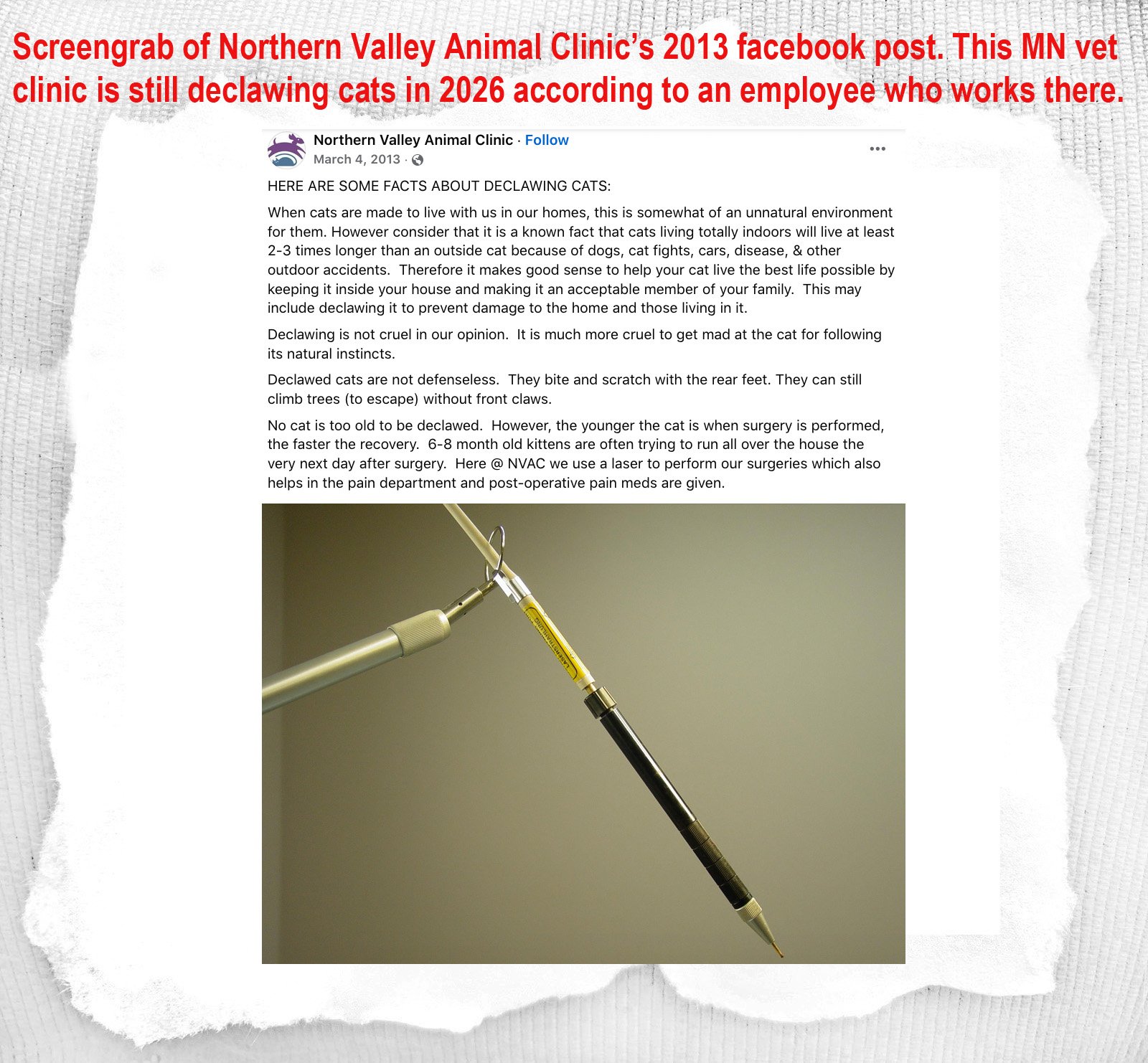
Link to Northern Valley animal clinic’s facebook page. (Then type in the word “declaw” in the search bar. https://www.facebook.com/NorthernValleyVet
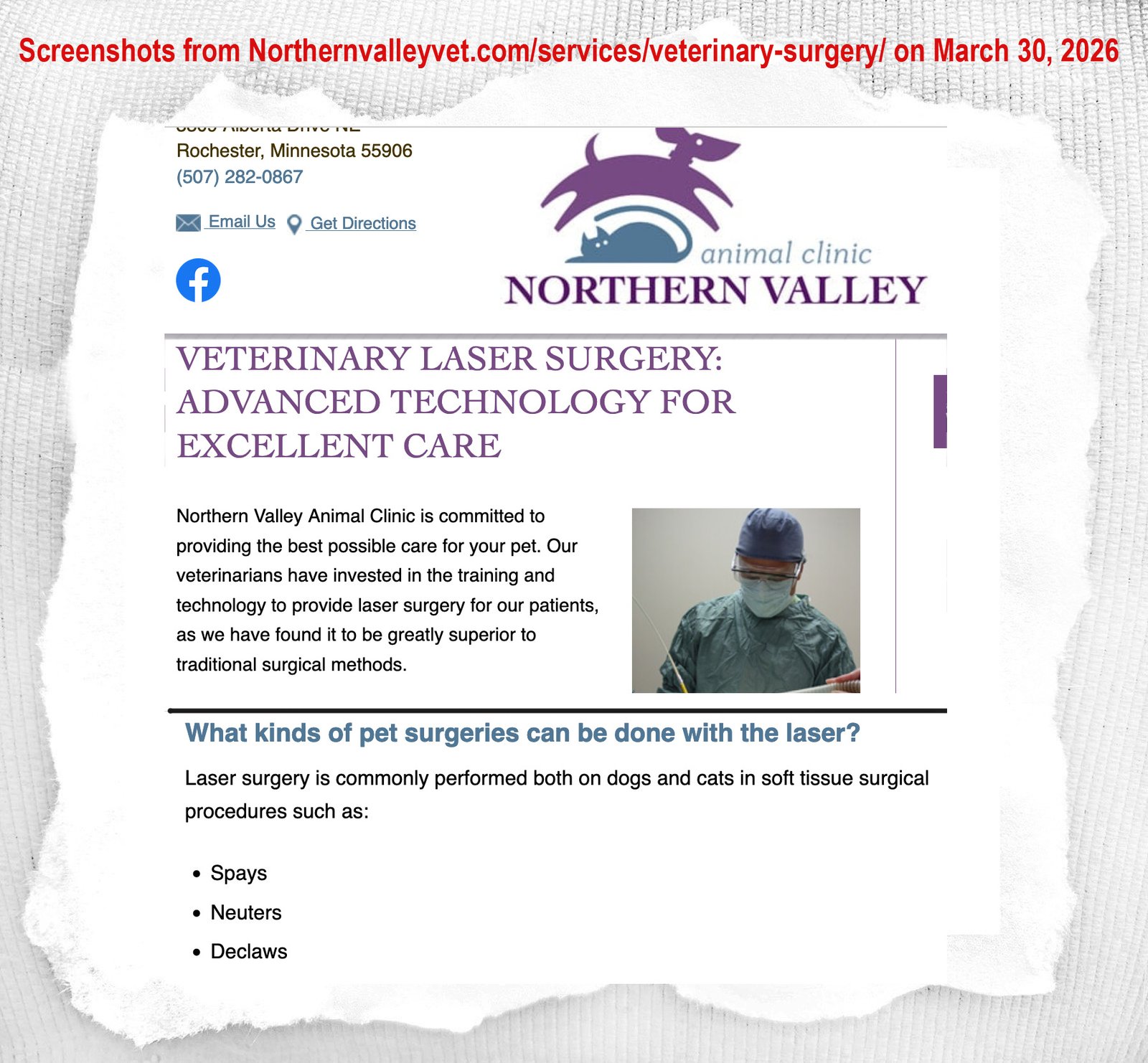
Link to their declaw page- https://www.northernvalleyvet.com/services/veterinary-surgery/
The researcher asked for the cost of a declaw for a 4 year old and a 1 year old cat and employee said you need a consult with their orthopedic veterinarian, Dr Treder, (MVMA member) to see why you want a declaw and to see if the cat is healthy enough for the procedure. They have 4 vets listed on their website. https://www.northernvalleyvet.com/about-us/veterinarians/
The employee said, “A declaw for an older cat is $560.” They said a declaw cost for a younger cat is $540. The doctor has to agree with your reasoning for the declaw and said for instance if there is a medical reason, and said that someone with thin skin who doesn’t want to get scratched is a medical reason.
Researcher asked if the cats are ok after the declaw long term and the employee said, “Yep, he’s an orthopedic surgeon and he is trained in that” but also said the older the cat is, the harder it is on them.
Researcher asked if Dr Treder does declaws regularly and the employee said yes.
The employee said they make nail caps and you can trim them for issues with scratching furniture. They said if you have a medical reason you need it done, he will go over that with you.
Researcher asked if they use a laser and if that’s better and the employee said they do and they feel it’s better because there’s a lot less bleeding.
A March 4, 2013 FACEBOOK post by this AAHA Accredited Animal Hospital said:
“HERE ARE SOME FACTS ABOUT DECLAWING CATS:
When cats are made to live with us in our homes, this is somewhat of an unnatural environment for them. However consider that it is a known fact that cats living totally indoors will live at least 2-3 times longer than an outside cat because of dogs, cat fights, cars, disease, & other outdoor accidents. Therefore it makes good sense to help your cat live the best life possible by keeping it inside your house and making it an acceptable member of your family. This may include declawing it to prevent damage to the home and those living in it.
Declawing is not cruel in our opinion. It is much more cruel to get mad at the cat for following its natural instincts.
Declawed cats are not defenseless. They bite and scratch with the rear feet. They can still climb trees (to escape) without front claws.
No cat is too old to be declawed. However, the younger the cat is when surgery is performed, the faster the recovery. 6-8 month old kittens are often trying to run all over the house the very next day after surgery. Here @ NVAC we use a laser to perform our surgeries which also helps in the pain department and post-operative pain meds are given.”
Shakopee, MN area vet clinics
64) Marschall Road Animal Hospital.
They have a good educational page about declawing. Here’s the link. https://www.marschallroadvet.com/declawing-in-cats.html
They do not declaw cats. Researcher asked why they don’t declaw and the employee said because they believe it’s an inhumane practice and it’s kind of like cutting off your first knuckle.
65) Shakopee Veterinary Clinic.
They do not declaw cats and said most vets do not do declaws anymore.
66) Prior Lake Pet Hospital. Prior Lake, MN
Employee said that a neuter/2 paw declaw is $821.15 and a neuter/4 paw declaw is $1153.37.
They require an exam and blood work before the surgeries. They said that Dr Tubman and Dr Albright do their declaws. They have 6 vets listed on their website. https://priorlakepethospital.com/our-veterinarians/
Researcher asked if the cats are ok after the declaw long term and the employee said there can always be complications with a front declaw with arthritis later on in life or the cat not using the litter box.
The employee said they use a laser to cauterize nerve endings and blood vessels and said it’s less painful and less bleeding and recovery is the same, around 2-3 weeks and they are very “tender.”
—————
Here is a FACEBOOK post about a person asking for a vet clinic for a declaw. https://www.facebook.com/groups/1638035956489345/posts/3403248223301434/
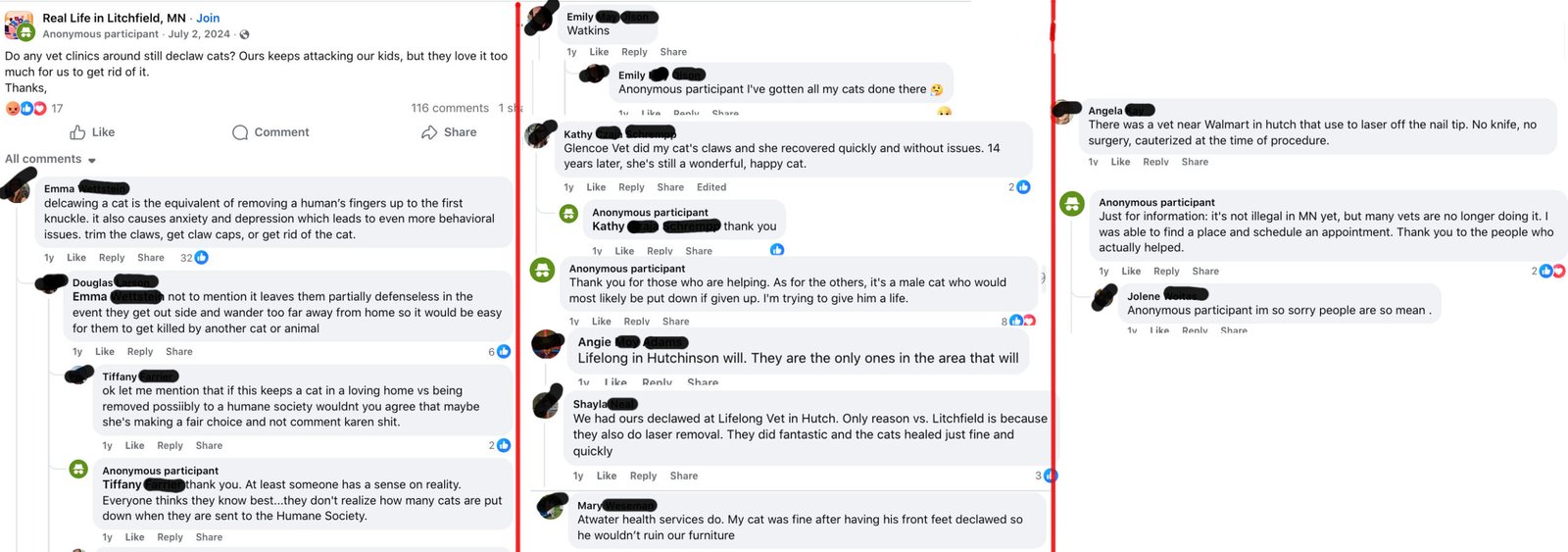
(Watkins Vet Clinic and Lifelong Vet clinic are listed in our survey as #8 and #11 and are part of Animals Inc. https://animalsincvet.com/ vet clinics which are Vetcor clinics.)
67) Animal Health Services. Atwater, MN
The employee said that a neuter/declaw is $265 and pain meds are around $50. They said Dr Kim and (Dr Noah only on Tuesdays), perform their declaws.
Researcher asked if the cats are ok after a declaw long term and the employee said, “There’s been conflicting research” and said it depends on how big they are when they get it done but said usually they are ok.
Researcher asked if they do declaws pretty regularly and the employee said yes.
The employee said they do not perform 4 paw declaws and researcher asked why and the employee said, “Because it’s not good for them” and said the recovery is harder and if they get out they have no defenses.
68) CareVet Hutchinson.
The said that they do not declaw cats. Researcher asked why and the employee said that studies show declawed cats can have some pain later in life and arthritis and said a lot of places have stopped declawing.
69) Glencoe Veterinary Clinic. Glenco, MN
They said they do not declaw cats. Researcher asked why and the employee said most places have gone away from that and don’t do declaws anymore, it can cause a lot of health problems for the cat, and it’s like cutting your finger off at the knuckle.
70) Cliff Lake Veterinary Clinic. Eagan, MN
The do not declaw cats. Researcher asked why and the employee said it’s becoming an elective surgery that a lot of vets aren’t learning and said it’s an amputation.
71) Rock Veterinary Clinic. Luverne, MN
The employee said that a neuter/declaw is around $220 and they only have one vet who does their declaws, Dr Michelle. They have 5 vets listed on their website.
The researcher asked if the cats are ok long term after a declaw and the employee said sometimes there are complications with the procedure itself because “removing the nails can give them arthritis sooner.”
Researcher asked if they do declaws regularly and the employee said yes.
———————————————————————————————————–
Co-chair of the committee, Bobbie Harder. District 17B Henderson said in the hearing:
“And as we talked about the bill, I believe I had mentioned that a veterinarian, my area, you know, questioned the bill because she had said that this is rarely done. It’s sort of like a last resort as we have heard. I too have had cats in the past after having that done this here and sort of makes a little squeamish because when my cat was declawed,(she doesn’t recall her cat having any problems.) I was actually in the room when it was done. So I can tell you that its it’s not for people to watch. And hats off to all the veterinarians for all the work that they do. But in the end, I do believe that I’m going to agree with the veterinarian. I think it’s the person’s name that this is a case by case basis in if someone wants to do this to their cat, while I wouldn’t do it,should I be the one to stand in their way? It’s really between owner of the pet and the veterinarian to,to go through all the all the pros and the cons and from the veterinarian that I know she had said that before, that this is ever take into consideration that they go through all the steps to do to avoid having and a cat, a cat declawed. So I I’m gonna go, it’s a case-by-case basis and I don’t want to be in between a pet owner and the veterinarian. So I apologize, but I’m not going to support the bill at this time. But thank you.”
Minnesota House District 17B veterinary clinics. (covering parts of Carver County like Carver and Watertown, Sibley County like Henderson, and western McLeod County townships).
72) Watertown Veterinary Clinic. Watertown, MN
The employee said they do not perform declawing. Researcher asked why they don’t declaw and the employee said they don’t do them anymore unless there’s a specific medical reason for the cat and said a lot of vets are steering away from them.
73) Healing Hands Veterinary Hospital – Carver, MN
Here’s what it says on their website: “At our hospital, we prioritize the health and well-being of animals above all else. Therefore, we only perform surgical procedures that are medically necessary and decline requests for procedures that may cause harm or discomfort to animals, such as feline declawing, canine debarking, ear cropping, tail docking or dew claw removal. We understand that these procedures were commonly performed in the past, but we believe that they are a disservice to our furry friends.” Link- ttps://healinghandsvethospital.com/policies/
74) Minnesota Valley Veterinary Services. Two locations.
Le Sueur location.
The employee said that a declaw is no longer done but then said to do a declaw you have to have a medical reason with a medical note from a doctor. They said there needs to be a medical reason in the household for the cat to be declawed for instance if the cat is hurting somebody. Then the employee said it’s not really being done and will only be done, “if there’s a medical necessity, not for the cat, but for humans.”
75) Arlington location.
Here’s a 2019 Facebook post by this clinic.
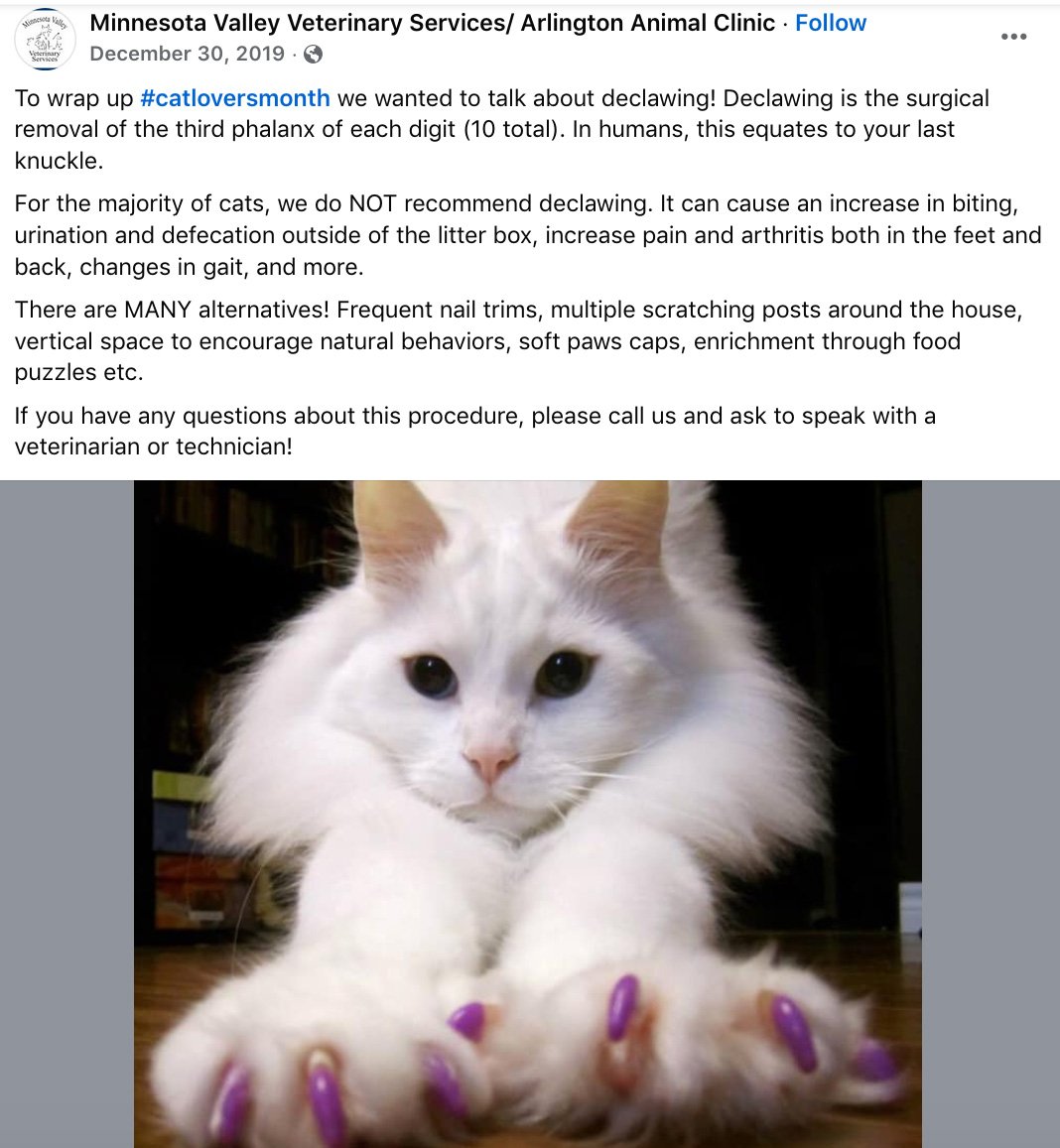
The employee said they do not declaw. The employee said declawing is going to be illegal because a bill is in the Senate being passed as a bill to make it illegal because it’s not medically necessary. Researchers asked if a declaw is bad for a cat and the employee said, “Correct.”
(Also, #69 here in our survey Glencoe Veterinary Clinic and #68 CareVet of Hutchinson are in this area and do not declaw cats. #11 Lifelong Vet Clinic declaws cats and according to an employee, their vet Dr Angela Gearey does them regularly and they say that cats are ok long term from a declaw. We reached out to Animal Medical Center on Crow River to ask them if they declaw cats and are waiting for a reply. They have many Facebook posts of declawed cats who were found and need to find their owners or lost their homes.)
————————————————————————————————————–
76) Minnesota Valley Pet Hospital. Mankato, MN
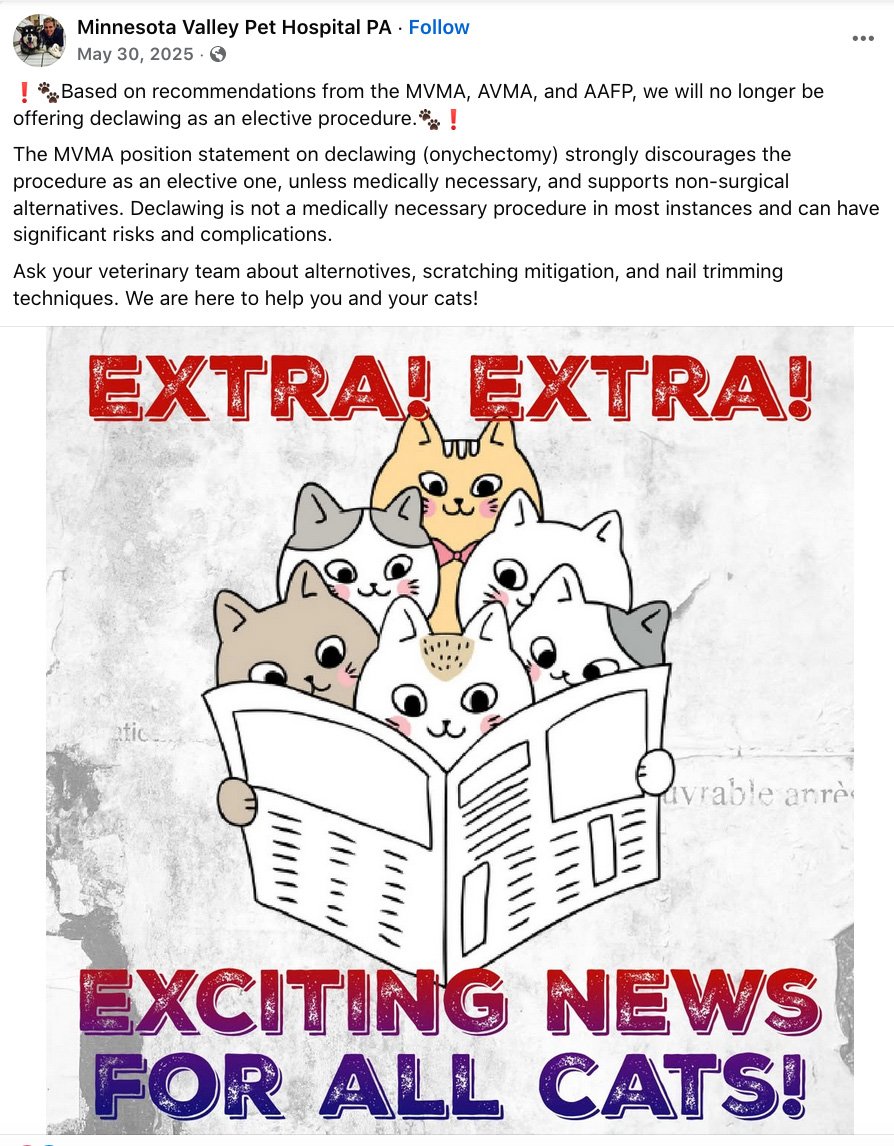
They posted this saying that they no longer offer declawing as an elective procedure. We emailed this clinic asking them if they offer declawing and if they declaw cats for a medical issue for a cat owner like thin skin, immune-compromised, or diabetes and they responded with “We do not offer declawing services.”
77) Advanced Care Pet Hospital. Sartell, MN
This was on Advanced Care Pet Hospital in 2018. They took off the declaw info after we posted a Facebook post about it that year.
Here is the link to our 2018 Facebook post about this MN clinic. https://www.facebook.com/photo?fbid=10157997306473642&set=a.373178554854082
(A CitytheKitty follower said they called this clinic on March 27, 2026 and asked if they declaw cats and the employee said they do. Our supporter asked the employee if she would be open to receiving materials that show how detrimental declawing is to cats. The employee said they were fully aware of this but sometimes it’s necessary for their clients. Our supporter asked if they counsel their clients on the negative and painful impact on the lives of cat having an amputation and the employee said they do.)
78) Rural Legacy Veterinary Clinic. Slayton, MN
Employee said that a neuter/declaw $250. They said that Dr Jenn does their declaws with a scalpel.
The employee said that they highly advise against declawing because it really affects their behavior and can cause arthritis changes. Researcher asked if the cats are ok long term after a declaw and the employee said” it’s hard on them trying to… ” and a long pause and said it can cause arthritis in their feet later in life.
79) White Bear Animal Hospital. White Bear Lake, MN
They have a “Declawing your Cat” pdf on their website that says, ”
Here’s the link. https://whitebearanimalhospital.com/wp-content/uploads/2025/02/Declawing.pdf
They said that they do not do declaws anymore because it’s not good for their paws.
80) Camden Pet Hospital. Minneapolis, MN.
They do not declaw cats.
81) Spring Valley Vet Clinic. Spring Valley, MN
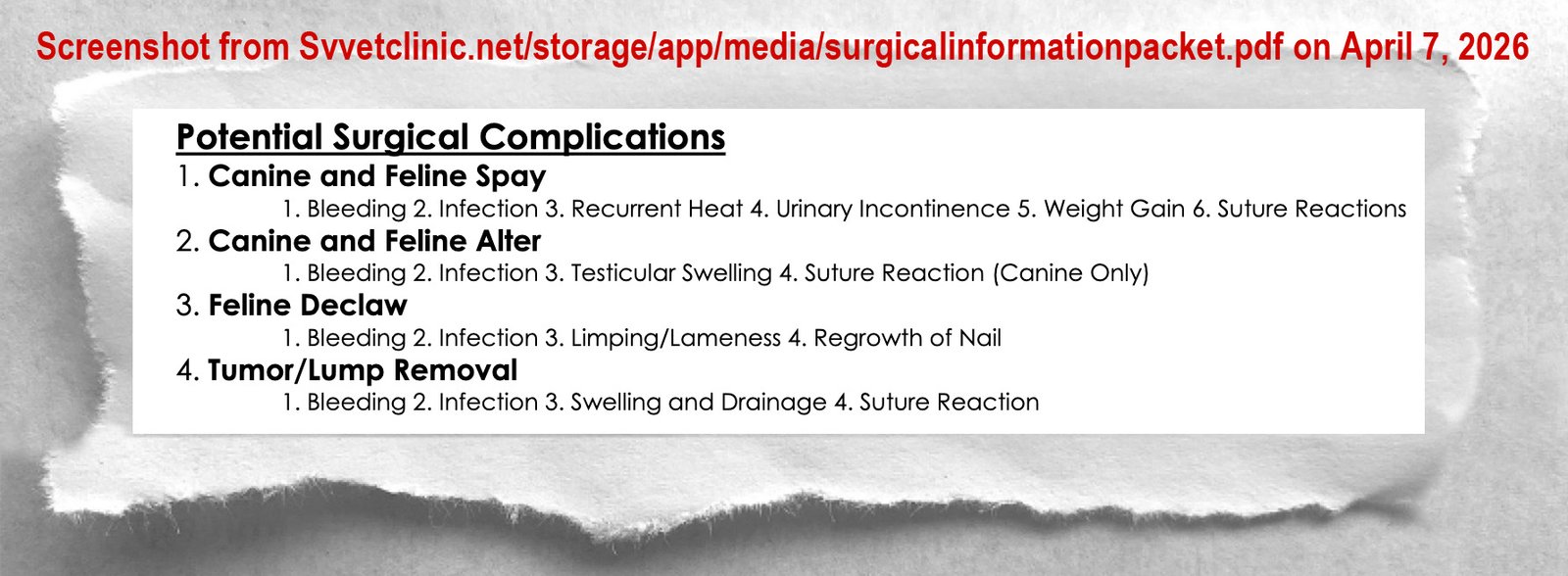
They mention declawing on their Surgical Consent Form. https://www.svvetclinic.net/storage/app/media/surgicalinformationpacket.pdf
The employee said a neuter/declaw is between $550-$750 and the $750 amount would include blood work and a couple other things. They said that Dr Gehling does their declaws with a scalpel.
Researcher asked of those cats seem to be ok long term after the declaws and the employee said, “Yea, they seem to do just fine” and said “it’s a little hard on them to take their toes off” and said they are taking off the first joint off but said they seem to do ok. Researcher asked if she does declaws pretty regularly and the employee said yes.
82) Brainerd Animal Hospital. Brainerd, MN
They say this on their January 27, 2026 website’s blog section in the “Declawing Cats” blog , “At our clinic, our goal is to help pet owners make informed, compassionate decisions about their pets’ care. We are frequently asked about declawing cats, and while we do offer this procedure, we strongly encourage clients to carefully consider the risks of declawing and explore safer, non-surgical alternatives first” and this, “If you are concerned about scratching behavior or are researching declawing for cats, we encourage you to speak with our veterinary team. Together, we can determine the best approach to support your cat’s health, comfort, and long-term wellbeing.”
Researcher asked for the cost of a neuter/declaw and the employee said it was around $756. They said Dr Dutton does their declaws and they have 3 vets listed on their website and two of them have the last name of Dutton. They said they need to see the cat first for an initial exam to establish care and make sure the cat has vaccines.
Researcher asked of those cats seem to be ok long term after the declaws and the employee said, “Yep, they seem to do ok” and said the recovery process just takes a little big longer and they can be quite sore for awhile but also said they tend to do alright. Researcher asked if they do declaws regularly and they said, “We don’t.”
They said that it is probably $300-$500 more to do the 4 paw declaw with a neuter.
Their website also says, “Member of the Minnesota Veterinary Medical Association” and “Keep Your Pet Healthy and Happy.”
83) Dougherty Veterinary Clinic. Duluth, MN
This clinic says on their website, “THE FINEST IN VETERINARY CARE, We are dedicated to providing excellent care.”
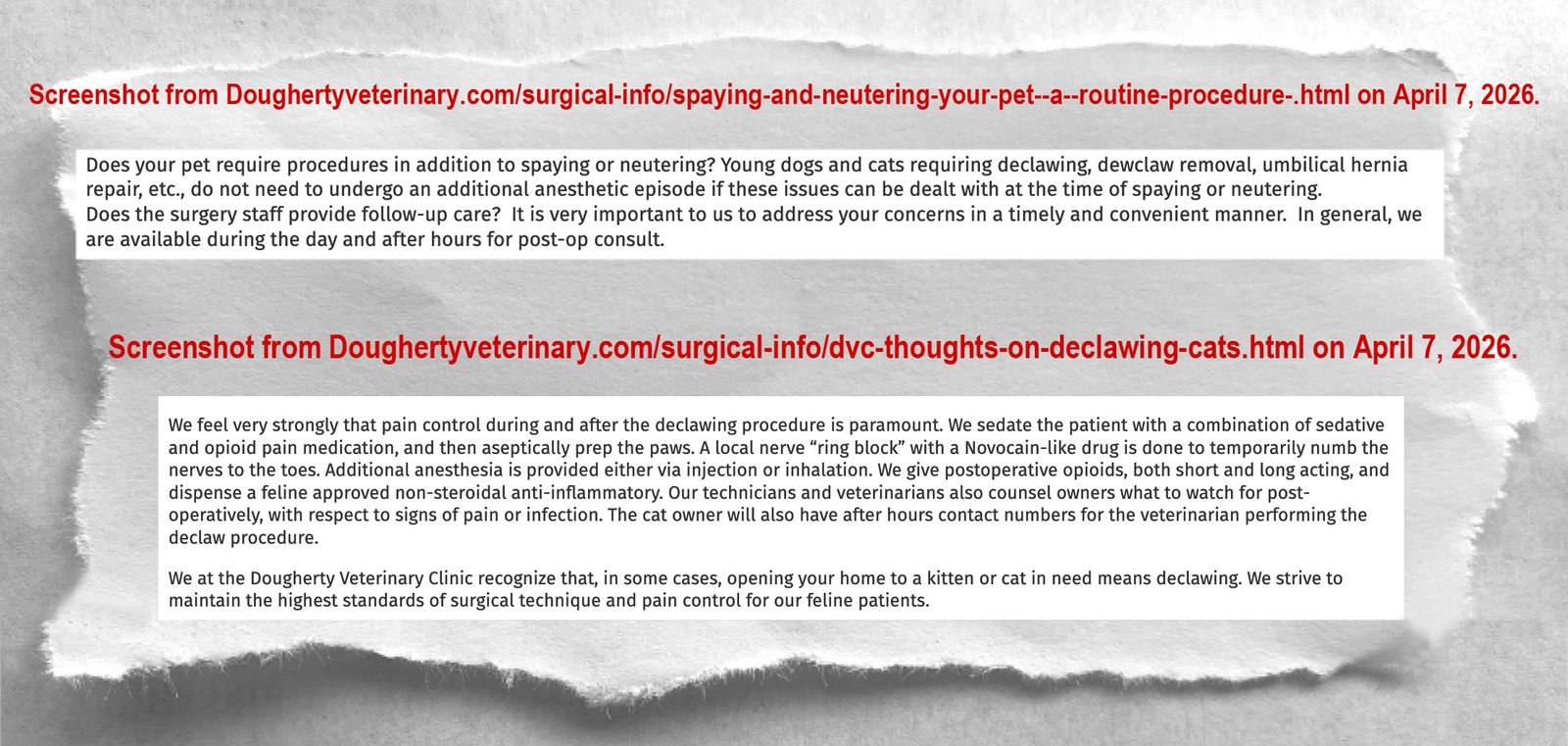
They mention declawing in their spaying and neutering section. Link- https://www.doughertyveterinary.com/surgical-info/spaying-and-neutering-your-pet–a–routine-procedure-.html
This clinic has declawing mentioned in their “DVC thoughts on declawing cats” section and it mentions the humane alternatives and how they support AAFP’s declawing position but it doesn’t talk about how declawing is bad for a cat’s health and well being and the negative effects it causes for cats. The end of the page says, “We feel very strongly that pain control during and after the declawing procedure is paramount. We sedate the patient with a combination of sedative and opioid pain medication, and then aseptically prep the paws. A local nerve “ring block” with a Novocain-like drug is done to temporarily numb the nerves to the toes. Additional anesthesia is provided either via injection or inhalation. We give postoperative opioids, both short and long acting, and dispense a feline approved non-steroidal anti-inflammatory. Our technicians and veterinarians also counsel owners what to watch for post-operatively, with respect to signs of pain or infection. The cat owner will also have after hours contact numbers for the veterinarian performing the declaw procedure. We at the Dougherty Veterinary Clinic recognize that, in some cases, opening your home to a kitten or cat in need means declawing. We strive to maintain the highest standards of surgical technique and pain control for our feline patients.”
The employee said they aren’t taking new clients and couldn’t give an estimate for a neuter/declaw. But they did say that they typically can do the neuter/declaw together but it’s up to the doctor.
84) Faribault Veterinary Clinic. Faribault, MN
The employee said a neuter with a front declaw is $698. They said that Dr Thorsen does their declaws and uses a scalpel. They have 3 vets listed on their website. http://www.faribaultvet.com/meet-our-doctors.html
Researcher asked of those cats seem to be ok long term after the declaws and the employee said, “Yea, we don’t recommend declawing” and said however they know that sometimes there are situations where it’s necessary and said that they will not do a declaw on a cat that’s over 7 lbs and said the younger they are, the better. Researcher asked if she does declaws pretty regularly and the employee said, “Yes, we don’t do them as much as we used to” but said she still does them. Researcher asked why they don’t do the 4 paw declaws and the employee said that typically they don’t usually do the back ones because they don’t cause damage and said it’s usually the front claws that cause the damage.
85) Keller Lake Animal Hospital. Maplewood, MN
They employee said they do not declaw and said it’s illegal in Minnesota.
Here’s the March 2026 testimony by the MVMA’s spokesvet, Dr Rob Memmem with the facts to each of his points.
March 24, 2025. Here’s the link to the YouTube recording of the hearing and Dr Rob Memmem’s testimony is at the 9 minute mark. Minnesota 2026 declawing bill hearing.
“My name is Robert Memmem.
I’m a resident and a practice owner in Minnetoka, Minnesota. We’re a small animal general practice that provides general medical surgical care for cats on a daily basis.
I’m also the most immediate past president of the Minnesota Veterinary Medical Association, which I’m here representing today. So, I appreciate the time and opportunity to share association’s stance on this issue.
I like to start with reading our MVMA policy on elective declawing and then share some facts that some of which overlap with what’s already been presented and then our position on the proposed ban.
So first, our policy statement. ‘The MVMA recommends that elective declawing of cats be strongly discouraged unless the procedure is medically necessary as determined by the attending veterinarian. The elective declawing of cats provides no animal health benefits and is strongly associated with negative animal health and welfare outcomes. Veterinarians should educate their clients about normal cat behavior, details of how the procedure is performed, health risks of the procedure, and long-term negative outcomes and of course, alternative management options.’
1) MVMA’s Dr Rob Memmem went on to say, “Now, one thing I think is important to note. The language we use in our policy, such as we strongly discourage unless medically necessary. If you look at the American Animal Hospital Association or the AVMA’s position you’ll find very similar language, not necessarily prohibiting language but strongly discouraging type of language. So I think we’re very consistent with what some of these national organizations are recommending and their views on this issue.”
Fact: Veterinary medical associations, including the MVMA, are fundamentally trade associations driven by the financial and professional interests of their members
Memmem’s comparison omits the reality that these organizations prioritize member profits over cat welfare. The MVMA exists to serve its members and collects dues from them, and many of these veterinarians continue to perform declawing. The American Animal Hospital Association (AAHA) has not banned declawing in its accredited hospitals because doing so would risk losing revenue from the many hospitals that still declaw cats; their new voluntary declawing standard will only become mandatory in 1–3 years and only with member support.
The AVMA exists to represent its members, many of whom still declaw cats, and influential AVMA delegates with ties to declawing clinics shape national declawing policy.
Memmem also failed to mention the major veterinary organizations that have completely banned declawing such as the Feline Veterinary Medical Association, Fear Free Pets, VCA Animal Hospitals, and National Veterinary Associates, giving legislators an incomplete and misleading picture of where the profession truly stands.
Question to the MVMA. Why did the MVMA mislead legislators by citing AAHA and AVMA policies, without disclosing that the AVMA and MVMA are trade associations shaped by the financial and professional interests of members who still declaw cats, that AAHA has not banned declawing in its accredited hospitals to avoid losing revenue from hospitals that continue declawing, and failing to mention that many influential and major veterinary organizations like the Feline VMA, VCA, Fear Free Pets, Banfield, National Veterinary Associates, and many more have fully condemned and banned declawing because of how inhumane and harmful it is to cats?
2) MVMA’s Dr Rob Memmem went on to say, “So some facts to consider with this context. As mentioned before
Minnesota’s Veterinary Medical School is no longer teaching this procedure as part of its training and a decreasing number of veterinary clinics are offering to perform this procedure entirely.”
Fact: Declining training does not equal adequate protection.
While Minnesota’s veterinary school may no longer teach declawing, many clinics have one or two vets who still perform it. The key issue is that cats in Minnesota are still being declawed and permanently harmed, which is why legislation remains necessary.
Question to the MVMA. If Minnesota’s veterinary school no longer teaches declawing and doesn’t perform it in their small animal hospital unless it’s for a medical necessity for the cat, how does the MVMA justify opposing legislation when the procedure is still routinely performed by many veterinarians in the state, leaving cats vulnerable to permanent harm?
How does the MVMA justify opposing this legislation when the remaining veterinarians who still declaw are profiting from the procedure, performing it for convenience and questionable justifications, and absorbing all continued demand for this inhumane amputation procedure?
3) MVMA’s Dr Rob Memmem went on to say, “Veterinarians are trained to distinguish between medical and behavioral conditions and provide appropriate client education and counseling.”
Fact: Education claims do not always reflect reality.
The claim that veterinarians provide appropriate client education is not consistently supported by what clinics tell cat owners. Many declawing clinics do not educate cat owners about how bad declawing is or about the easy humane alternatives.
Question to the MVMA. Do you have any real data that shows how many declawing vets in MN are providing appropriate client education and counseling about it? Are you aware that many declawing vets aren’t always honest about declawing since it’s an indefensible procedure and many of their clinics lie and say that declawing is ok for a cat long term?
4) MVMA’s Dr Rob Memmem went on to say, “Comprehensive client education calmly changes an owners desire to proceed with the procedure in the first place.”
Fact: Education can prevent declawing, but is it actually happening?
While comprehensive education may change an owner’s decision, the concern is that many clinics still performing declaws do not fully disclose the harmful consequences, so owners are not always making a truly informed choice.
Question to the MVMA. Do you have any real data that proves that shows that comprehensive client education calmly changes an owners desire to proceed with the procedure in the first place and that declawing vets in MN are doing that?
5) MVMA’s Dr Rob Memmem went on to say, “Veterinarians are committed to informed consent and thorough discussion alternatives regardless of whether or not they elect to perform this procedure and they may consider claw removal in limited case specific situations that involve factors beyond a medical diagnosis for the cat. Examples being situations where behavioral modification strategies to address destructive scratching are ineffective. Owners who are elderly, disabled and may have special needs. Owners who are immune compromised and are more susceptible to infection or illness as a result of a scratch.
Fact: Informed consent must include the truth.
Saying veterinarians are committed to informed consent and alternatives is only meaningful if clinics are consistently explaining the long-term pain, permanent harm, and humane options before offering surgery. Many clinics that declaw cats are NOT informing cat owners and in fact are deceiving them to think that declawing is ok for their cat.
Also, no human health agency or veterinary organization recommends declawing for any owner health issue, including for elderly, disabled, or immune-compromised individuals. The Centers for Disease Control and Prevention, National Institutes of Health, American Animal Hospital Association (AAHA), and Feline Veterinary Medical Association and others all recommend common-sense measures such as nail trims, nail caps, hygiene, and avoiding rough play—not declawing. In fact, declawed cats are often more likely to bite, and bites pose a far greater infection risk than scratches.
Question to the MVMA. Do you have any real data that shows that declawing a cat for a person with a health issue keeps the cat in that home? Can you list any organization or agency that condones or recommends declawing cats for human health or elderly people? Also, how do you know that veterinarians are having discussions with their clients about the harm that declawing causes and the alternatives?
6) MVMA’s Dr Rob Memmem went on to say, “We also believe current surgical techniques and modern anesthetic and pain medications have greatly reduced the pain and discomfort and negative outcomes associated with the procedure.”
Fact: Better pain control does not remove lifelong pain, suffering, and harm.
Improved anesthesia and pain meds may reduce short-term pain, but it does not change the long-term consequences: chronic pain, lameness, arthritis, and behavioral issues.
Question to the MVMA. What are you basing your belief on that current surgical techniques and modern anesthetic and pain medications have greatly reduced the pain and discomfort and negative outcomes associated with the procedure for a cat long term. Can you provide any real data that backs up your belief?
7) MVMA’s Dr Rob Memmem said, “And for some households, unmanaged behavioral concerns, or concerns about human health might contribute to decisions involving relinquishment or even euthanasia. And so as veterinarians, our aim is to provide options that support animal welfare by also taking into fact, we need to address the circumstances to reduce the rates of relinquishment or certainly euthanasia.”
Fact: Relinquishment and euthanasia claims need evidence.
This is an antiquated and false excuse to condone declawing. There is no clear evidence that declawing prevents surrender or euthanasia and in fact none of the veterinary or animal welfare organizations condone declawing for this reason. In many cases, declawed cats later develop biting or litter box issues that can increase the risk of losing their home. There are no veterinary or animal welfare organizations that condone declawing to prevent euthanasia or relinquishment.
Question for the MVMA. What evidence does the MVMA have to support the claim that declawing prevents relinquishment or euthanasia, when data show that declawed cats are often surrendered or even euthanized due to behavioral and health problems caused by the procedure, which is why shelters and animal welfare organizations strongly support banning declawing?
8) MVMA’s Dr Rob Memmem, “So as an association our stance, regardless of personal feelings about the procedure, even amongst our members, the decision to perform a treatment or therapy should be made on a case-by-case basis between a veterinarian and a pet owner.”
Fact: Declawing is not a treatment or therapy.
Calling declawing a “treatment or therapy” is misleading. It is a non-therapeutic amputation of the last bone in each of the cat’s toes, performed on healthy anatomy and treating no disease or injury.
Question for the MVMA. Explain how declawing is a veterinary treatment or therapy for a cat?
9) MVMA’s Dr Rob Memmem said, “So with that in mind, when we look at the proposed bill in
House 1857 it does bring up some serious concerns that would cause us to oppose it. First and foremost, it removes the veterinarians and the client’s right to choose whether to perform a surgical procedure.”
Fact: “Right to choose” is not a defense for an inhumane, unnecessary, and harmful surgery.
Veterinarians have an ethical duty to refuse non-therapeutic procedures that harm an animal. Declawing should not be defended as a matter of convenience or client choice.
Question for the MVMA. How does the MVMA justify framing declawing as a matter of ‘veterinarian and client choice’ when ethical and progressive veterinary standards hold that non-therapeutic, harmful, and inhumane procedures should be refused?
10) MVMA’s Dr Rob Memmem, “We believe it’s (a law) fundamentally unnecessary because the veterinary medical profession has appropriately regulated itself moving away from this procedure over the years and it continues to do so in a thoughtful and compassionate manner.”
Fact: The profession’s self-regulation has failed.
If the profession had truly moved away from declawing, it would not still be a routine, advertised, and profitable procedure in many clinics in America. Recent CitytheKitty.org surveys found about 60% of Minnesota clinics and 80% in Ohio still perform it. While many ethical veterinarians have stopped, the clinics that continue are capturing the business and profiting from this cruelty. At the same time, there is no visible public education campaign from the MVMA informing cat owners or their member vets about the inhumane nature of declawing or the easy humane alternatives.
For more than 70 years, declawing has remained legal despite being introduced without long-term studies on its effects on cats. Today, countless studies document the pain, behavioral harm, and lifelong damage it causes, and even the MVMA admits that “The elective declawing of cats provides no animal health benefits and is strongly associated with negative animal health and welfare outcomes.” The science is clear: the time has come to end declawing and stop fighting to keep this inhumane procedure legal.
Question for the MVMA: If the veterinary profession has truly ‘appropriately regulated itself’ regarding declawing, how do you explain that the majority of veterinary clinics in Minnesota, and in the U.S., still perform declawing, many regularly, and some even advertise the procedure, causing permanent harm to healthy cats, while the MVMA has conducted no public education about its inhumane nature or the available humane alternatives?
11) MVMA’s Dr Rob Memmem said, “We don’t think it considers a legitimate medical conditions of the animal owner when banning the procedure for reasons other than the therapeutic need of a cat.”
Fact: Human health claims are unsupported.
As discussed in #5, there are no veterinary or human health organizations that condone or recommend declawing for owner medical reasons. In fact, declawed cats are often more likely to bite, increasing risk.
Question to MVMA. Same as question #5.
12) MVMA’s Dr Rob Memmem said, “And then finally, we believe it sets a dangerous precedent and legislating what surgical procedures a veterinarian may perform in general.”
Fact: This statement is fear-based and unsupported by reality.
Calling an anti-declawing law a “dangerous precedent” is fear-mongering. Declawing has already been banned for years in New York and in other states, and there has been no effort to strip veterinarians of other surgical procedures. Animal welfare laws already exist to prevent cruelty and protect animals from harmful practices, and prohibiting this non-therapeutic, inhumane amputation procedure is fully consistent with that purpose—not a threat to veterinary medicine.
Question for the MVMA: If banning declawing truly sets a ‘dangerous precedent’ as you claim, how do you explain that states like New York and others have prohibited the procedure for years without any attempt to restrict veterinarians from performing other necessary or therapeutic surgeries?
13) MVMA’s Dr Rob Memmem said, “I’d just like to respond to the last comment about the rates of declaws not coming down over recent decades. The Minnesota veterinary medical association performed a survey of our membership last year and this year. We have over 2000 members, approximately two-thirds of our Minnesota veterinarians are in our membership. And I know it’s hard to see from here, but this is a graph of when veterinarians in our state, our members stopped performing elective declaws, either personally or their clinic stopped offering it.. 2010 is here, you can see a huge increase in the number of our veterinarians no longer performing the procedure over the last 15 or so years. So, an encouraging trend. I have more statistics on those numbers but in general as a summary, I would say currently about 30% of our veterinarians that are still involved in practice where that would be an option are offering declaws, 70% are not. But there’s a huge discrepancy in the number of veterinarians who are 2008 graduates and younger, or newer, no longer performing the procedure versus veterinarians that graduated before that. So we’re seeing a definite trend with our Minnesota veterinarians in no longer offering or strongly discouraging the procedure. I don’t know how that applies to some of our national numbers, but I mean, this is really important considering these are the people who this bill would affect and we’re seeing that type of change we’re looking for through educating veterinary professionals and educating the general public and cat owners. “
Fact: Even with fewer veterinarians performing declaws, many cats in Minnesota are still being mutilated and harmed. While the MVMA cites a declining trend among 2008 graduates and younger vets—reporting that only about 30% of their member vets still perform declaws—our survey shows that many Minnesota veterinarians, including younger ones born in the 1990s, continue to routinely declaw healthy cats. Most of these declawing vets are not listed on the MVMA’s website as members, meaning the association’s survey significantly undercounts the true number of cats at risk. Our survey of 76 vet clinics in MN found that around 60% continue to perform declawing, leaving cats to endure lifelong pain, lameness, and behavioral issues. Additionally, the MVMA provides no public education on declawing or humane alternatives for their members or cat owners. Only legal prohibition can ensure protection for these cats.
Question for the MVMA:
The MVMA told lawmakers that declawing is a declining practice, particularly among younger veterinarians, based on a survey with only 783 responses out of more than 2,000 members. However, our survey found that many Minnesota veterinarians, including younger vets, still routinely perform declaws, and many of those declawing vets are not listed as MVMA members. Given these gaps, how can the MVMA be confident that the 30% figure accurately reflects what is happening statewide, and how does the association justify opposing legal protections when voluntary trends still leave thousands of cats at risk of lifelong pain and behavioral harm?
Here’s the email we sent to the MVMA and Dr Rob Memmem on April 13, 2026.
Dear MVMA and Rob Memmem,
We are requesting clarification on the MVMA’s testimony and position regarding elective declawing of cats in Minnesota for a story currently being finalized. We are wrapping up reporting and plan to publish tomorrow afternoon.
The story will be distributed to Minnesota and national news media, as well as state legislators.
In addition, we intend to submit this reporting to 60 Minutes as part of a broader national story pitch examining how the veterinary medical associations have used misleading testimony to block anti-declaw legislation and preserve what remains a billion-dollar industry in America.
We would appreciate a response prior to publication.
Below are key points from Dr. Rob Memmen’s 2026 testimony, along with supporting facts and follow-up questions for your response.
- National Organization Comparisons
Memmem: “If you look at the AAHA or AVMA’s position you’ll find very similar language… strongly discouraging.”
Fact: The MVMA and AVMA exist to serve members, many of whom still declaw cats. AAHA has not banned declawing to avoid losing accreditation revenue from hospitals that still perform it. Major veterinary organizations and veterinary group companies like FVMA, Fear Free Pets, VCA, and NVA have fully banned declawing.
Question: Why did the MVMA cite the AVMA and AAHA as if they represent the profession’s overall stance, without disclosing that the AVMA is a member-driven organization whose policies are shaped by delegates tied to clinics that still declaw cats, and that AAHA has not fully banned declawing in order to avoid losing accreditation revenue from hospitals that still perform the procedure? Why were major organizations and veterinary groups that have fully prohibited declawing omitted, creating a false appearance of profession-wide alignment?
AAHA-https://citythekitty.org/why-does-aaha-org-choose-profits-over-the-welfare-of-innocent-cats/
AVMA- https://citythekitty.org/avmas-credibility-in-crisis-leaders-with-financial-ties-to-declawing-shape-policy-prompting-calls-to-rename-it-the-american-veterinary-money-association/
- Training Decline
Memmem: “Minnesota’s Veterinary School is no longer teaching this procedure…”
Fact: Cats are still being declawed in many clinics; declining training does not protect cats from harm.
Question: How does the MVMA justify opposing legislation when declawing is still routinely performed in MN, leaving thousands of cats vulnerable to this inhumane procedure? - Education Claims
Memmem: “Veterinarians provide appropriate client education and counseling.”
Fact: Many declawing clinics fail to fully inform owners of long-term harm or humane alternatives.
Question: Do you have data showing declawing vets consistently provide adequate client education? - Effectiveness of Education
Memmem: “Comprehensive education calmly changes an owner’s desire to proceed.”
Fact: Education is often incomplete; many owners are not making informed decisions.
Question: Do you have evidence that education in MN clinics consistently prevents declawing? - Human Health & Special Circumstances
Memmem: Declawing may be considered in cases involving elderly, disabled, or immune-compromised owners.
Fact: No veterinary or human health organization recommends declawing for owner health; declawed cats are more likely to bite.
Question: Can you provide data or organizations that condone declawing for human health or elderly individuals, and confirm vets consistently inform clients of harm and alternatives? Can you provide data that shows declawing keeps a cat in a home? - Pain Management
Memmem: “Modern anesthetic and pain medications have greatly reduced negative outcomes.”
Fact: Pain control cannot prevent long-term chronic pain, lameness, arthritis, or behavioral issues.
Question: Please provide the evidence and data that supports your claim that modern techniques prevent long-term harm from declawing? - Relinquishment & Euthanasia
Memmem: Declawing may reduce surrender or euthanasia.
Fact: No evidence supports this and no veterinary organization or animal welfare organization condones or recommends declawing for human health reasons; declawed cats often develop behavioral issues increasing risk of surrender.
Question: What data supports declawing as a means to prevent relinquishment or euthanasia? - “Treatment or Therapy” Claim
Memmem: So as an association our stance, regardless of personal feelings about the procedure, even amongst our members, the decision to perform a treatment or therapy should be made on a case-by-case basis between a veterinarian and a pet owner.”
Fact: Declawing is a non-therapeutic, inhumane amputation of healthy anatomy.
Question: How does the MVMA define declawing as treatment or therapy? - Right to Choose
Memmem: Opposing the bill removes the veterinarian and client’s right to choose.
Fact: Ethical veterinary standards reject non-therapeutic, harmful procedures.
Question: How does MVMA justify framing declawing as ‘veterinarian and client choice’ when it’s inhumane, non-therapeutic, and harmful to a cat’s long term health and well-being? - Self-Regulation
Memmem: The profession has regulated itself away from declawing.
Fact: Our survey shows that around 61% of MN clinics still perform declaws; many advertise it. No public education campaign exists for declawing in MN.
Question: If self-regulation works, why do so many MN clinics still routinely perform declawing without public education? - Human Health Claims Revisited
Memmem: Declawing considers human conditions.
Fact: Unsupported by science; declawed cats may bite more.
Question: Same as #5. - “Dangerous Precedent” Claim
Memmem: Banning declawing sets a dangerous precedent.
Fact: States like New York have banned declawing without limiting other surgeries.
Question: How does MVMA justify calling an anti-declawing law a ‘dangerous precedent’? - MVMA Survey
Memmem: “Currently about 30% of our veterinarians offer declaws; 70% have stopped.”
Fact: MVMA received 783 responses out of 2,000 members (~2/3 of MN vets). Many declawing vets are not members. CitytheKitty.org found around 60% of MN clinics still perform declaws.
Question: How can the MVMA continue to claim that elective declawing is rare in Minnesota when its testimony relied on responses from only 783 self-selected members, while an independent survey of randomly selected clinics found that around 60% still perform the procedure, including many younger veterinarians, suggesting the association’s data significantly understates the true statewide risk to cats?
Can you please provide the data from your two studies that are referenced in this pdf. MVMB- “The complete survey results can be requested from MVMA.” https://www.lrl.mn.gov/docs/2026/mandated/260284.pdf
Thanks,
City the Kitty and team
Declawing is animal cruelty. Know the facts. https://citythekitty.org/declawing-facts-vs-myths-humane-options/