————————————————————————————————————————————————–
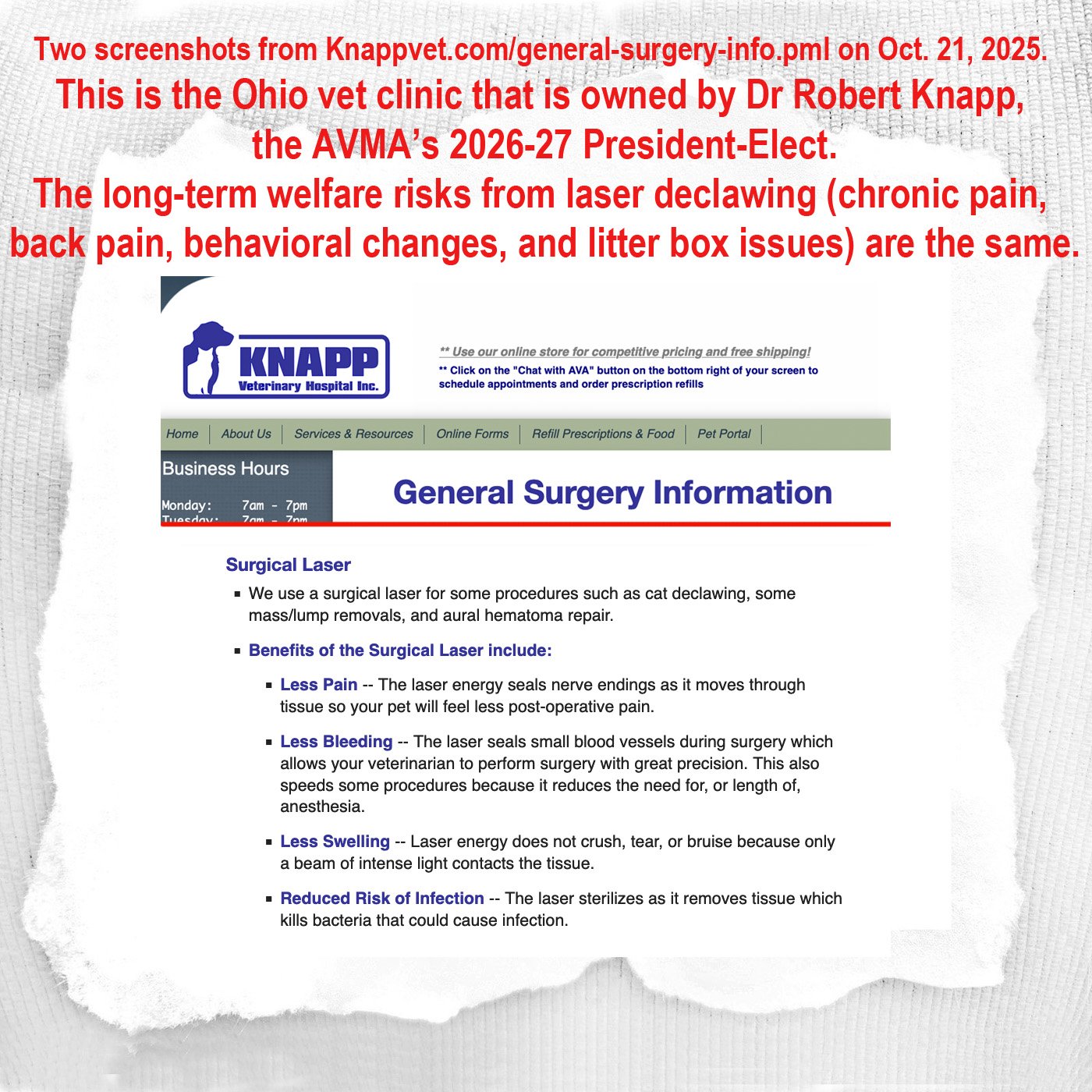
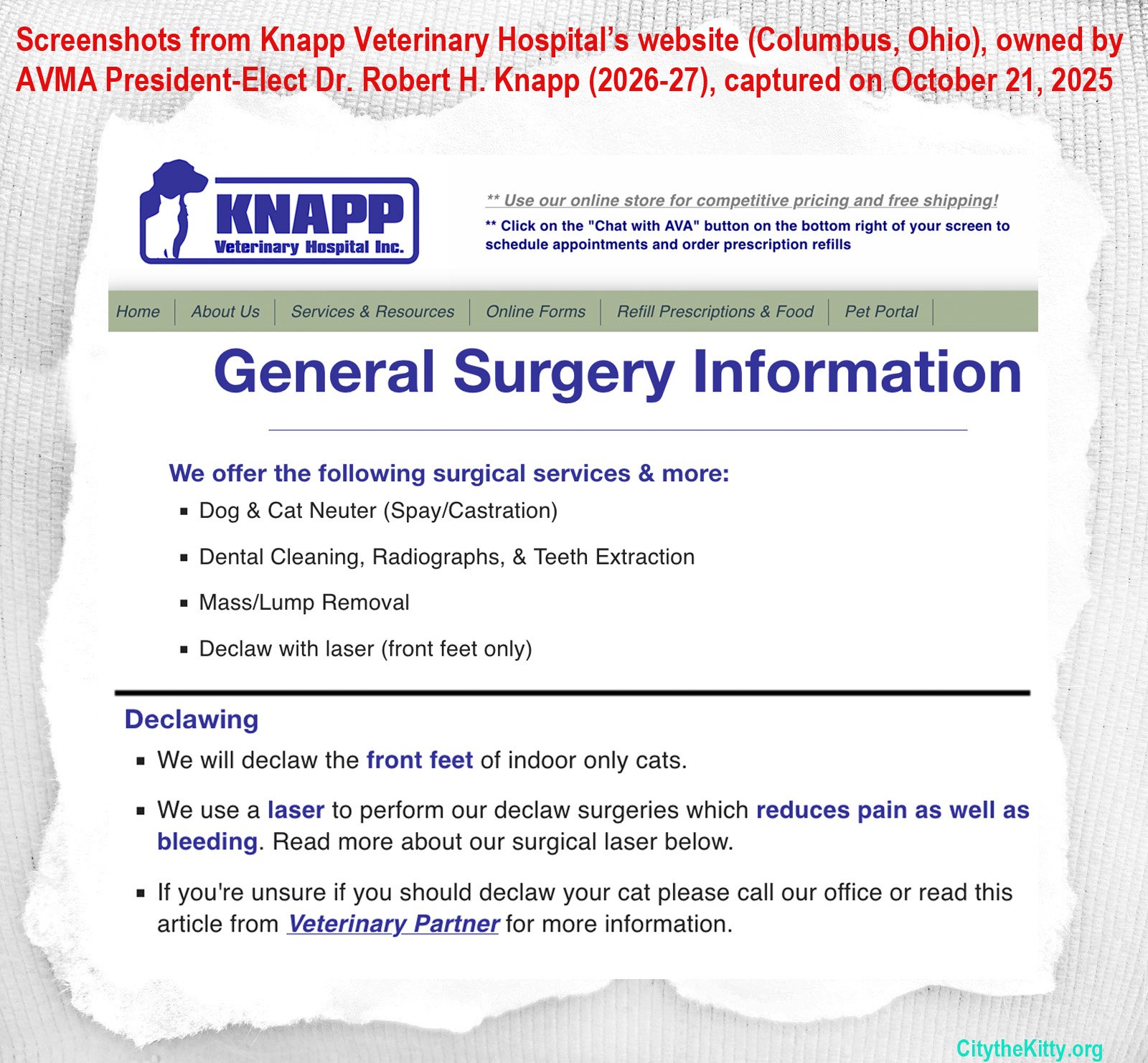
Screenshots captured on October 21, 2025 from the website of the AVMA’s Pres.-Elect’s website. (The “Declaw with laser (front feet only” was taken down in the week or so after our story was published on Oct. 21, 2025 but the “Declawing” and “cat declawing” mention in the “Surgical Laser” section was kept up until sometime in early November. )
Nearly 75 Years After The AVMA Helped Popularize Declawing, Two Veterinarians Connected to Declawing Clinics Rise to AVMA’s Top Leadership
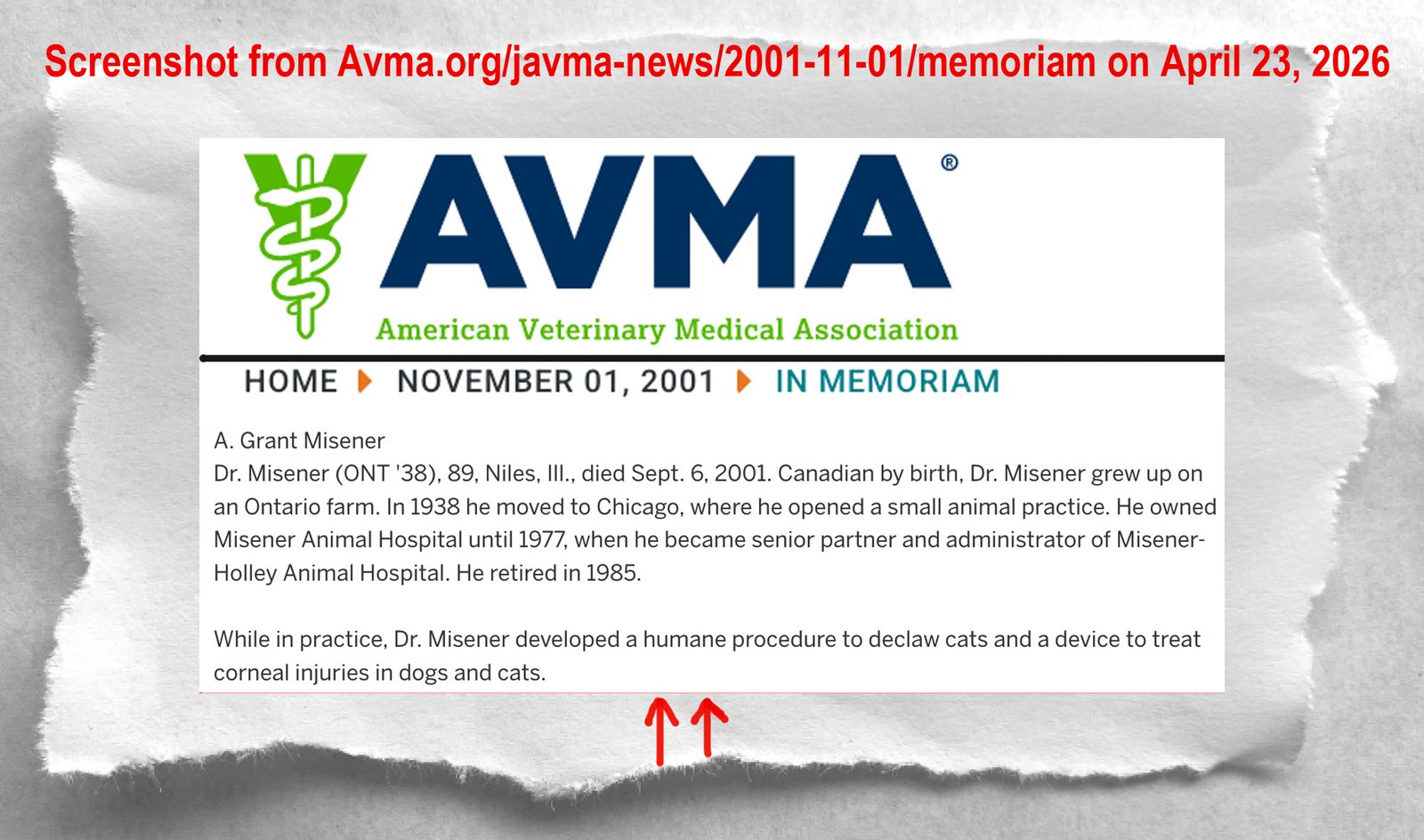
In November 1952, the Journal of the American Veterinary Medical Association (JAVMA) published an article by Chicago veterinarian Dr. A. Grant Misener about his guillotine-style declawing technique for domestic cats.
The article presented declawing as a solution for scratched furniture and concerns about “cat scratch fever,” despite the absence of research on the procedure’s long-term negative effects on cats.
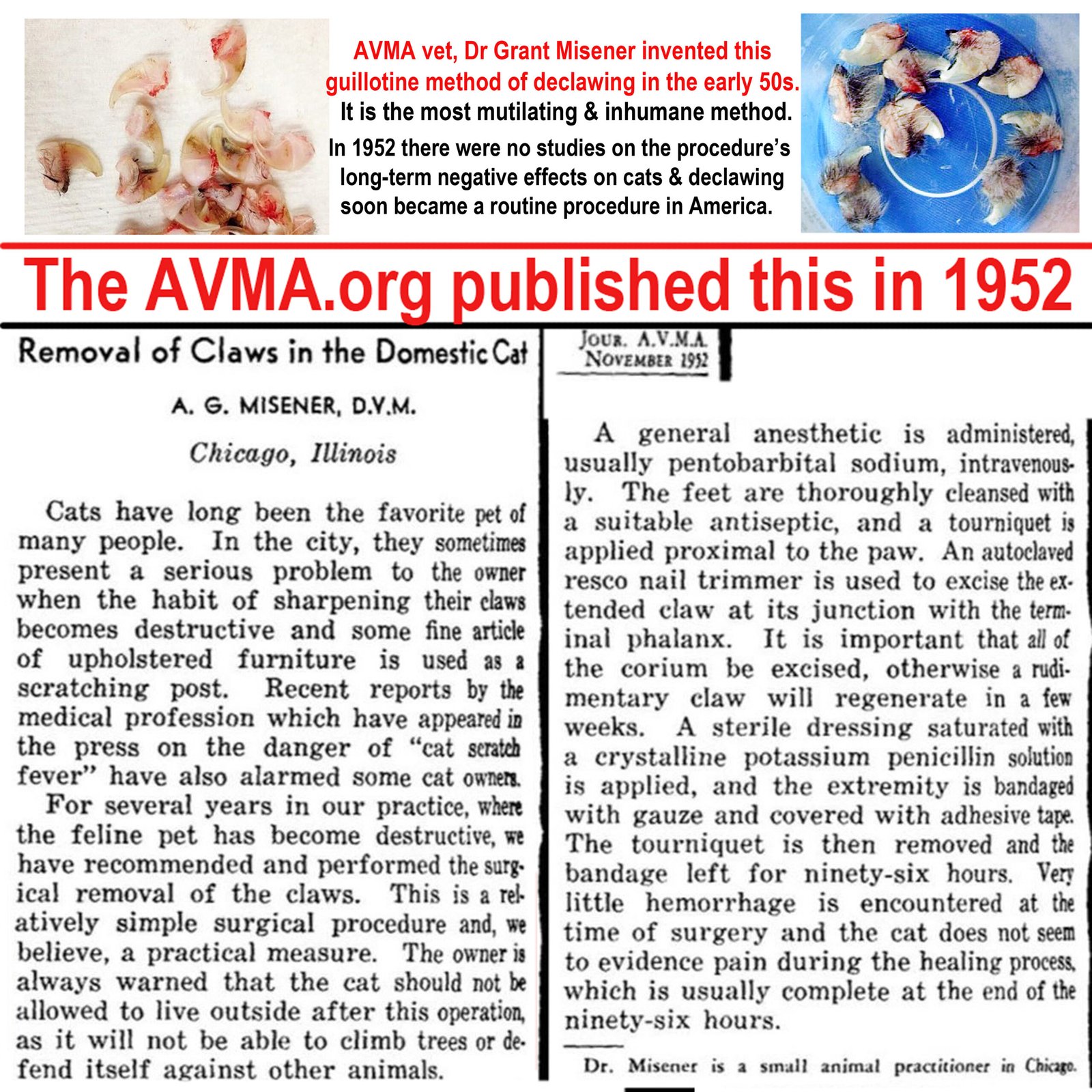
Published in the AVMA’s own journal, the article helped legitimize and spread a practice that decades of research would later link to chronic pain, mobility problems, and behavioral issues.
The AVMA said Dr Misener “developed a humane procedure to declaw cats” in his 2001 obituary on the AVMA website, despite knowing all the studies that showed how inhumane and mutilating this guillotine declaw method was.
Nearly 74 years later, declawing remains a routine procedure in many vet clinics and by many AVMA veterinarians.
On July 11, 2026, the AVMA House of Delegates unanimously elected Dr. Robert Knapp as its 2026-27 President-Elect and Dr. Elizabeth Boggier as Vice President during the AVMA Convention in Anaheim, California.
The election highlights the central controversy surrounding the AVMA’s declawing policy: the organization has acknowledged the serious harm of declawing by condemning the procedure in exotic and wild cats in 2012, yet it refuses to take the same position for domestic cats despite the procedure involving the same amputation and carrying the same risks of pain and suffering.
The elections also have placed two veterinarians connected to declawing at the top of the AVMA’s leadership structure as the organization faces renewed criticism for refusing to fully condemn declawing in domestic cats.
City the Kitty’s Investigations
City the Kitty investigations in September/October 2025 found that Dr Robert Knapp’s clinic, Knapp Veterinary Hospital, in Columbus, Ohio advertised its declawing services, and an employee told researchers the clinic performs declaws “all the time” and that Dr Knapp could perform a declaw.
They also found that at MountainView Veterinary Hospital in Denville, NJ, owned by Dr. Elizabeth Boggier, employees said they could only perform declawing for owner-related medical reasons but that it was up to the discretion of the doctor. An employee said Dr Boggier and Dr Lynn perform their declaws. At the time of the investigation, MountainView Veterinary Hospital was a Cat Friendly Practice and that information appeared inconsistent with FelineVMA Cat Friendly Practice standard since they only allow declawing in their Cat Friendly Practices if it’s for the health of the cat, not the owner.
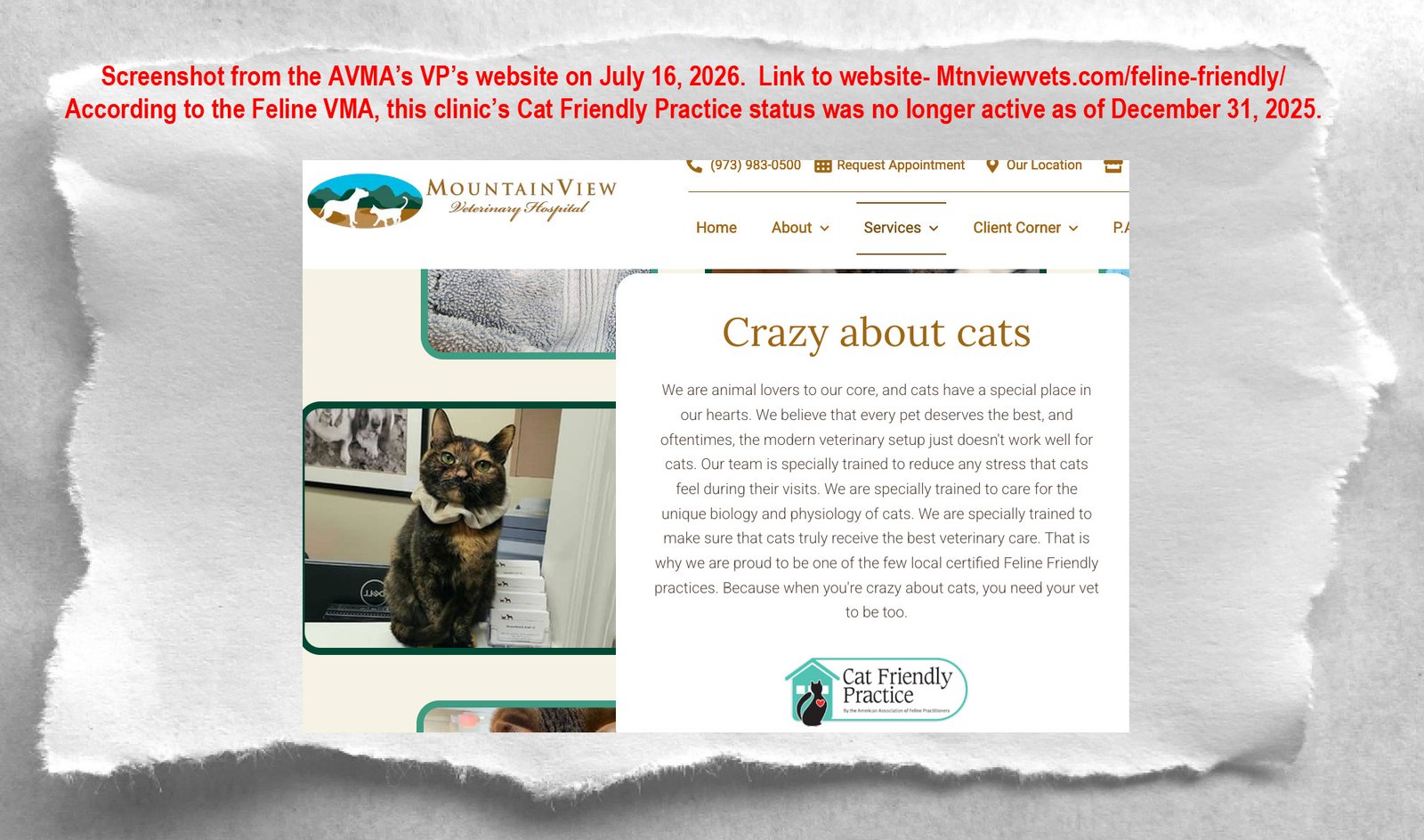
As of July 16, 2026, this hospital continues to display Cat Friendly Practice branding on its website and Facebook posts, despite the FelineVMA stating on July 15, 2026 that this hospital stopped being a Cat Friendly Practice on Jan. 1, 2026.
Declawing is an inhumane amputation of the last bone of each toe. Decades of research have linked the procedure to chronic pain, mobility changes, and behavioral problems in cats.
Yet while the AVMA has condemned declawing in exotic and wild cats, it continues to defer the decision for domestic cats to individual veterinarians, stating that it “respects the veterinarian’s right to use professional judgment” in determining whether the procedure is necessary and appropriate.
AVMA President-Elect’s Hospital, Knapp Veterinary Hospital
A September and October 2025 investigation by the nonprofit City the Kitty found that Knapp Veterinary Hospital even advertised their declawing service on their website.
“Yes, they do them all the time, yes.”
That was the response in September 2025 from an employee at Knapp Veterinary Hospital in Columbus, OH, the vet clinic owned by newly elected AVMA President-Elect Dr. Robert Knapp, when asked whether the clinic’s veterinarians perform declawing often.
One employee said all their veterinarians—including Dr. Robert Knapp—perform laser declaws, adding they are done “Monday through Friday.” Another employee said that all four of their doctors can do a declaw/spay and it just depends on what day of the week it is.
Researchers also documented that the hospital advertised “Declaw with laser (front feet only)” on its website, touted their laser declawing and quoted prices ranging from $416.97 to $455 for a declaw alone and $680 to $720 when combined with a spay or neuter.
Shortly after City the Kitty published its story on October 21, 2025, the declaw information was removed from the hospital’s website.
Despite multiple opportunities to respond, Dr. Knapp and Knapp Veterinary Hospital did not provide comment.
City the Kitty first contacted Knapp Veterinary Hospital and the AVMA’s Senior Media Relations Manager, Michael San Filippo and two other AVMA media contacts, on November 10, 2025, asking whether the removal of declawing information from its Knapp’s website meant they stopped declawing or only a decision to stop advertising it.
After Dr. Knapp’s election as AVMA President-Elect, City the Kitty contacted him again on July 11, 2026, requesting comment on why Dr. Knapp and his clinic continue to perform declawing despite extensive scientific evidence showing the procedure causes pain and long-term harm to cats. We also asked if he would use his leadership position to encourage the AVMA to fully condemn the declawing of domestic cats, support anti-declawing legislation, and prioritize animal welfare over the interests of vets who continue performing this procedure, and would he consider ending declawing at his hospital.
No response was received.
AVMA Vice President’s Hospital, MountainView Veterinary Hospital
City the Kitty’s investigation also documented questions involving MountainView Veterinary Hospital in Denville, New Jersey, the practice owned by Dr. Elizabeth Boggier.
In September 2025, while MountainView promoted itself as a Feline VMA Cat Friendly Practice on its website and facebook posts City the Kitty researchers found that two employees at MountainView Veterinary Hospital in Denville, New Jersey, identified Dr. Elizabeth Boggier and Dr Lynn as the two doctors who performs declaws. Staff said the hospital considers owner-related circumstances—including people with thin skin, those taking blood thinners, and hospice patients—as reasons the procedure could be approved.
Those statements appeared inconsistent with the FelineVMA’s Cat Friendly Practice standards, which state declawing is appropriate only when medically necessary for the health of the cat, not because of an owner’s medical circumstances.
To verify the accuracy of its findings, City the Kitty contacted the Feline VMA in late October 2025 after documenting employee statements that MountainView Veterinary Hospital was offering declawing because of owners’ medical conditions. City the Kitty asked whether the Feline VMA’s Cat Friendly Practice® standards had changed to permit declawing for owner-related reasons.
The Feline VMA told City the Kitty in an email , “Cat Friendly Practices® must confirm their practice does not conduct any elective declaws (onychectomies) and only performs onychectomy if deemed medically necessary by a licensed veterinarian and that would mean if it was medically necessary for the cat like neoplasia or an injury to their paw..”
The Feline VMA said this in a July 15, 2026 email after City the Kitty reached out to them about this issue, “After your initial complaint, we did reach out to this member who confirmed they do not perform elective declawing and have not for many years.“
Seeking to verify the hospital’s certification status, City the Kitty asked the Feline VMA in July 2026 whether MountainView Veterinary Hospital was still a Cat Friendly Practice®. In emails dated July 16 and 17, 2026, the FelineVMA responded, “We have confirmed that Mountainview Veterinary Hospital in Denville, NJ is not currently a Cat Friendly Practice,” and said the hospital’s Cat Friendly Practice® status has been inactive since December 31, 2025.
However, as of July 2026, MountainView continued displaying Cat Friendly Practice branding on its feline friendly website page and posting Facebook posts in 2026 about being a Cat Friendly Practice, including the one below on July 15, 2026.
City the Kitty reached out to Dr Boggier on July 11, 2026 asking about these issues but didn’t receive a reply.
The employee statements, the hospital’s response to the Feline VMA, the apparent conflict with Cat Friendly Practice standards, and MountainView’s continued promotion of Cat Friendly Practice branding despite the FelineVMA’s statement that the hospital was no longer certified raise serious questions about transparency, accountability, and the accuracy of the hospital’s public representations.
When those questions involve the practice of the AVMA’s newly elected Vice President, the profession’s highest levels of leadership, they demand clear answers and a commitment to honesty, consistency, and public trust.
AVMA’s Position Under Renewed Scrutiny
The leadership elections also renew scrutiny of the AVMA’s own declawing policy.
The AVMA says in its new 2025 declawing position it “respects the veterinarian’s right to use professional judgment” in deciding whether to declaw a cat and has opposed or expressed concerns about legislation banning the procedure in several states.
In 2012, the AVMA condemned declawing in exotic and wild cats, acknowledging the welfare concerns associated with amputating the end of each toe. Yet it continues to permit declawing of domestic cats under certain circumstances, even though the surgery involves the same amputation and similar risks.
City the Kitty has also questioned whether veterinarians connected to declawing practices should help shape AVMA policy on the procedure, raising broader concerns about transparency and potential conflicts of interest.
A Profession Still Reckoning With Its Past
In his acceptance speech, Dr. Knapp praised the legacy of his family’s veterinary hospital, founded by his grandfather in 1945, saying he was “proud to continue the legacy of care and service.”
That legacy now faces renewed examination.
The AVMA’s new President-Elect, Dr Robert Knapp, declaws cats and owns a hospital where employees described declawing as something performed “all the time” and where declaw advertising disappeared after investigative scrutiny.
The AVMA’s new VP, Dr Elizabeth Boggier, is owns a hospital whose employees described declawing for human health issues that appeared inconsistent with Cat Friendly Practice standards, who is advertising their clinic as a Cat Friendly Practice when their status ended on Dec. 31, 2025, and whose Cat Friendly branding on their website still remained publicly displayed.
Nearly 75 years after the AVMA’s own journal helped normalize declawing in American veterinary medicine, two veterinarians who perform declawing and own hospitals facing questions about the procedure now hold the organization’s two highest elected offices.
For critics, the issue is no longer just whether declawing should continue.
It is whether the veterinary profession’s leading organization can credibly claim to advance animal welfare while its top elected leaders remain directly connected to this inhumane amputation procedure that is considered animal cruelty and continues to face growing scientific, ethical, and public scrutiny.
PLEASE sign our petition to the AVMA’s Pres-Elect Dr Robert Knapp and VP Dr Elizabeth Boggier. https://www.change.org/p/avma-pres-elect-vp-stop-declawing-at-your-clinics-support-declawing-bans
———————————————————————————————————————————————–
- After City the Kitty published its story in Oct. 2026, the nonprofit attempted to obtain responses from Dr. Knapp and AVMA leadership. City the Kitty emailed Dr. Knapp, Michael San Filippo the AVMA’s Senior Media Relations Manager, and other AVMA officials asking whether Knapp Veterinary Hospital had stopped declawing or had simply removed declawing information from its website after public scrutiny. The email noted that the clinic first removed language advertising laser declawing and later removed its entire declawing section. City the Kitty also asked whether the AVMA had advised the clinic to remove the information because continuing to advertise declawing reflected poorly on the organization. No response was received.
- City the Kitty also contacted AVMA leadership in January seeking comment for a separate investigation into declawing as a source of moral stress and moral injury among veterinary professionals. The organization asked how the AVMA reconciles its focus on veterinary well-being with its continued defense of declawing as a matter of “professional judgment” when many veterinary professionals report being ethically distressed by being required to schedule, assist with, or care for cats after the procedure. The AVMA was also asked whether it has surveyed members about declawing-related moral stress, how it addresses potential conflicts when leaders or delegates connected to declawing clinics help shape policy, and whether it would develop resources addressing declawing-related ethical distress. The AVMA did not respond to those questions.
Here are the questions that were asked to the AVMA by City the Kitty nonprofit.
- Has the AVMA conducted a formal poll or survey of its membership to assess how veterinarians/veterinary teams feel about elective declawing continuing in practice?
If so, what were the results, and will they be made public?
If not, is the AVMA considering doing so, given the issue’s relevance to member wellbeing?
- How does the AVMA reconcile its extensive guidance on moral stress with its continued defense of declawing as a matter of “professional judgment,” when most of your due paying members probably identify the procedure as inhumane, wrong, ethically distressing, and below the standard of care?
- Why does the AVMA continue to oppose or lobby against state and local anti-declawing laws—laws that would reduce both animal suffering and moral stress and injury among veterinary teams? How can you justify keeping declawing legal while knowing it harms so many of your own members?
We are receiving numerous firsthand accounts from veterinary staff nationwide describing deep moral stress and lasting injury from being forced to assist in, witness, or care for cats after declawing. These are not isolated cases—they are consistent, ethical professionals speaking out about a procedure they are against and know is wrong.
By defending declawing under the guise of “professional judgment,” the AVMA appears to prioritize a small, outnumbered group of declawing veterinarians over the welfare of cats and the majority of veterinary professionals.
Does the AVMA believe this is acceptable and if so, why?
- The AVMA often stresses putting its members’ interests and professional freedom first. When it comes to declawing—a procedure many clinics still offer and profit from—does this mean vets’ financial interests take priority over animal welfare and ethics?
And how does the AVMA manage potential conflicts of interest when leaders or delegates whose clinics perform declawing help shape the policy? Our story shows how several AVMA decision-makers have direct ties to declawing services, yet there’s no clear public rule requiring them to step aside during policy decisions.
Why doesn’t the AVMA require recusal for anyone with financial ties to declawing when voting on its declawing policy?
- Does the AVMA want to respond to concerns raised by members and the public when senior leadership—including the incoming 2026–27 President-Elect—operate clinics that advertise and routinely perform declawing, potentially signaling acceptance of the practice despite evolving science and ethics? After we published our story, Dr. Knapp’s clinic removed its declawing information from its website. Does this mean the clinic has stopped declawing—or was the information removed simply because advertising animal cruelty brought public scrutiny?
- Given that you know that many veterinarians and staff experience moral stress and injury from performing or assisting with elective declawing, is the AVMA considering new awareness campaigns or educational efforts to highlight this specific source of ethical distress and burnout among members?
- Will the AVMA develop targeted awareness resources—such as articles, webinars, or wellbeing modules—to help the profession recognize and address this moral stress caused by declawing?
The AVMA emphasizes that addressing moral stress requires leadership, advocacy, and systemic change—not only individual coping strategies. Many ethical and humane veterinarians and veterinary professionals see declawing as one of the most preventable sources of moral stress and injury in the profession today.
We would welcome your insight into how the AVMA is evaluating this issue moving forward, if you care about this specific source of moral stress and injury to your members, and whether changes to policy or advocacy are being considered in light of you being aware of its impact on both animal welfare and member well-being.